A New Era for Mexican Patent Law: Mexico Publishes Sweeping Amendments to the Federal Law for the Protection of Industrial Property
Introduction
Mexico has just enacted the most consequential set of patent law reforms in a generation. On April 3, 2026, the Mexican government officially published amendments to the Federal Law for the Protection of Industrial Property (Ley Federal de Protección a la Propiedad Industrial, or FLPIP/LFPPI), introducing a comprehensive package of procedural and substantive changes that will directly reshape patent filing and prosecution strategies for every applicant seeking protection in Mexico.
For practitioners managing global pharmaceutical, biotechnology, and chemistry patent portfolios, these reforms demand immediate attention. Mexico is the second-largest economy in Latin America and a critical filing jurisdiction under the Patent Cooperation Treaty (PCT), the United States-Mexico-Canada Agreement (USMCA) trade framework, and bilateral investment strategies across the Americas. The published changes touch every phase of the patent prosecution lifecycle, from the initial filing decision through priority claims, office action responses, and grant, and they introduce entirely new procedural mechanisms that have no precedent in Mexican patent law.
Notably, these reforms arrive in a high-stakes context. The USMCA sunset review is underway in 2026, and the United States Trade Representative’s 2025 Special 301 Report placed Mexico on the Priority Watch List for deficiencies in its intellectual property framework. The amendments published represent Mexico’s most direct legislative response to these pressures, aligning the Mexican system with international norms in several key areas while also introducing novel procedural tools aimed at accelerating prosecution and providing greater certainty to applicants.
This post provides a comprehensive analysis of each major reform, its practical implications for patent practitioners, and the strategic considerations that should inform filing and prosecution decisions in Mexico going forward. We also identify key open questions and areas where the implementing regulations, still pending, will be critical.
Background: The Mexican Patent System Before the Published Reforms
To appreciate the magnitude of these changes, it is important to understand the baseline. Mexico’s current patent framework is governed by the FLPIP, which took effect on November 5, 2020, replacing the earlier Industrial Property Law. The FLPIP was itself a significant legislative overhaul, enacted to bring Mexico into closer alignment with its obligations under the USMCA (Chapter 20) and other international agreements (CPTPP, EU–Mexico FTA). Among other things, the 2020 law introduced supplementary certificates for patent term adjustment, strengthened double patenting prohibitions, modified divisional application practice, expanded enforcement mechanisms, and granted the Mexican Institute of Industrial Property (IMPI) new powers including the authority to award damages in administrative infringement proceedings.
Despite these advances, several significant gaps remained. Mexico lacked a provisional patent application mechanism, a tool available in the United States (35 U.S.C. § 111(b)), Australia, and many other major filing jurisdictions. Priority rights, once lost due to a missed deadline, were irrecoverable. Abandonment resulting from a missed office action response was final and irreversible. And prosecution timelines before IMPI, while the subject of ongoing institutional efforts, lacked statutory ceilings, leading to unpredictable pendency, a particular concern given that Article 126 of the FLPIP provides for supplementary certificates only when prosecution exceeds five years due to unjustified delays attributable to IMPI.
The reforms published address each of these deficiencies, and more. They represent a clear legislative intent to modernize the Mexican patent system, improve its international competitiveness, and provide applicants with a more flexible, predictable, and time-bound prosecution experience.
The Key Reforms: A Detailed Analysis
Provisional Patent Applications: A New Filing Route for Mexico
Perhaps the single most transformative change in the published amendments is the introduction of provisional patent applications in Mexico. For the first time, applicants will be able to secure a recognized filing date before IMPI with reduced formal requirements, requiring only basic identification of the applicant or inventor and a description to identify the invention.
The mechanics are straightforward but come with important constraints. Once a provisional application is filed, the applicant must file a complete patent application within a non-extendable 12-month period from the provisional filing date. Failure to convert the provisional into a complete application within this window will result in the provisional being deemed withdrawn, automatically, without the need for a formal declaration by IMPI. Mexican provisional applications may not claim priority from any prior application, will not be published, and will not be subject to examination.
Strategic Implications. The introduction of provisional applications creates a new strategic tool for applicants at multiple levels. For innovators with early-stage inventions, particularly in the pharmaceutical and biotechnology sectors where experimental data is still being generated, the provisional mechanism allows securing a filing date in Mexico while deferring the cost and effort of preparing a complete application. This is especially valuable for companies conducting clinical trials or proof-of-concept studies where the scope of commercially relevant claims may not yet be clear.
However, practitioners must be acutely aware of the limitations. The prohibition on claiming priority from a prior application means that a Mexican provisional cannot serve as a “bridge” from an earlier U.S. provisional or PCT application. It is a standalone filing mechanism, designed to establish a Mexican filing date on its own terms. For applicants already operating within a global priority chain, the provisional is most useful as an independent, parallel filing to capture subject matter that may not be fully supported in the priority application, or to establish a Mexican-specific filing date for locally developed innovations.
The 12-month conversion deadline is absolute and non-extendable. Unlike the U.S. system, where a failure to convert a provisional can be remedied by filing a new non-provisional claiming priority (within 12 months), the Mexican system offers no second chance once the deadline passes. This demands rigorous docketing discipline. We recommend that firms managing Mexican provisionals establish redundant calendaring systems with alerts well in advance of the 12-month expiration.
Restoration of Priority Rights: A New Safety Net
Under the prior framework, missing the priority deadline in Mexico was a catastrophic, irreversible event if the application was not filed within the applicable term.
The recent amendments introduce a restoration mechanism allowing applicants to recover priority rights within a two-month grace period following the expiration of the original deadline (12 months for patents and utility models, and 6 months for industrial designs). This mechanism operates independently from the submission of the certified copy of the priority document and its Spanish translation, which relate to documentary compliance requirements addressed separately under the amended provisions. Restoration requires payment of a corresponding fee and submission of the certified copy of the priority document and its Spanish translation.
Strategic Implications. This reform aligns Mexico with international best practices, including the PCT framework (Rule 26bis.3) and the practice of numerous other patent offices that provide for restoration of priority. For global portfolio managers, this is an enormous practical benefit. Priority deadlines are among the highest-stakes deadlines in international patent prosecution, and a missed deadline in a single jurisdiction can have cascading consequences for patentability assessments, grace period calculations, and prior art exposure.
The two-month restoration window provides a meaningful buffer, but it is not unlimited. Practitioners should treat the original priority deadline as the operative deadline and use the restoration mechanism only as a safety net—not as a routine extension of time.
One open question is particularly significant: the amendments do not address restoration in the context of national phase entries of PCT applications. Mexico currently maintains reservations under the PCT regarding time limits for national phase entry, and it remains to be seen whether these reforms will prompt a review or lifting of those reservations. We will monitor this issue closely, as any change would have major implications for PCT filing strategies involving Mexico.
Corrective Mechanism for Priority Documentation
Closely related to the restoration of priority rights is a new corrective mechanism for priority documentation. Under existing Mexican practice, a certified copy of the priority document and its Spanish translation must be filed within three months from the Mexican filing date. The reform now authorizes IMPI, after expiration of this three-month term, to issue a requirement for the applicant to submit missing or deficient documentation within five business days.
Strategic Implications. While any corrective opportunity is welcome, the five-business-day window is alarmingly short, particularly for cross-border filings where obtaining a certified priority document and arranging a Spanish translation may require coordination across multiple time zones and service providers. In practice, the five-day period may be too compressed to be fully effective, especially for applicants who do not have the priority document readily available at the time the IMPI requirement is issued.
The practical takeaway is clear: applicants should not rely on this corrective mechanism as a substitute for timely compliance. The three-month deadline for submitting priority documentation remains the operative deadline, and the five-day corrective window should be understood as a last resort, not a planned fallback strategy.
An additional open question concerns the application of this mechanism to industrial design applications designating Mexico under the Hague System. The interplay between the Hague System’s procedural framework and IMPI’s documentation requirements is not addressed in the amendments, though it is possible that IMPI will extend this corrective opportunity to such cases.
Reinstatement of Rights Following Missed Prosecution Deadlines
This reform addresses what has long been one of the most unforgiving aspects of Mexican patent prosecution: the finality of abandonment. Under the prior system, failure to respond to an office action or to pay grant fees within the prescribed period resulted in definitive abandonment with no possibility of reinstatement. For applicants managing large portfolios across dozens of jurisdictions, this zero-tolerance approach created disproportionate risk, a single administrative error could permanently extinguish patent rights in Mexico.
The amendments now provide that applicants may request reinstatement of rights lost due to missed deadlines during prosecution, including failures to respond to formal examination requirements, substantive examination requirements, or grant-stage requirements. The request must be filed within 15 business days from the business day following the expiration of the missed deadline, together with full compliance with the omitted requirement and payment of the corresponding official fee.
Strategic Implications. The introduction of reinstatement rights is a watershed moment for Mexican patent practice. It transforms Mexico from one of the least forgiving patent jurisdictions in the Americas into one that offers meaningful procedural recourse for inadvertent lapses. This reform will be particularly valued by pharmaceutical and biotechnology companies with large Mexican portfolios, where the statistical probability of an occasional missed deadline increases with portfolio size.
The 15-business-day window is relatively tight by international standards, shorter than the reinstatement periods available in many other jurisdictions, but it is an improvement over the prior regime of absolute finality. Practitioners should ensure that their docketing systems are configured to flag reinstatement deadlines immediately upon any missed prosecution event.
Importantly, these provisions apply only to applications filed on or after the effective date of the amendments, namely, for all applications filed April 4, 2026, onward. Applications pending under the prior framework continue to be prosecuted under the old rules, meaning that the zero-tolerance abandonment regime remains in effect for the existing backlog. This creates a transitional period during which practitioners must track which applications fall under which framework.
Reduced Prosecution Timelines and Limits on Office Actions
The reforms introduce what may be the most ambitious prosecution timeline constraints in Mexican patent history. IMPI is now subject to a maximum period of one year for the issuance of a final decision in patent, utility model, and industrial design applications, once substantive examination has begun. In addition, an amendment to the applicable administrative regulations, which entered into force on March 12, 2026, reduces the number of substantive office actions from four to two for patent and utility model applications.
Strategic Implications. The combination of a one-year resolution ceiling and a two-office-action limit represents a paradigm shift in Mexican prosecution dynamics. Under the prior system, substantive examination could involve up to four rounds of office actions, and there was no statutory ceiling on the time IMPI could take to reach a final decision. The result was often protracted prosecution, with pendency times that could extend well beyond the five-year threshold triggering supplementary certificate eligibility under Article 126 of the FLPIP.
The new framework has several important consequences for prosecution strategy. First, with only two substantive office actions available, the margin for error in claim drafting and office action responses is dramatically reduced. Practitioners must front-load their prosecution efforts, ensuring that initial claim sets are carefully tailored to the Mexican examination framework and that responses to the first office action are as comprehensive as possible. The days of incrementally narrowing claims across four rounds of prosecution are over.
The main problem that applicants face with this drastic reduction from four to only two substantive office actions is that currently there are no Examiner guidelines and IMPI commonly issues first substantive office actions requesting documents (mainly articles cited in the ISR) and it is not until the second office action when Examiners raise all the pertinent novelty/inventive step objections. The amendment to the applicable administrative regulations also mentions that videoconferences with Examiners will be encouraged from the first office action and can be proposed by IMPI itself. However, it is unclear if the results of these videoconferences will be legally binding. Therefore, there is a need to clarify these issues and to have clear Examiner guidelines to assure applicants that there will be consistency throughout substantive examination in this new time-reduced scenario.
Second, the one-year resolution deadline creates an enforcement mechanism for applicants whose cases stall. If IMPI fails to issue a final decision within one year of commencing substantive examination, the applicant may request the issuance of a mandatory resolution through a newly created Specialized Technical Committee.
The Specialized Technical Committee: A New Oversight Mechanism
Among the more novel institutional innovations in the published reforms is the creation of a Specialized Technical Committee, constituted by IMPI’s Board of Directors and composed of at least three members. This committee is responsible for determining whether a request for the issuance of a mandatory resolution on a pending application should proceed.
The mechanism operates as follows: when an applicant’s patent, utility model, or industrial design application has experienced unjustifiable delays during prosecution, the applicant may request that the Technical Committee intervene. The committee then contacts the examiner in charge, and specific timeframes govern the examiner’s compliance. Failure to comply with the committee’s requirements could result in sanctions against the examiner.
Strategic Implications. The Technical Committee introduces an accountability mechanism that is unprecedented in Mexican patent practice. For the first time, applicants have a formal channel to escalate delays beyond simply waiting for IMPI to act. The prospect of examiner sanctions creates institutional incentives for timely resolution.
However, significant questions remain unanswered. The criteria for selecting committee members have not been disclosed. More critically, the standard for determining whether a delay was “reasonable” or “unreasonable” is undefined. Without clear guidelines, there is a risk of inconsistent application—or, alternatively, of the committee becoming a rubber stamp that either grants or denies mandatory resolution requests without rigorous analysis.
Notably, the mandatory resolution mechanism is available retroactively: applications that are currently pending and were filed before the reform entered into force may apply for a mandatory resolution once the Technical Committee has been assembled. This could generate a significant initial volume of requests, particularly from applicants whose cases have languished in the examination queue for years.
Expanded Third-Party Observations
The amendments extend the availability of third-party observations, previously limited to patent applications, to utility model and industrial design applications. Third parties may submit observations within a two-month period from publication of the application.
Strategic Implications. While this expansion is procedurally straightforward, it has meaningful implications for competitive monitoring strategies. Companies that track competitor filings in Mexico, particularly in sectors like consumer products, industrial equipment, and medical devices where utility models and design registrations are commercially significant, now have a formal mechanism to submit prior art or other observations challenging those filings. The two-month window from publication is tight, so effective use of this tool requires proactive monitoring of IMPI’s publication gazette.
Transitional Provisions and Effective Date
The amendments enter into force on the day following their publication, namely on April 4, 2026. Pending applications will continue to be prosecuted under the legal framework in force at the time they were filed. The two-office-action limit entered into force separately on March 12, 2026, and applies to all patent and utility model applications filed on or after that date.
This creates a dual-track prosecution environment that practitioners must manage carefully. Applications filed before the effective date of each reform operate under the prior rules (including the four-office-action regime and the absence of reinstatement rights), while applications filed on or after the relevant dates benefit from the new provisions. The exception is the mandatory resolution mechanism through the Technical Committee, which is available for all pending applications regardless of filing date.
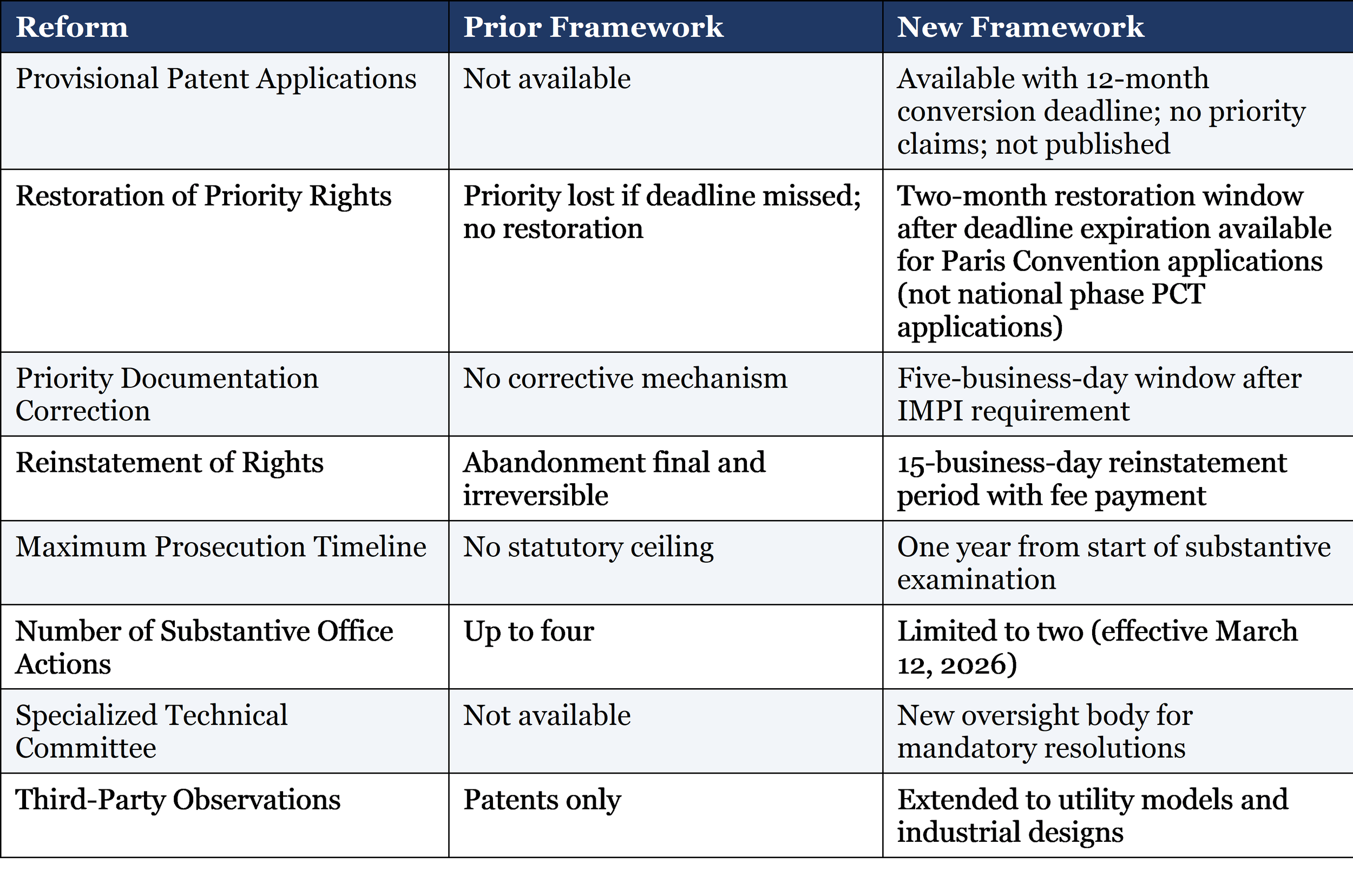
Summary of Key Reforms at a Glance
Open Questions and Pending Developments
While the amendments are comprehensive, several critical issues remain unresolved pending the issuance of implementing regulations, which are expected in the near term.
Implementing Regulations. FLPIP’s implementing regulations have not yet been updated to reflect the new provisions. Until these regulations are issued, practitioners and IMPI examiners alike will face uncertainty about procedural details, fee schedules, and the precise mechanics of the new mechanisms. The transitory provisions specify that the regulations of the prior law remain in effect until replaced, but this creates potential friction where the old regulations are inconsistent with the new statutory framework.
Technical Committee Composition and Standards. The criteria for selecting members of the Specialized Technical Committee and the standards for determining whether a prosecution delay is “reasonable” or “unreasonable” remain undefined. These standards will be critical in determining whether the committee functions as a meaningful accountability mechanism or a formalistic procedural step.
IMPI Capacity and Quality Concerns. The dramatic compression of prosecution timelines, from potentially years of examination with up to four office actions down to one year with only two office actions, raises legitimate questions about IMPI’s institutional capacity. The concern is twofold: whether IMPI can handle the increased workload within the mandated timelines, and whether the quality of substantive examination will be maintained under compressed schedules. A decline in examination quality could lead to weaker patents or, alternatively, a more formulaic approach to rejections that disadvantages applicants.
PCT National Phase Restoration. The amendments do not address the time limits applicable to national phase entries of PCT applications, and Mexico’s existing reservations under the PCT remain in place. Whether the priority restoration mechanism opens the door for a broader review of these reservations is an important open question for applicants who rely on the PCT route for Mexican filings.
Hague System Interplay. The applicability of the new corrective mechanism for priority documentation to industrial design applications filed through the Hague System is unclear. Practitioners with design portfolios that include Mexico through the Hague route should monitor IMPI’s guidance on this issue.
Strategic Takeaways for Practitioners
Review and update Mexico filing strategies immediately. The reforms apply to applications filed on or after the effective date. Applicants with pending filings or imminent filing deadlines in Mexico should assess whether any of the new mechanisms, particularly reinstatement rights and the mandatory resolution request, affect their prosecution posture.
Evaluate the provisional application tool for early-stage inventions. For clients in the pharmaceutical and biotechnology sectors with inventions still under development, the Mexican provisional application offers a way to establish a filing date with minimal formal requirements. Coordinate this decision with the broader global filing strategy, keeping in mind that the Mexican provisional cannot claim priority from an earlier application.
Front-load prosecution quality. With only two substantive office actions permitted, the margin for iterative claim narrowing is gone. Initial claim sets must be carefully drafted to align with IMPI’s examination standards, and responses to the first office action must be thorough, well-supported, and strategically designed to overcome all outstanding objections in a single round if possible. From a prosecution perspective, a uniform framework now applies to patents, utility models, and industrial designs regarding both the maximum examination timeframe and the number of office actions. In practice, however, these categories involve inherently different levels of complexity, and even within patent applications, the degree of technical complexity may vary significantly depending on the technological field, which may not always align with a standardized procedural model. It will be important to monitor how IMPI modifies their current dynamic for issuing office actions and if there will be Examiner guidelines that provide uniform criteria for Mexican Examiners.
Recalibrate docketing systems. The new reinstatement window (15 business days), the priority restoration period (two months), the corrective documentation period (five business days), and the 12-month provisional conversion deadline all create new docketing obligations. Ensure that foreign filing management systems are updated to track these deadlines accurately, with appropriate lead-time alerts.
Monitor the Technical Committee’s formation and early decisions. The committee’s establishment and initial rulings will signal how aggressively IMPI intends to enforce the new prosecution timelines. For applicants with long-pending cases, this mechanism may offer an opportunity to compel resolution.
Coordinate with Mexican counsel. The implementing regulations have not yet been issued, and IMPI’s operational guidance will evolve in the coming weeks and months. Maintaining close coordination with experienced Mexican patent counsel is essential during this transitional period.
Leverage third-party observations strategically. For companies engaged in competitive patent monitoring in Mexico, the extension of third-party observations to utility model and industrial design applications creates new opportunities to challenge competitor filings. Build these new observation opportunities into your monitoring protocols.
A Note on Global Context
Mexico’s reforms bring its patent system closer to the procedural frameworks of its major trading partners. Provisional patent applications are now available in Mexico, the United States, Australia, and numerous other jurisdictions. Priority restoration aligns Mexico with the PCT framework and with the practice of the European Patent Office and most national offices in Europe, Asia, and Oceania. The reinstatement of rights mechanism echoes similar provisions available in the United States (37 C.F.R. § 1.137), Europe (Rule 135 EPC), and many other offices worldwide.
At the same time, some of the specific parameters of the Mexican reforms, the absolute 12-month provisional conversion deadline, the five-business-day corrective window for priority documentation, the 15-business-day reinstatement period, are tighter than the analogous mechanisms in many peer jurisdictions. Practitioners managing multi-jurisdictional portfolios should be aware of these Mexico-specific constraints and adjust their workflows accordingly.
Readers interested in our prior coverage of divisional practice, third-party observations, and prosecution mechanics in other jurisdictions may wish to review our earlier posts on Japan, Singapore, India, China, New Zealand, Australia, and Brazil, all of which are available in the Patent Panorama archives. The Mexican reforms invite comparison with each of these systems, and we anticipate providing more detailed comparative analysis as IMPI’s implementation takes shape.
Conclusion
The publication of amendments to Mexico’s FLPIP represents a landmark moment in Latin American patent law. The reforms are ambitious, wide-ranging, and, if effectively implemented—position Mexico as a more flexible, efficient, and internationally aligned patent jurisdiction. The introduction of provisional applications, priority restoration, reinstatement of rights, statutory prosecution timelines, and a new institutional oversight mechanism collectively signal a modernization of the Mexican patent system that practitioners have long advocated for.
This post was written by Lisa Mueller, Rommy Morales and Mauricio Samano of Olivares.