Claim Construction and the Lexicographer’s Trap: Federal Circuit’s Narrow “Branched Alkyl” Construction in Alnylam Pharmaceuticals, Inc. v. Moderna, Inc.
Introduction
On June 4, 2025, the U.S. Court of Appeals for the Federal Circuit issued its decision in Alnylam Pharmaceuticals, Inc. v. Moderna, Inc., No. 2023-2357, affirming the District of Delaware’s claim construction that effectively ended Alnylam’s infringement case against Moderna’s blockbuster mRNA COVID-19 vaccine, SPIKEVAX®. The decision is a masterclass in the consequences of acting as one’s own lexicographer, and a stark reminder that definitions placed in patent specifications carry enormous weight, even when the patentee later wishes they had been drafted more flexibly.
At its core, the dispute centered on a single claim term: “branched alkyl.” Alnylam contended that the term should carry its ordinary chemical meaning— "a saturated hydrocarbon moiety that is not a straight chain." Moderna argued, and the District Court and Federal Circuit agreed, that Alnylam’s own specification provided a narrow, express definition requiring that one carbon atom in the branched alkyl group be bound to at least three other carbon atoms (i.e., a tertiary or quaternary carbon). Because Moderna’s SM-102 lipid contains only a secondary carbon at the relevant alpha position, bound to just two other carbons, the narrow construction was fatal to Alnylam’s infringement theory.
This decision carries significant implications for practitioners working in the life sciences and chemical patent space. It reinforces the principle that lexicographic definitions in patent specifications are binding and difficult to escape, even when the patentee points to embodiments, prosecution history, or dependent claim language that might suggest a broader reading. More practically, it underscores the critical importance of drafting definition sections with extreme care, particularly when those definitions employ the seemingly flexible phrase “unless otherwise specified.”
Below, we analyze the patents at issue, the underlying technology, the claim language, the procedural history, and the Federal Circuit’s reasoning, and we distill strategic takeaways for patent prosecutors and litigators alike.
Patents at Issue
Two Alnylam patents were at the center of this dispute:
U.S. Patent No. 11,246,933 (the ’933 patent): The parent patent, issued in February 2022. The ’933 patent is itself a great-grandchild of an original 2012 patent application, reflecting a complex continuation lineage. Representative claim 18 of the ’933 patent was at the heart of the claim construction dispute.
U.S. Patent No. 11,382,979 (the ’979 patent): A child patent of the ’933 patent, issued later in 2022. Representative claims 1 and 18 of the ’979 patent recite materially similar cationic lipid compositions and methods. No material differences between the two patents’ specifications were identified as relevant to the claim construction issue on appeal.
Both patents share effectively the same specification, including the “Definitions” section at column 412 of the ’933 patent (column 380 of the ’979 patent) that proved decisive in the case.
What Is the Technology?
The asserted patents address biodegradable lipids for the delivery of nucleic acids, a foundational technology in the mRNA therapeutics space. Understanding the technology requires some background in lipid nanoparticle (LNP) delivery systems, which are critical to the success of mRNA-based vaccines and RNA interference (RNAi) therapies.
The Problem: Delivering Nucleic Acids Into Cells
Nucleic acids—including messenger RNA (mRNA) and small interfering RNA (siRNA)—are powerful therapeutic molecules. They can instruct cells to produce specific proteins (mRNA) or silence the production of disease-causing proteins (siRNA through RNA interference). However, naked nucleic acids face two critical hurdles when administered to a patient: they are highly susceptible to degradation by nucleases in the bloodstream, and they have limited ability to cross cell membranes and gain access to the intracellular compartment where they need to function.
The Solution: Lipid Nanoparticles with Cationic Lipids
To solve these problems, researchers developed lipid nanoparticles (LNPs)—spherical carriers composed of lipid molecules that encapsulate the nucleic acid, protect it from degradation during transit, facilitate cellular uptake, and then degrade inside the cell to release the payload with minimal toxic effects. A key component of these LNPs is the cationic lipid, which is the lipid that interacts with the negatively charged nucleic acid and facilitates membrane fusion and cellular entry.
The Anatomy of a Cationic Lipid
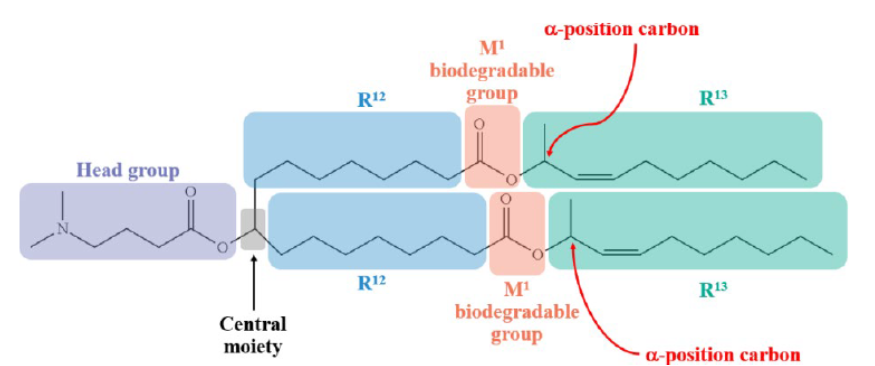
As described in the Alnylam patents, cationic lipids generally comprise three structural domains:
1. A head group – The polar, positively charged portion of the molecule. In the claimed lipids, this head group optionally comprises a primary, secondary, or tertiary amine, which provides the cationic character necessary for interaction with negatively charged nucleic acids.
2. A central moiety – A central carbon or nitrogen atom to which the head group and the hydrophobic tails are directly bonded. This serves as the structural linker connecting the polar head to the nonpolar tails.
3. Hydrophobic tails – Two nonpolar, hydrocarbon-based chains that extend from the central moiety. These tails drive the self-assembly of the lipid into nanoparticle structures and interact with cell membranes. Critically, each tail in the claimed lipids contains a biodegradable group (either —OC(O)— or —C(O)O—, which are ester linkages) that allows the lipid to be broken down and cleared from the body after it has delivered its nucleic acid payload.
The “Branched Alkyl” at the Alpha Position
The specific structural feature at the heart of this litigation is the nature of the carbon atom at the α-position (alpha position) relative to the biodegradable group in the terminal hydrophobic chain (designated R¹³ in the claims). The alpha-position carbon is the carbon atom immediately adjacent to the biodegradable ester group, on the side of the chain extending toward the terminus of the tail.
The central claim construction question was whether the “branched alkyl” at this alpha position requires a tertiary or quaternary carbon (bound to at least three other carbon atoms) or whether it also encompasses a secondary carbon (bound to only two other carbon atoms). In organic chemistry, carbon atoms are classified by how many other carbon atoms they are bonded to: a primary carbon is bonded to one, secondary to two, tertiary to three, and quaternary to four.

Moderna’s SM-102 Lipid
Moderna’s COVID-19 vaccine SPIKEVAX® uses the cationic lipid SM-102 to deliver its mRNA payload. The parties stipulated that SM-102 contains only a secondary carbon at the alpha position, meaning the carbon at issue is bound to just two other carbons. Under the District Court’s narrow construction of “branched alkyl” (requiring at least three carbon-carbon bonds at the branching carbon), SM-102 fell outside the claims. Under Alnylam’s broader proposed construction (any non-straight-chain saturated hydrocarbon), SM-102 would infringe.
Representative Claims
The Federal Circuit’s analysis focused on representative claim 18 of the ’933 patent. The Court also noted materially similar claims in the ’979 patent. The full text of the representative claim, as recited in the opinion, is as follows:
A cationic lipid comprising a primary group and two biodegradable hydrophobic tails, wherein
the primary group comprises (i) a head group that optionally comprises a primary, secondary, or tertiary amine, and (ii) a central moiety to which the head group and the two biodegradable hydrophobic tails are directly bonded;
the central moiety is a central carbon or nitrogen atom;
each biodegradable hydrophobic tail independently has the formula -(hydrophobic chain)-(biodegradable group)-(hydrophobic chain), wherein the biodegradable group is —OC(O)— or —C(O)O—;
for at least one biodegradable hydrophobic tail, the terminal hydrophobic chain in the biodegradable hydrophobic tail is a branched alkyl, where the branching occurs at the α-position relative to the biodegradable group and the biodegradable hydrophobic tail has the formula —R¹²-M¹-R¹³, where R¹² is a C4-C14 alkylene or C4-C14 alkenylene, M¹ is the biodegradable group, R¹³ is a branched C10-C20 alkyl, and the total carbon atom content of the tail —R¹²-M¹-R¹³ is 21 to 26;
in at least one hydrophobic tail, the biodegradable group is separated from a terminus of the hydrophobic tail by from 6 to 12 carbon atoms; and
the lipid has a pKa in the range of about 4 to about 11 and a logP of at least 10.1.
The court also referenced materially similar claims in the ’979 patent: claim 1 (reciting a lipid particle including a similar cationic lipid) and claim 18 (reciting a method of preparing a lipid particle mixture including a similar cationic lipid). The critical disputed terms across all asserted claims were “branched alkyl” and “branched C10-C20 alkyl.”
Procedural History
The procedural history of this case is relatively streamlined, as the dispute was resolved entirely at the claim construction stage without proceeding to trial.
Filing of the First Action (March 2022): In March 2022, shortly after the ’933 patent issued, Alnylam filed suit against Moderna, Inc., ModernaTX, Inc., and Moderna US, Inc. in the U.S. District Court for the District of Delaware (Case No. 1:22-cv-00335-CFC), alleging that Moderna’s activities involving the SM-102 cationic lipid in SPIKEVAX® infringed claim 18 and other claims of the ’933 patent.
Filing of the Second Action and Consolidation (July 2022): After the ’979 patent issued, Alnylam filed a second suit against Moderna in the same forum (Case No. 1:22-cv-00925-CFC), alleging infringement of claim 1 and other claims of the ’979 patent. The two actions were consolidated before Chief Judge Colm F. Connolly.
Joint Claim Construction Briefing (June 2023): The parties submitted a joint claim construction brief in June 2023. On the key disputed terms, Alnylam proposed what it characterized as the ordinary meaning of “branched alkyl”: “a saturated hydrocarbon moiety that is not a straight chain,” with the additional requirement for “branched C10-C20 alkyl” that the group contain 10 to 20 carbon atoms. Moderna proposed a construction tracking the specification’s definitional language: “Alkyl in which one carbon atom in the group (1) is bound to at least three other carbon atoms, and (2) is not a ring atom of a cyclic group.”
Markman Hearing and Ruling from the Bench (August 9, 2023): The District Court held a Markman hearing on August 9, 2023, at which it also addressed a related Alnylam case against BioNTech and Pfizer. The Court ruled from the bench, agreeing with Moderna that the passage in column 412 of the ’933 patent constituted “clear and unequivocal lexicography.” Accordingly, the Court construed “branched alkyl” as: “A saturated hydrocarbon moiety group in which one carbon atom in the group (1) is bound to at least three other carbon atoms, and (2) is not a ring atom of a cyclic group.” The Court explained that any departure from this lexicographic definition would need to be “clear and unmistakable,” and that Alnylam had not pointed to any such departure in the claims or written description.
Formal Claim Construction Order (August 21, 2023): The District Court entered its written claim construction order consistent with the bench ruling.
Stipulated Noninfringement and Final Judgment (August 2023): Following the claim construction order, the parties stipulated that Moderna did not infringe the asserted claims under the court’s construction, because Moderna’s SM-102 lipid did not satisfy the requirement of a carbon atom bound to at least three other carbon atoms at the alpha position. The District Court entered final judgment of noninfringement on August 30, 2023, dismissing Moderna’s counterclaims without prejudice.
Appeal to the Federal Circuit: Alnylam timely appealed the claim construction to the Federal Circuit under 28 U.S.C. § 1295(a)(1). The panel consisted of Circuit Judges Taranto, Chen, and Hughes, with Judge Taranto authoring the opinion.
Key Issues on Appeal
The appeal turned on a single, dispositive question of claim construction, which the Federal Circuit reviewed de novo because the construction rested entirely on intrinsic evidence. Within that overarching question, Alnylam raised two principal arguments:
Issue 1: Did the District Court Err in Holding That Alnylam Acted as Lexicographer?
Alnylam’s primary argument on appeal was that the column 412 passage in the specification, which defined “branched alkyl” as requiring a carbon bound to at least three other carbons, should not be treated as a binding lexicographic definition. Alnylam contended that the intrinsic record showed it did not intend to limit the term so narrowly and that the District Court’s construction improperly excluded disclosed embodiments. In support, Alnylam pointed to: disclosed embodiments in the specification that contained secondary carbons at the alpha position; chemical formulas (particularly Formula II) in the Summary section of the specification that were compatible with secondary carbons; representative saturated branched alkyl examples in the Definitions section (isopropyl, sec-butyl) that include secondary carbons; the dependent claim structure (claim 14), which Alnylam argued would collapse the scope differential between independent and dependent claims under the narrow construction; and prosecution history showing that Alnylam depicted branching at the alpha position using a figure consistent with a secondary carbon.
Issue 2: Even If the Column 412 Passage Is Definitional, Does the “Unless Otherwise Specified” Clause Save Alnylam’s Broader Reading?
In the alternative, Alnylam argued that even accepting the column 412 passage as definitional, the definition’s own qualifying language—“[u]nless otherwise specified”—opened the door to a broader meaning of “branched alkyl” in the context of the asserted claims. Alnylam contended that the claims, specification, and prosecution history collectively “otherwise specified” a broader definition encompassing secondary carbons at the alpha position.
Federal Circuit Holdings and Analysis
The Federal Circuit, in a unanimous opinion authored by Judge Taranto, affirmed the District Court’s claim construction in its entirety. The Court’s reasoning was methodical and thorough, addressing each of Alnylam’s arguments in turn.
The Column 412 Passage Is a Binding Lexicographic Definition
The Federal Circuit identified five independent indicators confirming the definitional character of the column 412 passage. First, the passage appeared under a section titled “Definitions.” The Court noted that this is a recognized marker of lexicographic intent, citing Thorner v. Sony Computer Entertainment America LLC, 669 F.3d 1362 (Fed. Cir. 2012) and AstraZeneca AB v. Mutual Pharmaceutical Co., 384 F.3d 1333 (Fed. Cir. 2004) Second, the term “branched alkyl” is set off in quotation marks—what the court described as a strong indication that a definition follows, relying on Sinorgchem Co. v. International Trade Commission. Third, the passage uses the phrase “refer to,” which the Federal Circuit has repeatedly held conveys definitional intent, citing ParkerVision, Inc. v. Vidal and Vasudevan Software, Inc. v. MicroStrategy, Inc. Fourth, the Court observed that elsewhere in the Definitions section, Alnylam used non-limiting terms such as “for example,” “e.g.,” “non-limiting examples,” and “include, but are not limited to”—language that contrasted meaningfully with the “refer to” formulation used for “branched alkyl.” Fifth, the inclusion of “[u]nless otherwise specified” itself suggests that the rest of the sentence establishes a generally applicable rule or definition.
The “Unless Otherwise Specified” Clause Requires Clarity to Trigger
Having established the passage as definitional, the Court turned to whether anything in the intrinsic record “otherwise specified” a different meaning. The Federal Circuit held that a high threshold of clarity is required to depart from a lexicographic definition. The Court reasoned that the word “specified” connotes notions of specificity, definiteness, explicitness, and precision. It analogized to statutory-definition principles, noting that once a patentee clears the high bar for lexicography, a correspondingly high bar must be cleared to find a departure, because public notice, public reliance, and the patentee’s control over definition drafting all support holding the patentee to its words.
The Court made a particularly incisive observation: the entire purpose of the first prong of the definition, requiring a carbon bound to at least three other carbons, is to specify the degree of branching at the alpha position. Since a non-branching carbon in a chain is already secondary (bound to two other carbons), branching within a chain necessarily requires a tertiary or quaternary carbon, except at the alpha position, where a secondary carbon is possible. Alnylam itself conceded at oral argument that the alpha position is the only place where a secondary carbon could satisfy a branching requirement. The Court found it would be “odd” to interpret the “unless otherwise specified” standard loosely if the effect would be to nullify the very reason for the first prong’s existence.
The Claims Do Not “Specify” a Different Definition
The Federal Circuit rejected Alnylam’s argument that the asserted claims required or were incompatible without a secondary carbon at the alpha position. The Court held that simply showing the claims could cover a secondary carbon (i.e., that they are compatible with one) does not establish that they require one. As Moderna demonstrated, the asserted claims can be practiced with a tertiary carbon at the alpha position in several configurations, for example, where the biodegradable group supplies a carbon-carbon bond to the alpha-position carbon, which then also connects to two carbons on the tail side.
Alnylam’s dependent-claim argument based on claim 14 of the ’933 patent fared no better. Claim 14 requires that the branched alkyl group has “only one carbon atom which is bound to three other carbon atoms.” Alnylam argued this meant the independent claim must be broader and include secondary carbons. The Court disagreed, finding that claim 14 narrows the independent claim in a different way, by limiting the number of tertiary carbons (to one), not by introducing a new category of carbons. The prosecution history confirmed this, as Alnylam distinguished claim 14 from prior art by noting the prior art had three tertiary carbons while claim 14 required only one.
The Specification Does Not “Specify” a Departure
Alnylam pointed to Formula II in the Summary section and various embodiments in the Detailed Description as evidence that the specification disclosed branched alkyls with secondary carbons.
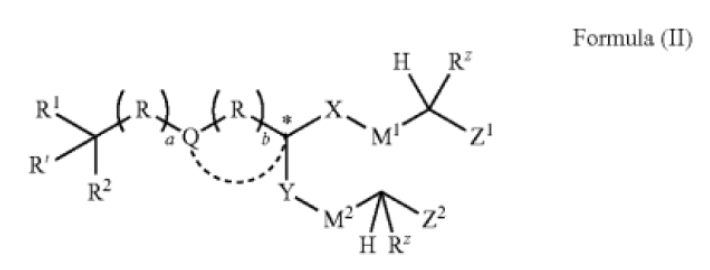
The Court systematically rejected these arguments. Regarding Formula II, the Court found a “missing link” between Formula II and the asserted claims—the claims do not expressly claim Formula II, and only a subset of the enormous number of possible substitutions within Formula II would yield a secondary carbon. Moreover, Alnylam had represented in its briefing that Formula II falls outside the asserted claims and reversed course too late, at oral argument, to preserve this argument.
As for the Detailed Description embodiments, nearly all of Alnylam’s cited examples fell outside the scope of the asserted claims for independent reasons—primarily because they contained carbon-carbon double bonds (making them alkenyl groups rather than the required alkyl groups). The Court thus found that these embodiments could not redefine “branched alkyl” for purposes of the asserted claims, and that the District Court’s construction did not improperly “read out” embodiments that would otherwise be covered.
Alnylam’s reference to the representative saturated branched alkyl groups listed in the Definitions section (isopropyl, sec-butyl) also failed. These groups fell outside the asserted claims for the independent reason that they contained far fewer than the required 10–20 carbon atoms. And even these examples did not necessarily require a secondary carbon at the alpha position: where the biodegradable group supplies a carbon-carbon bond, the alpha-position carbon becomes tertiary.
The Prosecution History, While Suggestive, Is Insufficient
The Federal Circuit acknowledged that the prosecution history “comes closest” to supporting Alnylam’s position. During prosecution of the ’933 patent in 2021, Alnylam submitted a figure illustrating “branching at the α-position” that depicted what could be interpreted as a secondary carbon. However, the Court found this figure ambiguous—it could be read as merely showing an example of what branching at the alpha position looks like (in contrast to the prior art’s total absence of branching), rather than specifying the particular degree of branching being claimed. In the face of an express specification definition requiring clarity to override, this ambiguous prosecution history evidence was not sufficient. The court cited Boss Control, Inc. v. Bombardier Inc., 410 F.3d 1372 (Fed. Cir. 2005) for the proposition that prosecution history may fail to overcome a clear specification definition.
The Court also rejected Alnylam’s argument that its choice to distinguish the prior art on tail length rather than branching degree proved it intended the claims to cover secondary carbons. The Federal Circuit declined to draw inferences from the patentee’s strategic choices among multiple available bases for distinction.
Key Takeaways for Practitioners
1. Definitions sections are loaded weapons. This case is a vivid illustration of the binding force of lexicographic definitions. Once a court determines that a patentee has acted as its own lexicographer—using recognized hallmarks such as a “Definitions” heading, quotation marks, and the “refer to” formulation—the resulting construction is extraordinarily difficult to escape. Practitioners should draft definition sections with the same rigor applied to claim language itself. Every word, every qualifier, and every example listed under a definition heading will be scrutinized as a potential limitation.
2. “Unless otherwise specified” is not the escape hatch it may appear to be. Alnylam likely included this qualifier hoping it would preserve flexibility to vary the definition of “branched alkyl” across different claims or contexts. The Federal Circuit’s holding makes clear that this clause demands a high threshold of clarity—specificity, definiteness, and explicitness—before a departure from the default definition will be recognized. Vague compatibility between the claims and a broader meaning is not enough. If practitioners intend to preserve the ability to depart from a default definition, they should consider building explicit, unambiguous departures directly into the claims or clearly labeled portions of the specification.
3. Disclosed-but-unclaimed embodiments cannot rescue an overly narrow definition. A recurring theme in Alnylam’s arguments was that the specification disclosed numerous embodiments with secondary carbons at the alpha position. The Federal Circuit was unpersuaded, emphasizing the “missing link” between disclosed embodiments and asserted claims. In a patent with hundreds of pages of embodiments and a complex continuation history, the court will not presume that a particular embodiment’s characteristics override an express definition unless the claims specifically direct the reader to that embodiment. Practitioners managing large specifications—common in chemical and pharmaceutical portfolios should ensure that the definitions they include are consistent with the full scope of claim coverage they intend to pursue, not merely with a subset of exemplary embodiments.
4. Dependent claim differentiation must be evaluated carefully. Alnylam’s argument that the dependent-claim-is-narrower principle required a broader construction of the independent claims was creative but ultimately unsuccessful. The Federal Circuit demonstrated that a dependent claim can narrow an independent claim in ways other than the dimension the patentee is litigating, here, by limiting the number of tertiary carbons rather than introducing a new category of carbon. When drafting dependent claims, practitioners should be aware that later litigators may attempt to use them as tools for broadening independent claims—and that courts will look closely at whether the narrowing occurs along the axis the patentee seeks to exploit.
5. Prosecution history arguments carry less weight than specification definitions. Even though the Federal Circuit acknowledged that the prosecution history “came closest” to supporting Alnylam, it was not enough. This hierarchy matters for prosecution strategy. Figures and statements made during prosecution to distinguish prior art may be interpreted more narrowly than the applicant intended. If an applicant wants a particular understanding of a claim term to control, the safest approach is to build that understanding into the specification itself—preferably outside the Definitions section if a broader meaning is intended—rather than relying on prosecution statements that a future court may view as ambiguous.
6. Waiver rules apply with full force in patent appeals. Alnylam’s attempt to reverse its position on whether Formula II falls within the asserted claims—first arguing it does not, then contending at oral argument that it does—was rejected as untimely. This is a practical reminder that positions taken in district court briefing and maintained through opening appellate briefs will be binding. Parties must identify and preserve all favorable claim construction arguments early in the litigation, and advocacy teams should carefully coordinate the arguments made at each stage to avoid inadvertent concessions.
The Broader Lexicographic Landscape: A Reminder for Drafters
Alnylam v. Moderna is far from the first Federal Circuit decision to demonstrate the high stakes of acting as one’s own lexicographer in the life sciences space. A brief survey of related precedent underscores both the power and the peril of specification definitions—and should serve as a practical reminder for patent prosecutors drafting applications today.
When Lexicography Works for the Patentee
In Martek Biosciences Corp. v. Nutrinova, Inc., 579 F.3d 1363 (Fed. Cir. 2009), the Federal Circuit demonstrated that a carefully drafted definition can save an infringement case. Martek’s patent on methods for achieving high concentrations of omega-3 fatty acids in an “animal” included an express definition: “The term ‘animal’ means any organism belonging to the kingdom Animalia.” The District Court had construed “animal” to exclude humans, which would have defeated infringement. In a 3-2 expanded panel decision, the Federal Circuit reversed, holding that because Martek explicitly defined the term, that definition controlled, and extrinsic evidence suggesting the ordinary meaning excluded humans was irrelevant. Martek is the mirror image of Alnylam: where the patentee’s definition broadened the term beyond its ordinary meaning, the definition was enforced. The lesson is symmetrical—definitions bind, whether they expand or contract claim scope.
Similarly, in Allergan Inc. v. Barr Laboratories, Inc., 2013 WL 314446 (Fed. Cir. Jan. 28, 2013), the Federal Circuit upheld a claim construction that relied on the patentee’s lexicographic redefinition of chemical nomenclature. The dispute involved whether the notation “-N(R⁴)₂” in a glaucoma treatment patent required identical R⁴ substituents, as the plain chemical meaning would suggest. The Court found that Allergan had acted as its own lexicographer and broadened the term to encompass non-identical substituents, based on how the term was used throughout the specification and claims. Allergan’s lexicography saved its infringement theory. The case is a reminder that when a patentee deliberately crafts a definition that is broader than the conventional meaning, and does so clearly and consistently, the Federal Circuit will enforce it.
When Lexicography Hurts the Patentee
On the other side of the ledger, SkinMedica, Inc. v. Histogen, Inc., No. 2012-1560 (Fed. Cir. Aug. 23, 2013), illustrates how implicit redefinition through consistent specification language can narrow claim scope. The patent described methods for producing pharmaceutical compositions using “conditioned cell culture medium.” The key term was “culturing cells in three dimensions.” The Federal Circuit found that the patentee had implicitly redefined this term to exclude the use of beads, based on the specification’s repeated use of disjunctive language (such as “as opposed to”) distinguishing bead-based methods from three-dimensional culturing. The Court also cautioned that the abbreviation “i.e.” is typically treated as definitional wherever it appears in a specification. Practitioners should use “i.e.” with extreme care; an offhand explanatory parenthetical can become a binding limitation.
Merck & Co. v. Teva Pharmaceuticals USA, Inc., 395 F.3d 1364 (Fed. Cir. 2005), cited directly in the Alnylam opinion—turned on whether Merck had successfully redefined the word “about” from its ordinary meaning of “approximately” to mean “exactly.” The Federal Circuit held that Merck had not clearly enough expressed this intent and reversed the district court. Merck establishes the high bar for lexicography in pharmaceutical patents: the redefinition must be clear, definite, and unmistakable. Ambiguity is resolved against the patentee’s preferred meaning.
And Boss Control, Inc. v. Bombardier Inc., 410 F.3d 1372 (Fed. Cir. 2005)—also cited in Alnylam, reinforces the hierarchy between specification definitions and prosecution history. The Court held that prosecution history failed to overcome a clear specification definition, even where history provided some support for the patentee’s broader reading. This is precisely the analytical framework the Alnylam court applied when it found that Alnylam’s prosecution history “came closest” but was ultimately insufficient to override the column 412 definition.
A Broader Lesson on Specification Drafting: Duke University v. Sandoz Inc.
While not strictly a lexicographer case, the Federal Circuit’s recent decision in Duke University v. Sandoz Inc., No. 24-1078 (Fed. Cir. Nov. 18, 2025), provides a complementary cautionary tale about specification drafting in the pharmaceutical space. The court overturned a $39 million jury verdict on a Latisse® hair growth patent, holding that the specification encompassed billions of possible prostaglandin compounds but failed to provide adequate “blaze marks” directing a skilled artisan to the narrow subgenus actually claimed. The patent’s specification described broad structural variability at multiple positions on the chemical backbone without sufficiently identifying the specific structural features common to the claimed compounds. Together with Alnylam, Duke v. Sandoz sends an unmistakable message: the way you draft your specification, whether through definitions, embodiment disclosures, or structural descriptions, has profound consequences for claim scope, enforceability, and validity.
The Drafting Imperative
These cases collectively reinforce several drafting principles that every patent prosecutor in the life sciences space should internalize. First, every definition included in a specification should be drafted with the same precision and strategic forethought as the claims themselves. Second, practitioners should audit their use of definitional signposts—“refer to,” “means,” “i.e.,” “as used herein”—recognizing that each one may be treated as lexicographic. Third, if a broader meaning is intended for certain claims, the specification must explicitly and clearly articulate that broader meaning rather than relying on implied flexibility. And fourth, practitioners should consider whether a Definitions section is truly necessary for a given term, or whether the risks of inadvertent narrowing outweigh the benefits of express definition. As the Alnylam court made clear, once the lexicographic threshold is crossed, the patentee is bound, and the threshold for escaping that definition is extraordinarily high.
This post was written by Lisa Mueller and Lucia Yuan.