Indonesia’s New Patent Application Regulation: Tighter Filing Requirements, Accelerated Examination, and a Formal Repeat Examination Mechanism

Introduction
Indonesia is quietly but decisively modernizing its patent system. With the enactment of Law No. 65 of 2024 on Patents, the third amendment to the foundational Patent Law No. 13 of 2016, Indonesia signaled its intent to align domestic patent practice more closely with international standards, broaden the scope of patentable subject matter, and streamline procedures for both domestic and foreign applicants. Now, with the issuance of Minister of Law Regulation No. 6 of 2026 on Patent Applications, the implementing regulation that translates the 2024 statutory amendments into operational reality, those intentions have taken concrete form.
Regulation No. 6 of 2026 was issued on January 13, 2026, and took effect on February 23, 2026. It replaces the previous implementing framework under Minister of Law and Human Rights Regulation No. 38 of 2018 (as amended by Regulation No. 13 of 2021), which the government determined was no longer aligned with current legal, institutional, and technological developments. The regulation also reflects the institutional restructuring of the Ministry of Law and Human Rights into the Ministry of Law.
For practitioners managing international patent portfolios that include Indonesia or advising clients who should be considering Indonesia as part of their Southeast Asian IP strategy, this regulation introduces several changes that demand immediate attention. The regulation tightens filing-stage compliance requirements, introduces formal mechanisms for accelerated examination and accelerated publication, and, perhaps most significantly, creates a structured administrative process for repeating substantive examination in certain circumstances, providing an alternative to judicial appeal that could meaningfully reduce cost and delay.
This post provides a detailed analysis of the regulation’s key provisions, places them in the context of Indonesia’s evolving patent landscape, and offers strategic guidance for practitioners navigating filings in this increasingly important jurisdiction.
Why Indonesia Matters: Context for the New Regulation
Before examining the regulation’s specific provisions, it is worth pausing to consider why Indonesia merits serious attention in any global patent portfolio strategy. Indonesia is ASEAN’s largest economy and the world’s fourth most populous country, with a rapidly growing technology sector and an expanding manufacturing base increasingly attractive to multinational companies pursuing “China +1” diversification strategies.
The numbers tell a compelling story. According to WIPO’s World Intellectual Property Indicators 2025, the Indonesian IP Office received 10,902 patent applications in 2024, representing 3.3% growth over 2023. Non-resident applications accounted for approximately 79% of filings, with Japanese applicants holding the largest share at 23.6%. Indonesia’s utility model filings have also been growing substantially, placing Indonesia among the world’s top jurisdictions by volume of utility model filings by origin. The country advanced from rank 75 in the Global Innovation Index in 2022 to rank 54 in 2024, reflecting meaningful improvements in its national innovation infrastructure.
Indonesia is also a member of both the Paris Convention and the Patent Cooperation Treaty (PCT), with national phase entry available at 31 months from the earliest priority date. The Directorate General of Intellectual Property (DGIP) participates in several accelerated examination programs, including the ASEAN Patent Examination Co-operation (ASPEC), the Japan-Indonesia Patent Prosecution Highway (PPH), and the DGIP-KIPO PPH pilot. These work-sharing mechanisms have historically reduced pendency from approximately 40 months to as little as 7–12 months for participating applications.
In short, Indonesia is not a peripheral filing destination, it is an increasingly central one. And the new regulation is designed to bring its administrative framework into alignment with the ambitions reflected in its amended patent law. With that context in mind, let us turn to the substance of Regulation No. 6 of 2026.
Effective Date and Transitional Provisions
The regulation took effect on February 23, 2026. Applications filed on or after that date must fully comply with the new requirements. Applications filed before February 23, 2026, will continue to be examined and processed under the previous regulation pursuant to transitional provisions. Practitioners should confirm with local agents which regime applies to any pending Indonesian applications and ensure that new filings are prepared in compliance with the updated requirements from the outset.
Substantive Changes
Expanded Definition of Invention
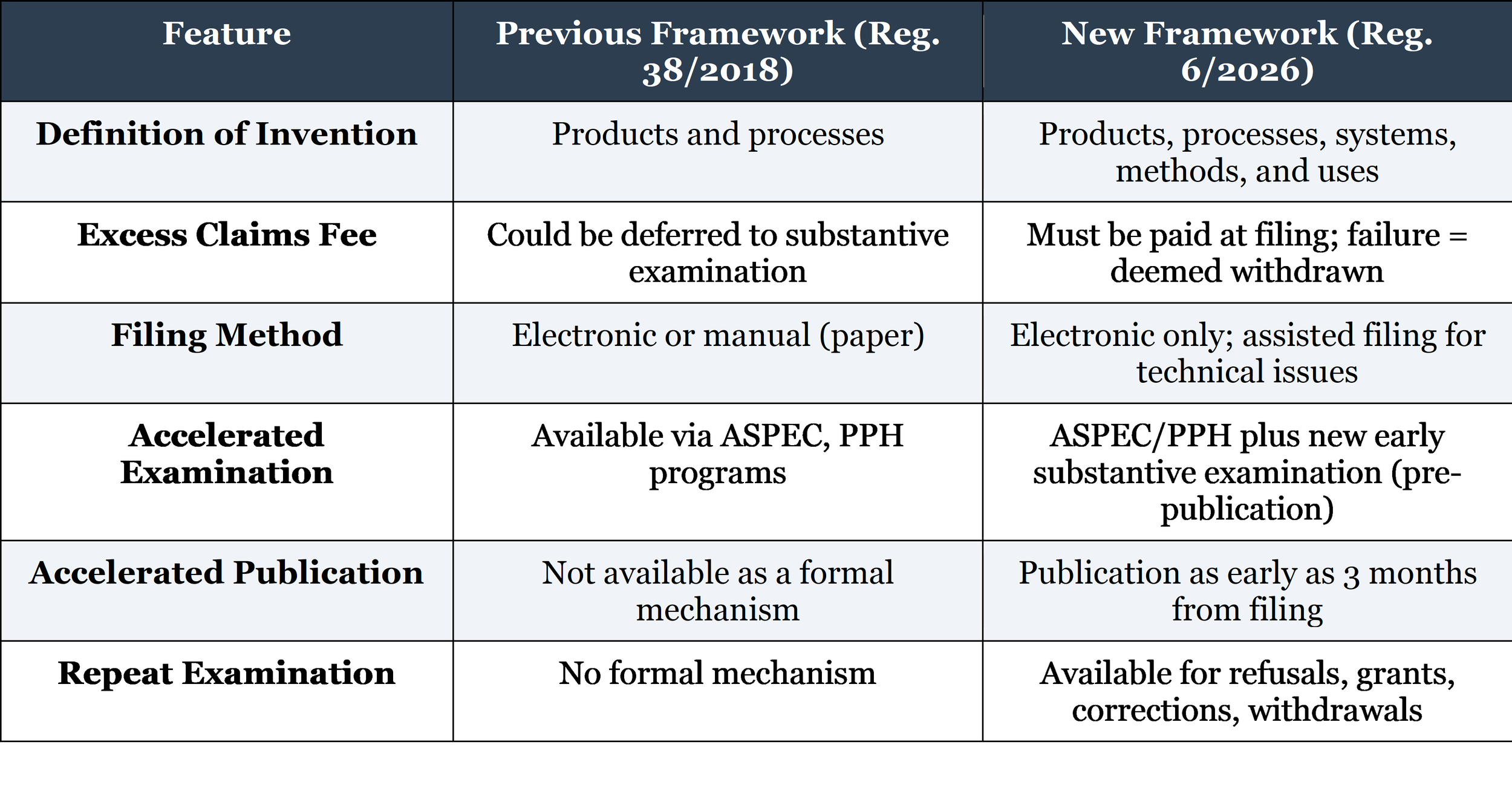
The regulation implements the expanded definition of “Invention” introduced by Law No. 65 of 2024. Under the previous framework, an invention was defined as an idea embodied in a specific problem-solving activity in the field of technology, in the form of a product or process. The new definition now explicitly encompasses systems, methods, and uses, in addition to products and processes.
This expansion is significant on multiple levels. For practitioners in the pharmaceutical and biotechnology sectors, the explicit inclusion of “uses” is particularly noteworthy, as it aligns with the patent law’s separate recognition that new uses of existing substances or compositions, including second and subsequent medical uses, may be patentable where they meet novelty and inventive step requirements. For technology companies, the inclusion of “systems” and “methods” provides a clearer statutory basis for protecting software-enabled inventions, digital methods, and IoT architectures, addressing a longstanding ambiguity in Indonesian patent practice where examiner interpretations of patentable subject matter were inconsistent.
Practitioners should, however, anticipate that the broadened definition may invite closer examiner scrutiny during substantive examination, particularly for method claims and use claims in areas where the boundaries of patentable subject matter remain contested. Early engagement with local counsel on claim strategy is advisable for applications in these categories.
Excess Claims Fee: Payment Now Required at Filing
One of the most immediately impactful changes for foreign filers is the requirement that excess claims fees (for each claim beyond the first ten claims) must now be paid at the time of filing. Under the previous regulation, applicants had the option to defer payment of excess claims fees to the substantive examination stage, providing flexibility to finalize claim strategy later in the prosecution cycle.
That flexibility is gone. Under the new regulation, failure to pay excess claims fees at filing may result in the application being deemed withdrawn. This introduces a hard deadline with a potentially severe consequence.
The practical implications are substantial. Patent claim strategy must now be finalized prior to filing, which reduces the flexibility that many applicants, particularly those entering national phase via the PCT, have relied on to adapt claim scope based on examination outcomes in other jurisdictions. Applicants face higher upfront costs at the filing stage, and the risk of inadvertent application loss due to fee miscalculation is non-trivial, particularly for applications with large claim sets.
Strategic recommendation: For PCT national phase entries, practitioners should coordinate with Indonesian local agents well before the national phase deadline to confirm the exact number of claims that will be filed and the associated fee calculation. Consider filing with a streamlined claim set at entry and amending claims later during prosecution, rather than entering with an expansive claim set that triggers significant excess claims fees at a stage when claim scope may still be in flux.
Procedural and System Changes
Mandatory Electronic Filing
The regulation mandates that all patent applications be filed electronically via the DGIP’s online filing system. Non-electronic filing is no longer available as an alternative route. The DGIP does provide assisted filing support, help desk or counter assistance when applicants encounter technical issues with the electronic system, but paper filing has been formally eliminated as a standalone option.
This transition is consistent with the broader trend across ASEAN and global patent offices toward digital-first filing systems. For foreign applicants who file through local agents, the shift to mandatory electronic filing is unlikely to create significant practical disruption, as most established Indonesian IP firms already use the DGIP’s e-filing platform. However, practitioners should confirm with their local agents that the electronic filing system can accommodate any special requirements for their applications, including large-format sequence listings, complex chemical structure drawings, or voluminous priority document submissions.
New Accelerated Examination and Publication Mechanisms
The regulation introduces two formal acceleration mechanisms that expand the toolkit available to applicants seeking faster prosecution in Indonesia.
Early Substantive Examination. Applicants may now request that substantive examination begin before publication, upon payment of an official fee. Under the standard Indonesian prosecution timeline, publication occurs 18 months after the filing or priority date, followed by a six-month third-party observation period, after which substantive examination proceeds. The new early examination mechanism allows applicants to bypass this waiting period and commence examination promptly, a potentially significant acceleration for applicants with time-sensitive commercial needs.
Accelerated Publication. The regulation also introduces an option to request accelerated publication, allowing publication as early as three months from the filing date, rather than the standard 18-month period. This mechanism, available upon payment of an official fee, is separate from and complementary to the early examination request. When combined, accelerated publication and early examination could significantly compress the overall prosecution timeline.
These new mechanisms supplement, rather than replace, the existing accelerated examination pathways available through the ASPEC program, the Japan-Indonesia PPH, and the DGIP-KIPO PPH pilot. Practitioners now have multiple levers for managing prosecution speed in Indonesia, which should be evaluated in the context of each application’s broader global prosecution strategy and commercial timeline.
Strategic recommendation: For pharmaceutical and biotechnology applicants with products approaching regulatory approval in Indonesia, or for companies seeking to establish enforceable patent rights ahead of market entry by a competitor, the combination of accelerated publication and early substantive examination is worth serious consideration. The ability to obtain granted patent rights potentially years earlier than under the standard timeline could provide meaningful commercial leverage.
Repeat Substantive Examination: A Significant New Administrative Remedy
Perhaps the most strategically significant development under Regulation No. 6 of 2026 is the introduction of a formal mechanism to repeat the substantive examination stage. This is a procedural innovation that did not exist under the previous regulatory framework and represents a meaningful expansion of the administrative remedies available to applicants.
The repeat examination mechanism is available for the following categories:
• Refusal decisions
• Post-grant corrections to the description, claims, and/or drawings (provided that the scope of protection is not broadened)
• Grant decisions
• Withdrawn applications
• Applications deemed withdrawn
The deadlines are as follows:
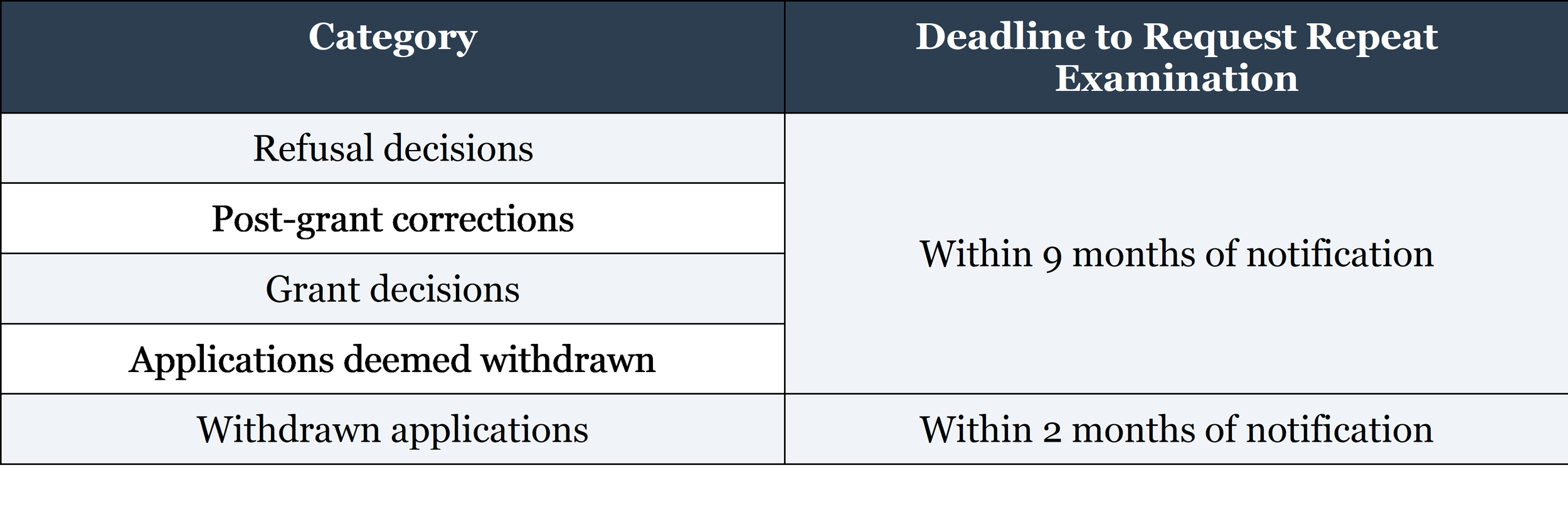
Once a request for repeat examination is filed, the Minister will issue a decision approving or rejecting the request within 12 months of receipt.
The strategic significance of this mechanism should not be underestimated. Under the previous framework, an applicant whose application was refused had limited options: accept the refusal or pursue an appeal through the Patent Board of Appeal and, if necessary, the courts – a process that entails significant time and cost. The repeat examination mechanism provides a new, intermediate administrative remedy that allows certain matters to be reconsidered at the examination level before escalating to formal appeal proceedings.
Equally notable is that repeat examination is available not only for refusal decisions but also for grant decisions and for applications that have been withdrawn or deemed withdrawn. The availability of repeat examination for granted patents, with the proviso that the scope of protection cannot be broadened, creates a formal pathway for post-grant corrections that could address errors or omissions in the granted claims or description. For withdrawn applications, the mechanism offers a potential avenue for revival that, while subject to tight deadlines, may provide a critical safety net for applicants who inadvertently lose rights due to administrative lapses.
Strategic recommendation: Practitioners should ensure that docketing systems are updated to capture the nine-month (or two-month, for withdrawn applications) deadline for requesting repeat examination, treating these deadlines with the same rigor as appeal deadlines in other jurisdictions. Failure to file within the prescribed period will foreclose this administrative remedy. For portfolio management purposes, the repeat examination mechanism may also reduce the overall cost and risk profile of Indonesian filings, as it provides an additional layer of administrative review before the expense of formal appeal proceedings is incurred.
Practical Implications and Current Limitations
While Regulation No. 6 of 2026 is now in force, practical implementation remains a developing picture. As of the date of this post, the DGIP has not yet issued the standard forms or the supporting regulations on Non-Tax State Revenue (PNBP) tariffs that will govern the specific fee amounts for the new accelerated examination, accelerated publication, and repeat examination mechanisms. This means that while the legal framework is operative, certain new features may not yet be practically accessible until the DGIP publishes the necessary implementing details.
This is not unusual in the context of Indonesian regulatory practice, implementing regulations frequently follow enabling statutes with some delay, but it does create a period of uncertainty that practitioners must manage carefully. We recommend the following approach:
• Confirm with local agents whether the DGIP’s electronic filing system has been updated to accommodate the new procedures before attempting to file requests for early examination, accelerated publication, or repeat examination.
• Monitor DGIP announcements regarding the publication of PNBP tariff schedules, which will determine the official fees for the new mechanisms.
• Ensure that all applications filed on or after February 23, 2026, comply with the new requirements, particularly the mandatory electronic filing requirement and the excess claims fee payment obligation at filing, regardless of the status of the supporting regulations.
Before and After: Key Changes at a Glance
Strategic Takeaways for Practitioners
Finalize claim strategy before filing.The mandatory payment of excess claims fees at filing eliminates the flexibility to defer claim refinement to later prosecution stages. For PCT national phase entries, coordinate with Indonesian counsel early to determine the optimal claim set for national phase entry. Consider entering with a focused claim set and amending during prosecution rather than incurring excess claims fees on a claim set that will likely be narrowed.
Evaluate the new acceleration mechanisms.The combination of early substantive examination and accelerated publication provides a meaningful new pathway for expediting prosecution, separate from and complementary to existing ASPEC and PPH options. For applications with commercial urgency, particularly in the pharmaceutical and technology sectors—this combination should be assessed as part of the global prosecution strategy.
Docket repeat examination deadlines. The repeat examination mechanism is a valuable new administrative remedy, but it is subject to strict deadlines (nine months for most categories, two months for withdrawn applications). These deadlines should be treated with the same rigor as appeal deadlines.
Leverage the broadened invention definition. The explicit inclusion of systems, methods, and uses in the definition of “Invention” creates new opportunities for protection in the software, digital health, and IoT spaces. Practitioners advising clients in these sectors should reassess whether inventions previously considered difficult to protect in Indonesia may now have a clearer path to patentability.
Monitor implementing details. The regulation is in force, but certain mechanisms await the publication of PNBP tariff schedules and standard forms. Practitioners should stay in close contact with Indonesian local agents and monitor DGIP announcements for updates on practical implementation.
Reassess Indonesia’s place in your portfolio strategy. For clients not currently filing in Indonesia, the combination of a modernized regulatory framework, growing patent activity, accelerated examination options, and Indonesia’s strategic economic position makes this an opportune moment to reconsider. Indonesia’s patent system is maturing rapidly, and the new regulation is a concrete signal that the DGIP is investing in procedural infrastructure that supports both domestic innovation and foreign applicant engagement.
Conclusion
Minister of Law Regulation No. 6 of 2026 reflects a deliberate effort by Indonesia to modernize and tighten its patent application framework while simultaneously introducing new tools that give applicants greater control over the speed and trajectory of prosecution. The regulation’s most notable features, mandatory electronic filing, upfront excess claims fees, early substantive examination, accelerated publication, and a formal repeat examination mechanism, collectively shift the balance of procedural responsibility toward the filing stage, demanding more careful preparation upfront while offering meaningful acceleration and administrative review options on the back end.
For practitioners managing international patent portfolios, the takeaway is clear: Indonesia’s patent system is evolving toward a more structured, more predictable, and more internationally aligned framework. The window for filing under the previous, more flexible regime has closed. The practitioners and applicants who adapt their strategies to the new regulation’s requirements, and who take advantage of its new mechanisms, will be well-positioned to build effective patent protection in one of Southeast Asia’s most important and rapidly growing markets.
We will continue to monitor the DGIP’s issuance of supporting regulations and standard forms, and will update Patent Panorama readers as practical implementation details become available.
This post was written by Lisa Mueller and Kian Hoe Khoo of Davies Collison Cave