Projected Doses Were Not Enough: Federal Circuit Affirms Lack of Enablement in Wyeth v. AstraZeneca

Introduction
On July 9, 2026, the U.S. Court of Appeals for the Federal Circuit affirmed a post-trial judgment as a matter of law (JMOL) invalidating asserted claims of U.S. Patent Nos. 10,603,314 and 10,596,162 for lack of enablement. Wyeth LLC v. AstraZeneca Pharmaceuticals LP, No. 2024-2325 (Fed. Cir. July 9, 2026). The decision left in place the District Court's order setting aside a five-day jury verdict that had found the claims not invalid, found AstraZeneca liable for induced infringement based on sales of Tagrisso (osimertinib), and awarded Wyeth $107.5 million in damages.
The precedential opinion is important for life sciences practitioners because it draws a precise line between FDA-style safety and efficacy requirements, which the claims did not impose, and the patent-law obligation to enable the treatment method actually claimed. The asserted claims required daily administration to a patient of a "unit dosage" calculated to produce a therapeutic effect. The specification, however, disclosed only three example inhibitors, in vitro activity, and broad "general" and "projected" dosage ranges. It did not teach a skilled artisan how to translate those disclosures into a daily patient dose across the full claimed class without undue experimentation.
Wyeth is not a categorical "no clinical data, no patent" decision. It is a full-scope enablement decision with particular force for method-of-treatment claims that combine functional compound breadth with a patient-level dosing result. The practical lesson is straightforward: the more dimensions a claim asks a skilled artisan to navigate, the more the specification must provide a reproducible path through them.
The Patents and the Claimed Technology
The asserted claims were claims 1, 3, and 9 of U.S. Patent No. 10,603,314 (the ’314 patent) and claim 1 of U.S. Patent No. 10,596,162 (the ’162 patent). The patents share materially the same specification and concern methods of treating gefitinib- and/or erlotinib-resistant non-small cell lung cancer (NSCLC).
Gefitinib and erlotinib are reversible epidermal growth factor receptor (EGFR) tyrosine kinase inhibitors. They bind noncovalently and can dissociate over time. The patents sought to address resistance to those drugs by using irreversible inhibitors that covalently bind at specified cysteine residues in EGFR or erb-B2.
The breadth of the claimed chemistry mattered. The specification stated that the irreversible EGFR inhibitor could be "any compound" that binds cysteine 773 of EGFR, while the representative claim also covered an inhibitor binding cysteine 805 of erb-B2. Yet the specification identified only three exemplary compounds, EKB-569, HKI-357, and HKI-272, and reported in vitro experiments showing increased killing of NSCLC cells harboring an EGFR mutation.
The dosing disclosure was similarly broad. The specification defined a "unit dosage" as a physically discrete unit containing a predetermined quantity of active material "calculated to produce the desired therapeutic effect." It explained that dosing depended on the patient, the compound, the route of administration, disease severity, the patient's ability to use the active ingredient, and practitioner judgment. It then offered a general daily range of about 0.5 to 1,000 mg/kg and a projected total daily dosage of about 1 to 1,000 mg, preferably about 2 to 500 mg, without explaining how those ranges were derived or how a practitioner should select a dose for a particular compound and patient.
That combination created the central enablement problem. The claims did not merely cover a class of inhibitors or a dosage range. They required a therapeutically effective daily dose for a broad, functionally defined class of inhibitors. In other words, the disclosure had to guide the skilled artisan through a two-dimensional "compound-by-dose" space without leaving the essential work to future research.
The Representative Claim
Claim 1 of the ’314 patent, which the Federal Circuit treated as exemplary, recites:
1. A method for treating gefitinib and/or erlotinib resistant non-small cell lung cancer in a patient in need thereof, comprising administering daily to the patient having gefitinib and/or erlotinib resistant non-small cell lung cancer a pharmaceutical composition comprising a unit dosage of an irreversible epidermal growth factor receptor (EGFR) inhibitor that covalently binds to cysteine 773 residue in the ligand-binding pocket of EGFR or cysteine 805 residue in the ligand-binding pocket of erb-B2.
The words that ultimately mattered were not only "an irreversible EGFR inhibitor," but also "administering daily," "to the patient," and "unit dosage." Before trial, the District Court adopted the specification's express definition of "unit dosage," and Wyeth did not challenge that construction on appeal. Because the definition required a predetermined quantity calculated to produce the desired therapeutic effect, the claim itself carried an in vivo therapeutic requirement even though it did not require FDA approval or a particular clinical endpoint.
From Jury Verdict to Post-Trial JMOL
· September 2021 - Complaint. Wyeth sued in the District of Delaware, alleging that AstraZeneca induced infringement through the marketing, distribution, and sale of Tagrisso.
· March 2023 - Claim construction. The District Court adopted the specification's definition of "unit dosage," including the requirement that the predetermined quantity be calculated to produce the desired therapeutic effect.
· Jury trial. After a five-day trial, the jury found the asserted claims not invalid, found induced infringement, and awarded $107,500,000 in damages.
· August 2024 - Post-trial JMOL. The District Court held that no reasonable jury could have found the claims enabled. It emphasized the absence of patient-dosing examples and unrebutted evidence that therapeutically effective levels for named compounds exceeded tolerated levels in humans.
· Appeal. Wyeth argued that the District Court had changed the claim construction after trial by importing clinical safety requirements and that the evidence could not support JMOL. Wyeth also raised a pre-issuance damages issue under 35 U.S.C. § 154(d), which the Federal Circuit did not reach after affirming invalidity.
The Federal Circuit's Analysis
Claim Language, Not FDA Standards, Controlled
Wyeth characterized the District Court's analysis as requiring a "safe" or non-lethal dose even though the claims did not recite clinical-trial endpoints. The Federal Circuit rejected the characterization. It agreed that the claims did not require FDA approval, an absence of side effects, a particular level of clinical efficacy, or any other standard that would make a drug attractive to a practicing clinician.
But the absence of FDA-type limitations did not permit the Court to read "administering daily," "patient," and "unit dosage" out of the claim. Giving those terms operative meaning required a repeatable dosing regimen calculated to produce a therapeutic effect in a patient. That requirement went beyond identifying a compound that inhibited EGFR or killed cancer cells in a test tube, while still stopping short of full FDA safety and efficacy standards.
The panel also held that the District Court's post-verdict discussion was a permissible elaboration of its existing claim construction, not a new construction. Before and after trial, the operative meaning remained the same: a daily unit dosage calculated to produce the desired therapeutic effect in a patient. That construction framed the enablement question that followed.
Full-Scope Enablement Required a Workable Dosing Path
The Court began with familiar full-scope principles. Under 35 U.S.C. § 112(a), the specification must enable the full scope of the invention as defined by the claims. Citing Amgen Inc. v. Sanofi, 598 U.S. 594, 610 (2023), the panel reiterated that "[t]he more one claims, the more one must enable." And under Baxalta Inc. v. Genentech, Inc., 81 F.4th 1362, 1365 (Fed. Cir. 2023), the specification must teach skilled artisans to make and use the claimed invention across that scope without undue experimentation.
Here, the claims combined a functionally defined inhibitor class with a functionally defined dosage result. Therefore, the specification needed to provide a generalizable route for determining a daily unit dosage that would produce a therapeutic effect in a patient across the claimed compounds. The panel framed the missing link succinctly: the specification needed to provide "some basis for translating" the disclosed in vitro activity into the claimed daily regimen "in a patient."
The statement that a skilled artisan "is aware of the effective dose for each patient" did not fill that gap. Ordinary skill may supplement an enabling disclosure, but it cannot substitute for disclosure of the novel aspects of the claimed invention. That principle, reflected in Idenix Pharmaceuticals LLC v. Gilead Sciences Inc., 941 F.3d 1149, 1159 (Fed. Cir. 2019), was particularly important because determining the claimed dosage was not incidental to the invention. It was part of what the claims required.
In Vitro Activity Did Not Explain How to Reach a Daily Patient Dose
The specification contained no working example of a unit dosage calculated to achieve a therapeutic effect and suitable for daily administration to a human patient. Its experimental results were in vitro, and it did not explain how to extrapolate from those concentrations to in vivo exposure or patient dosing. The omission was especially consequential because the specification itself described dose selection as dependent on multiple variables, including the patient, the compound, the route of administration, disease severity, and the degree of therapeutic effect sought.
In an unpredictable field, acknowledging those variables while supplying no method for resolving them left skilled artisans with a research program rather than an enabled treatment method. The patents supplied a destination, but not a reliable route. That is the type of disclosure the Federal Circuit has previously characterized as only a "starting point" or a "direction for future research," rather than a teaching that permits practice of the claimed invention without undue experimentation. See ALZA Corp. v. Andrx Pharmaceuticals, LLC, 603 F.3d 935, 939-41 (Fed. Cir. 2010).
Broad "General" and "Projected" Ranges Did Not Cure the Gap
The patents disclosed numerical ranges, but the Court focused on their character and context. The ranges were described as "general" and "projected." The specification did not explain how they were derived, how to select among them for a particular compound, or how they related to a unit dosage calculated to produce a therapeutic effect in a patient.
A broad dosage range is not automatically non-enabling, and Wyeth should not be read to require a single optimized dose. The problem was that the numbers did not provide a meaningful selection rule or a validated bridge to the claimed daily regimen. The skilled artisan still had to discover, through screening and iteration, which compounds and doses were workable. As the Court explained through its reliance on Genentech, Inc. v. Novo Nordisk A/S, 108 F.3d 1361, 1366 (Fed. Cir. 1997), background knowledge is a rule of supplementation, not a substitute for a basic enabling disclosure.
Toxicity Evidence Exposed Missing Guidance; It Did Not Add a New Claim Limitation
The trial evidence gave the disclosure gap practical significance. AstraZeneca presented unrebutted evidence that, for HKI-272 and EKB-569, therapeutically effective levels reflected in the record exceeded the maximum tolerated dose in humans; the evidence suggested that the same might be true for HKI-357. Wyeth's own expert agreed that a skilled artisan calculating a patient dose would seek to avoid toxic levels, and a co-inventor testified that concentrations described in the patents were more than five times higher than what could be administered to patients. The inventors' 2008 publication likewise stated that the required in vitro concentrations might not be achievable in patients because of toxicity.
The Federal Circuit did not convert "non-toxic" into a freestanding claim limitation. Rather, the toxicity evidence showed that the named preferred embodiments and broad ranges did not teach which doses, if any, could be administered daily while producing the claimed therapeutic effect. Some inoperative embodiments do not automatically defeat enablement. But when inoperative territory becomes substantial and forces skilled artisans to conduct extensive screening to identify workable embodiments, it weighs heavily toward undue experimentation. See Atlas Powder Co. v. E.I. du Pont de Nemours & Co., 750 F.2d 1569, 1576-77 (Fed. Cir. 1984) where the Court stated, “[I]f the number of inoperative combinations becomes significant, and in effect forces one of ordinary skill in the art to experiment unduly in order to practice the claimed invention, the claims might indeed be invalid.”
The Jury Verdict Did Not Foreclose JMOL
Enablement is a legal conclusion based on underlying factual findings, and invalidity must be proven by clear and convincing evidence. At the same time, a jury verdict cannot stand when, even after viewing the evidence in the nonmovant's favor, no reasonable jury could find for that party under the governing law.
The panel found that threshold met. The absence of patient-dosing examples, the lack of a dose-selection methodology, the breadth of the functional claims, and unrebutted concessions from Wyeth's own witnesses left no evidentiary basis on which a reasonable jury could find the full scope enabled. The decision is therefore also a reminder that a favorable jury verdict is not insulated from post-trial review when the record on a dispositive technical issue is one-sided.
How the Decision Fits into Modern Enablement Doctrine
Wyeth does not announce a new enablement test. It applies familiar full-scope principles to a method-of-treatment claim whose breadth resided in two places at once: the functionally defined class of inhibitors and the patient-level dosing result. Amgen supplied the breadth principle; Baxalta reinforced that functionally claimed classes must be enabled across their scope; Idenix underscored that ordinary skill cannot supply the missing novel teaching; and ALZA and Wyeth & Cordis Corp. v. Abbott Laboratories, 720 F.3d 1380, 1386 (Fed. Cir. 2013), support the conclusion that a starting point followed by iterative screening is not enough in an unpredictable art.
Although the panel did not separately march through the In re Wands factors, its reasoning tracks their practical concerns: broad claim scope, an unpredictable field, few disclosed embodiments, no patient-dosing examples, limited guidance, and substantial experimentation needed to separate operative from inoperative embodiments. See In re Wands, 858 F.2d 731, 737 (Fed. Cir. 1988).
A useful way to understand the case is as a "compound-by-dose" problem. The same disclosure might support a narrower claim directed to a particular compound, a narrower structural class, or an in vitro use. But once the claims required any qualifying inhibitor to be administered daily in a therapeutically effective unit dosage to a patient, the specification had to enable that combined space.
The Boundary the Court Drew
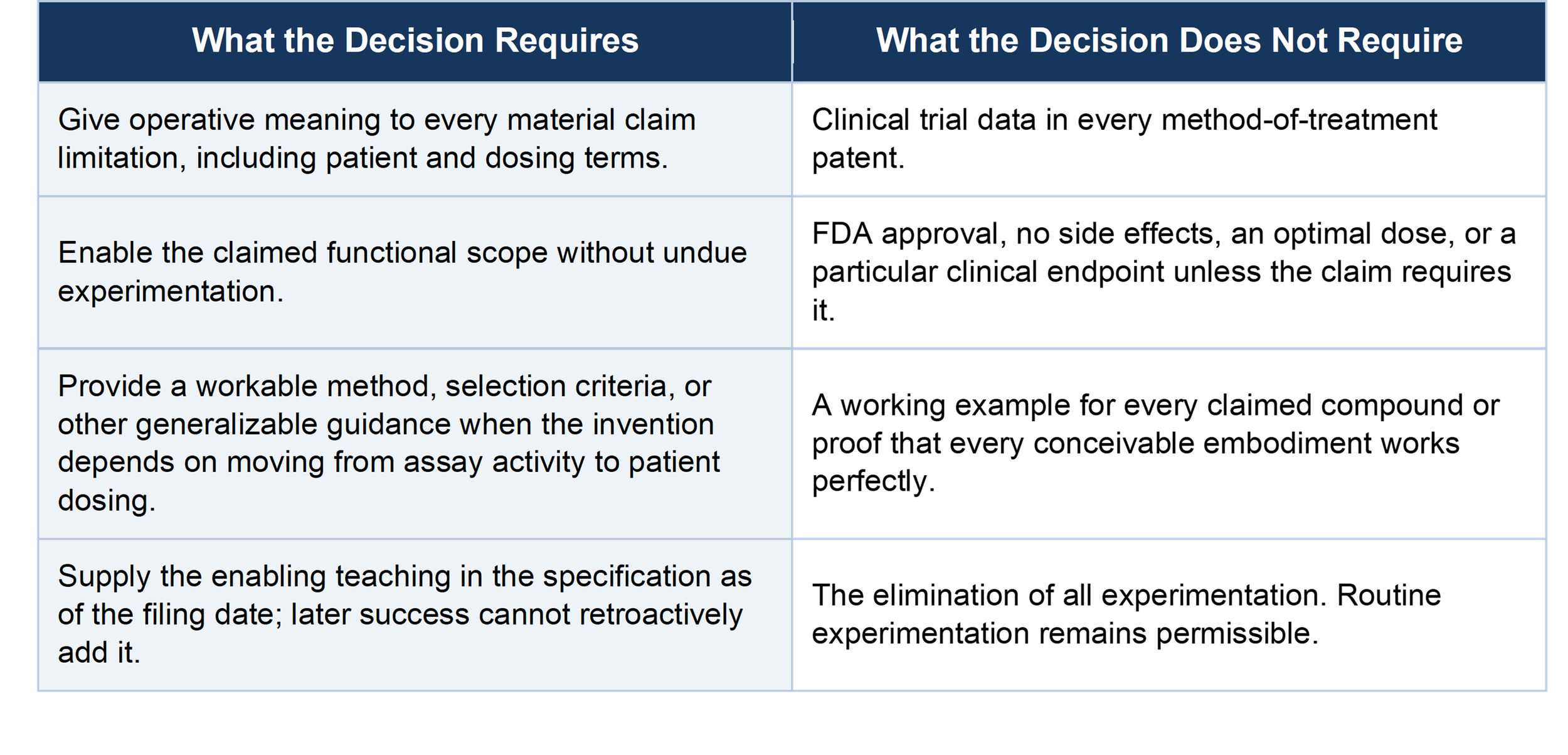
The opinion is easiest to apply by separating what § 112(a) required on this record from what the Federal Circuit expressly did not require:
Strategic Implications for Drafting, Prosecution, and Portfolio Management
For Patent Drafting: Build the Translational Bridge
Where claims will require patient dosing, the specification should explain how a skilled artisan moves from the disclosed experimental endpoint to an administrable regimen. Clinical trial data are not categorically required, but a generalizable methodology may be. Depending on the technology, useful support may include in vivo data, pharmacokinetic or pharmacodynamic relationships, exposure targets, bioavailability assumptions, route-specific considerations, dose-escalation logic, biomarkers, or validated scaling methods.
The key is not the volume of data but the quality of the instruction. A specification that reports potency at one endpoint and then states that practitioners know the effective dose may leave the central inventive work undone. By contrast, a specification that explains how relevant variables interact and provides a reasoned selection framework is better positioned to show that any remaining experimentation is routine.
For Claim Strategy and Continuation Practice: Match Breadth to the Original Disclosure
Functional language can be valuable, but it should be calibrated to the technical teaching. When a specification names only a few compounds, practitioners should consider whether the broadest claims should be limited by structure, subclass, binding profile, mutation, route, regimen, dosage band, biomarker, or named agent. Layered dependent claims directed to those narrower features can preserve meaningful fallback positions if the broadest functional claim later faces a full-scope challenge.
Continuation practice deserves particular scrutiny. A later claim may be commercially attractive and linguistically supported by the original disclosure, yet still extend beyond what that disclosure enables. Later-generated data cannot retroactively cure an enabling gap at the relevant filing date. Before pursuing a new dosing or patient-population claim in a continuation, counsel should map each limitation against the original specification and ask whether the application supplies a workable route, not merely the words.
For Litigation and Due Diligence: Map the Claim Against the Technical Record
For patentees and challengers alike, claim construction may determine the enablement burden. Definitions such as "unit dosage," and seemingly ordinary phrases such as "administering daily" or "to the patient," can transform an assay-based disclosure into an in vivo enablement dispute. Those terms should be addressed early rather than treated as secondary to the validity analysis.
A disciplined litigation or diligence review should create a claim-to-disclosure map. Identify every functional result and patient-level limitation; locate the examples, ranges, selection rules, and predictive relationships that support them; and test whether the disclosed embodiments are operative across the asserted scope. Later publications, inventor testimony, and expert concessions cannot add disclosure to the patent, but they may become powerful evidence that the original teaching left critical work to future experimentation.
Key Takeaways
1. Claim language sets the enablement burden. The Court did not impose FDA requirements. It gave effect to the patentee's own choices: "administering daily," "to the patient," and a "unit dosage" calculated to produce a therapeutic effect.
2. The missing translational bridge, not the absence of clinical trials, was decisive.In vitro data may contribute to an enabling disclosure, but here they did not explain how to reach the claimed daily patient dose across the functional class.
3. Broad numerical ranges need a reasoned selection method. "General" and "projected" ranges did not help when the specification did not explain their derivation, how to select within them, or how they related to the claimed therapeutic result.
4. Ordinary skill supplements; it does not substitute. A statement that practitioners know the effective dose cannot replace the method, criteria, or parameters that make dose selection routine.
5. Inoperative embodiments and toxicity evidence can expose a disclosure gap. Toxicity was not a new claim limitation. It showed that the patent did not teach how to distinguish workable patient regimens from substantial unworkable territory.
6. Portfolio strategy must match functional breadth to filing-date support. Broad compound-and-dose claims require a generalizable teaching across both dimensions. Later scientific success cannot repair an earlier enabling deficiency, so practitioners should build fallback claims and audit continuation claims against the original disclosure.
Wyeth should not deter applicants from pursuing meaningful method-of-treatment or dosing claims. It should prompt disciplined alignment among claim language, experimental support, and the instructions supplied to skilled artisans. When claims span a broad compound class and a patient-level dosing result, the specification must show the route, not merely the destination.
This post was written by Lisa Mueller.