Salts, Ratios, and Security: Federal Circuit Affirms Nuedexta Preliminary Injunction but Vacates Bond Waiver in Otsuka v. Hetero

Introduction
On July 1, 2026, the U.S. Court of Appeals for the Federal Circuit issued a precedential decision in Otsuka America Pharmaceutical, Inc. v. Hetero Labs Limited, No. 2025-2016 (Fed. Cir. July 1, 2026). The panel affirmed a preliminary injunction preventing Hetero from launching a generic version of Nuedexta, but vacated and remanded the District Court's decision to waive security under Federal Rule of Civil Procedure 65(c). Judge Bryson authored the majority opinion, joined by Judge Stoll. Judge Dyk dissented from the claim-construction and preliminary-injunction rulings but concurred in the bond ruling.
The dispute turned on a deceptively small unit-of-measure question. When a patent claim recites a weight-to-weight ratio of dextromethorphan to quinidine, and both drugs are administered as salts, should the ratio use the total weights of the administered salt compounds or only the weights of the pharmacologically active moieties? The first calculation produced a ratio of 1:0.5. The second produced approximately 1:0.56. That difference determined whether Hetero's proposed generic satisfied the ratio limitation for purposes of Otsuka's likelihood-of-success showing.
The decision matters in two ways. First, it shows how chemical-form terminology, clinical-study shorthand, prosecution history, and the commercial embodiment can combine to resolve a pharmaceutical claim-construction dispute. Second, it provides a practical warning for Hatch-Waxman litigants: under Third Circuit law, security under Rule 65(c) ordinarily cannot be waived when a preliminary injunction stops a commercial launch. Because the appeal arose at the preliminary-injunction stage, the panel did not enter a final judgment of infringement; it affirmed the District Court's determination that Otsuka was likely to succeed on the merits.
The Product, the Patent, and the Disputed Ratio
Nuedexta combines dextromethorphan and quinidine to treat pseudobulbar affect (PBA) or emotional lability. Dextromethorphan provides the therapeutic effect. Quinidine reduces the rapid metabolism of dextromethorphan by the liver, allowing dextromethorphan exposure to reach a therapeutic level. Avanir Pharmaceuticals owns U.S. Patent No. 7,659,282, which is scheduled to expire on August 13, 2026.
Each Nuedexta capsule contains 20 mg of dextromethorphan hydrobromide and 10 mg of quinidine sulfate. Hetero's abbreviated new drug application (ANDA) product used the same salt amounts and carried the same indications. Claim 1 of the '282 patent recites:
1. A method for treating pseudobulbar affect or emotional lability, the method comprising administering to a patient in need thereof dextromethorphan in combination with quinidine, wherein the amount of dextromethorphan administered comprises from about 20 mg/day to about 80 mg/day and wherein the amount of quinidine administered comprises from about 10 mg/day to less than about 30 mg/day with the proviso that the weight to weight ratio of dextromethorphan to quinidine is 1:0.5 or less.
A salt includes the active ionic species together with a counterion, and the mass contributed by that counterion changes the numerical result. Thus, measuring the full administered salts does not necessarily produce the same ratio as measuring only the dextromethorphan and quinidine active moieties.
The Competing Calculations
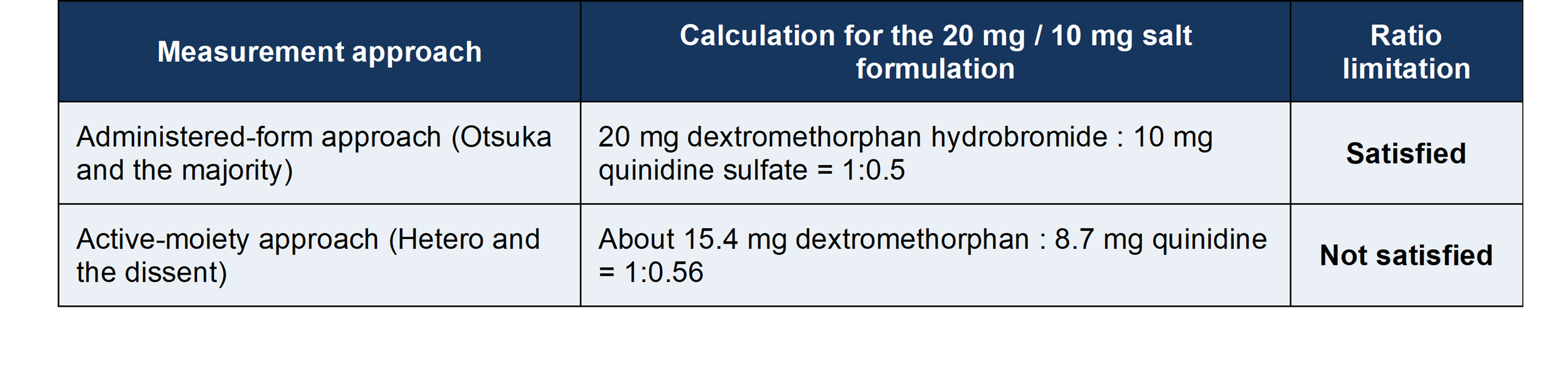
Under the administered-form construction adopted by the majority, both Nuedexta and Hetero's generic satisfied the 1:0.5-or-less ratio limitation. Under Hetero's active-moiety construction, neither product did.
From ANDA Approval to Preliminary Injunction
· August 2024 - ANDA approval. The U.S. Food and Drug Administration approved Hetero's ANDA for a generic product with the same indications and the same nominal salt amounts as Nuedexta.
· July 2025 - Proposed launch and suit. After Hetero signaled that it intended to launch on or after July 10, 2025, Otsuka filed suit in the District of Delaware and sought emergency relief.
· July 23, 2025 - Preliminary injunction. After first issuing a temporary restraining order, the District Court adopted Otsuka's claim construction, found Otsuka likely to prove infringement, and enjoined Hetero's launch.
· Rule 65(c) waiver.The District Court declined to require a bond, reasoning that Hetero's asserted financial harm was speculative and that a multimillion-dollar bond could chill access to the courts.
· Appeal. Hetero challenged both the preliminary injunction and the bond waiver. The Federal Circuit reviewed claim construction de novo, the preliminary-injunction ruling for abuse of discretion, and the Rule 65(c) issue under Third Circuit law because the bond requirement is not unique to patent law.
The Federal Circuit's Claim-Construction Analysis
The Claims Supported Consistent, Salt-Inclusive Usage
The majority began with the claims. Dependent claims 7 and 8 expressly refer to dextromethorphan or quinidine "in a form of a pharmaceutically acceptable salt." Those claims confirmed that the references to dextromethorphan and quinidine in independent claim 1 encompass administration in salt form.
Hetero did not argue that claim 1 prohibited administration of salts. Instead, it argued that the ratio should still be calculated using only the active moieties contained within those salts. The majority found no textual basis for giving "dextromethorphan" and "quinidine" one meaning in the administration limitations and a different, active-moiety-only meaning in the ratio limitation. Consistent usage favored measuring the form actually administered.
The Specification Used Compound Names as Shorthand for the Administered Salts
The specification supplied the strongest support for Otsuka. It described the active ingredients as including both the free bases and their pharmaceutically acceptable salts, and it repeatedly identified dextromethorphan hydrobromide and quinidine sulfate in the disclosed embodiments. The clinical-study descriptions then used "dextromethorphan," "quinidine," "DM," and "Q" as shorthand for doses that were actually administered in salt form.
Table 38 was particularly important. It converted hydrated salt forms to the corresponding anhydrous salt amounts, but it did not convert dextromethorphan hydrobromide to free-base dextromethorphan or quinidine sulfate to free-base quinidine. The reported "DM" and "Q" quantities matched the salt quantities in the capsules. The majority treated that drafting pattern as evidence that the patentees used the administered salt quantities as the operative dosing quantities.
The Prosecution History Reinforced the Same Reading
The prosecution history pointed in the same direction. The Examiner characterized the application as involving dextromethorphan or dextromethorphan hydrobromide in combination with quinidine or quinidine sulfate. The majority also relied on an inventor declaration whose dosing exhibit used the salt forms. Although these statements did not recite the final construction verbatim, the majority found them consistent with the specification's salt-inclusive usage.
The Commercial Product Confirmed, but Did Not Alone Dictate, the Construction
Under Hetero's construction, Otsuka's own Nuedexta formulation would fall outside the asserted claim. Citing Osram GmbH v. International Trade Commission, 505 F.3d 1351, 1358 (Fed. Cir. 2007), the majority considered it highly improbable that the patentee intended to draft or amend the claim so that it excluded the product the patent was intended to protect. The Orange Book listing identifying the '282 patent as covering Nuedexta reinforced that inference.
The majority did not rely on the commercial product in isolation. It used the product evidence as confirmation of the claims, specification, and prosecution history. That limitation matters because the dissent emphasized that prosecution amendments can sometimes narrow an issued claim away from a commercial embodiment.
The Construction Did Not Render Claim 1 Indefinite
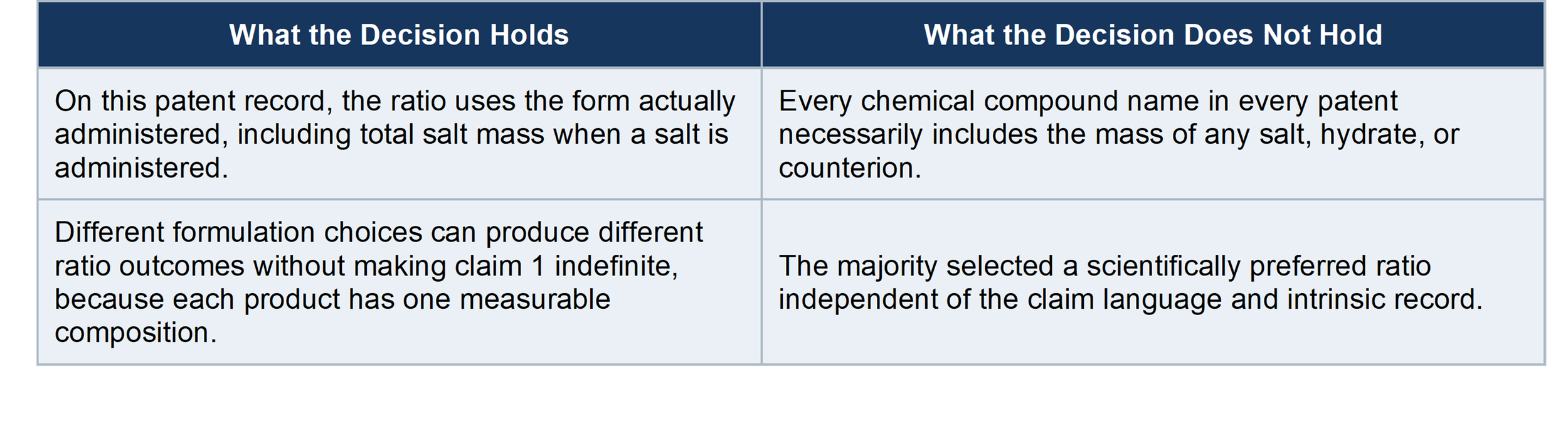
Hetero argued that including salt forms would create uncertainty because different salts, hydrates, or free-base combinations could change the ratio. The majority disagreed. For any particular product, the administered form and its amount are measurable, and only the selected form is used in the calculation. Different formulation choices may produce different infringement outcomes, but they do not create multiple competing calculations for the same formulation.
Extrinsic Technical Evidence Could Not Override the Intrinsic Record
Hetero's expert opined that a skilled artisan would understand the claimed ratio to compare the active drug moieties. The majority gave that testimony less weight because it conflicted with the way the patent itself used the disputed terms. The result is a familiar claim-construction lesson: technical testimony can illuminate the science, but it is most persuasive when it fits the intrinsic record rather than asking the court to rewrite it.
Judge Dyk's Dissent: Measure the Active Moieties
Judge Dyk agreed that the claims permit administration through salt forms, but he would have measured only the dextromethorphan and quinidine active moieties contained within those salts. In his view, the invention sought to reduce quinidine exposure while maintaining an effective dextromethorphan level. Because counterions add mass without contributing the relevant therapeutic activity, comparing total salt weights can distort the biologically meaningful relationship between the two active compounds.
The dissent also emphasized that "dextromethorphan" and "quinidine" name specific chemical compounds. If the patentee intended to claim full salt weights, Judge Dyk reasoned, the claims could have said so. He read the specification's conversion guidance as evidence that the patent taught practitioners to distinguish salt mass from active-moiety mass, and he viewed the clinical-study shorthand as insufficient to redefine the final ratio limitation.
The prosecution history likewise looked different to the dissent. Judge Dyk considered the earlier examiner statements imprecise summaries of broader claims and focused instead on the final allowance of a weight-to-weight ratio stated without salt-language qualifiers. He also rejected the majority's commercial-product inference, explaining that prosecution narrowing can leave a product outside the final claim scope. On that construction, Hetero raised a substantial question of noninfringement, and Judge Dyk would have reversed the preliminary injunction.
The Unanimous Rule 65(c) Ruling
The panel divided on claim construction but agreed that the District Court could not waive Rule 65(c) security on this record. Rule 65(c) requires a movant obtaining a preliminary injunction to provide security in an amount the court considers proper to cover costs and damages if the enjoined party is later found to have been wrongfully restrained. Because that requirement is procedural rather than patent-specific, Third Circuit precedent controlled.
Third Circuit law interprets the requirement strictly. Waiver may be available when there is no risk of monetary loss or in limited noncommercial or public-interest circumstances. But under Zambelli Fireworks Manufacturing Co. v. Wood, 592 F.3d 412, 425-26 (3d Cir. 2010), the Third Circuit has not excused security where an injunction prevents commercial, money-making activity. A generic drug launch falls squarely within that category.
The Federal Circuit vacated the waiver and remanded for the District Court to determine an appropriate amount. It did not set the bond or require security equal to any particular damages estimate. The District Court retains discretion to consider the limited time remaining before the '282 patent's scheduled expiration and the evidence of potential loss. The panel also noted that District of Delaware Local Rule 54.1(b)(10) may permit reasonable bond premiums or expenses to be recovered as taxable costs.
Why Otsuka Matters for Patent Practitioners
For Patent Drafting: Define the Measurement Basis
A numerical limitation is only as clear as its measurement convention. If a dose, ratio, or concentration is intended to use the mass of the administered salt, the claim or specification should say so. If it is intended to use active-moiety weight, free-base equivalent, anhydrous weight, hydrated weight, or another basis, that convention should be stated with equal precision. Definitions, examples, formulation tables, labels, and clinical-study descriptions should use the same basis or explain any conversion explicitly.
The need for precision extends beyond salts. Solvates, hydrates, complexes, stereoisomers, conjugates, prodrugs, and multicomponent formulations can all change the relationship between nominal mass and the amount of active material. A short definition at filing can avoid a market-entry dispute years later.
For Prosecution and Portfolio Management: Audit the Entire Intrinsic Record
The majority relied not only on the claim text but also on shorthand in clinical-study sections, the treatment of hydrate conversions in a table, an inventor declaration, and the examiner's descriptions of the claims. Practitioners should therefore audit the full record when amending a numerical limitation. A claim may appear precise while the specification and prosecution papers quietly point to a different measurement convention.
Commercial-product alignment also deserves an explicit check. The majority found it improbable that the patentee intended not to encompass Nuedexta, while the dissent cautioned that prosecution narrowing can do exactly that. Before allowance, counsel should calculate the relevant limitation both as the claim literally reads and under any plausible alternative convention, then confirm that the intended product and meaningful design-around space are treated as expected.
For Litigation and Due Diligence: Build the Construction from the Patent Outward
Otsuka is not a universal rule that compound names always carry the full mass of every salt. The outcome depended on this patent's claims, specification, prosecution history, and confirmatory product evidence. Litigants and diligence teams should begin by mapping every use of the disputed term across those sources, including tables, abbreviations, examples, declarations, and amendments, before turning to expert opinions about the scientifically preferred measurement.
The preliminary posture also matters. The majority affirmed a likelihood-of-success determination and the District Court's exercise of discretion; it did not adjudicate final infringement after a full merits trial. That distinction should be preserved when citing the decision in later disputes.
For Preliminary-Injunction Practice: Develop the Security Record Early
Parties seeking or opposing a commercial-launch injunction in the Third Circuit should treat Rule 65(c) as a central evidentiary issue, not an afterthought. Relevant proof may include launch readiness, inventory and supply commitments, expected sales and pricing, the remaining patent term, anticipated market erosion, the period of restraint, and the cost of obtaining security. The movant should be prepared to address amount and form even when it believes the risk of wrongful injunction is low; the enjoined party should support its claimed exposure with concrete, non-speculative evidence.
The Boundary the Decision Draws
The decision is easiest to apply by separating the propositions the panel actually decided from broader rules it did not announce:
Key Takeaways
1. The administered form controlled on this record. The majority construed dextromethorphan and quinidine to refer to the form in which each compound was administered, so the full salt weights supplied the ratio for Nuedexta and Hetero's product.
2. The decision is patent-specific, not a universal salt-weight rule. A different claim structure, specification, or prosecution history could support an active-moiety or free-base-equivalent construction.
3. Define exactly what is being weighed. Claims involving salts, hydrates, solvates, or other forms should identify whether a numerical limitation uses as-administered mass, active-moiety mass, free-base equivalent, anhydrous mass, or another convention.
4. Shorthand and prosecution papers can become claim-construction evidence. Clinical-study labels, tables, declarations, examiner characterizations, and amendment history all contributed to the majority's reading.
5. Commercial embodiments and expert testimony are consequential but secondary.The product-exclusion point confirmed the intrinsic record, while Hetero's technical expert could not overcome language the majority found inconsistent with the patent itself.
6. Rule 65(c) security should be planned with the injunction. In the Third Circuit, waiver is highly constrained when an injunction blocks commercial activity, although the District Court retains discretion over the amount of security.
Otsuka v. Hetero illustrates how pharmaceutical claim scope can turn on the mass carried by a counterion and how a few hundredths in a ratio can influence market entry. The majority and dissent disagreed about which measurement was legally and scientifically faithful to the patent, but both opinions underscore the same drafting lesson: when claim scope depends on weight, the patent should leave no doubt about what is being weighed.
This post was written by Lisa Mueller