Cross-Family OTDP After Allergan: The PTAB’s Precedential Decision in Ex parte Baurin

Introduction
On August 6, 2026, the Patent Trial and Appeal Board’s Appeals Review Panel (ARP) issued a precedential decision in Ex parte Baurin, Appeal No. 2024-002920, involving U.S. Application No. 17/135,529 (the ‘529 application), assigned to Sanofi. The ARP reversed the Board’s earlier decisions and affirmed six obviousness-type double patenting (OTDP) rejections against claims directed to dual-variable-region antibody-like binding proteins having a cross-over binding-region orientation.
The decision is striking because the challenged claims could not have extended exclusivity beyond the principal reference patent. The '529 application has a patent-term filing date of March 28, 2012, and existing terminal disclaimers mean that any patent issuing from it could not extend beyond March 28, 2032. The representative reference, U.S. Patent No. 10,882,922 (the ‘922 patent) has a patent-term filing date of April 13, 2017, a twenty-year term ending in 2037, and 70 days of patent term adjustment (PTA). The earlier Board treated the absence of any possible timewise extension as decisive. The ARP did not.
Instead, the ARP held that the risk of divided ownership and multiple suits, often called the anti-harassment rationale, can independently support OTDP under In re Fallaux, 564 F.3d 1313 (Fed. Cir. 2009), In re Hubbell, 709 F.3d 1140 (Fed. Cir. 2013), and In re Cellect, LLC, 81 F.4th 1216 (Fed. Cir. 2023). It also confined the Federal Circuit’s 2024 decision in Allergan USA, Inc. v. MSN Laboratories Private Ltd., 111 F.4th 1358 (Fed. Cir. 2024), to a narrow same-family setting involving a challenged claim that was first-filed by actual filing date, first-issued, and later-expiring, with the challenged patent and reference sharing the same patent-term filing date.
But Baurin is not a simple endorsement of broad OTDP practice. After concluding that precedent compelled the result, the ARP devoted a substantial part of the decision to explaining why a freestanding anti-harassment rationale may be poor policy. It described the risk of backward-looking rejections against foundational work, burdens on collaborations and employee mobility, and a potential ownership "trap" that a terminal disclaimer cannot always cure. The ARP then proposed a more term-focused framework that the Office might use if the Federal Circuit narrows the anti-harassment doctrine.
The decision has two layers. The first layer is immediate and binding: examiners should continue pre-Allergan practice under MPEP § 804, and anti-harassment can stand alone. The second layer invites clarification from the Federal Circuit; the related appeal, In re Ablynx N.V., Appeal No. 26-1333, may provide it. Practitioners must plan portfolios under the first layer while watching closely for the Federal Circuit to address the second.
The Application and the Claimed Technology
The '529 application was filed on December 28, 2020, as a continuation of U.S. Application No. 14/947,791. Through the continuation chain, it claims the benefit of U.S. Application No. 13/433,033, filed March 28, 2012, and U.S. Provisional Application No. 61/468,276, filed March 28, 2011. For patent-term purposes, March 28, 2012 started the twenty-year clock.
The technology concerns antibody-like binding proteins assembled from two polypeptide chains. Each chain carries two variable domains, and the variable domains are arranged so that light-chain-derived and heavy-chain-derived regions cross over to form two antigen-binding sites. Representative claim 1 also specifies two alternative sets of amino-acid linker lengths. The claimed architecture is intended to permit the desired variable-domain pairing while reducing incorrect chain association.
The direct 2011-priority family also produced U.S. Patent Nos. 9,221,917 and 9,181,349. The '529 application already contains terminal disclaimers over those two patents. Those earlier family patents were not among the six references at issue on appeal, but they matter because they already cap the potential term and tie enforceability to common ownership.
The Representative Claim
Claim 1, which the Board treated as illustrative, recites:
1. An antibody-like binding protein comprising two polypeptide chains that form two antigen binding sites, wherein a first polypeptide chain comprises the structure VL1-L1-VL2-L2-CL, and a second polypeptide chain comprises the structure VH2-L3-VH1-L4-CH1;
wherein:
(a) VL1 is derived from a VH of a first immunoglobulin heavy chain variable domain, VL2 is derived from a VH of a second immunoglobulin heavy chain variable domain, VH2 is derived from a VL of a second immunoglobulin light chain variable domain, and VH1 is derived from a VL of a first immunoglobulin light chain variable domain;
wherein VL1 and VH1 associate to form a first antigen binding site, and VL2 and VH2 associate to form a second antigen binding site;
(b) CL is an immunoglobulin light chain constant domain;
(c) CH1 is the immunoglobulin CH1 heavy chain constant domain; and
(d) L1, L2, L3, and L4 are amino acid linkers;
wherein L1 is 3 to 12 amino acid residues in length, L2 is 3 to 14 amino acid residues in length, L3 is 1 to 8 amino acid residues in length, and L4 is 1 to 3 amino acid residues in length; or
L1 is 1 to 3 amino acid residues in length, L2 is 1 to 4 amino acid residues in length, L3 is 2 to 15 amino acid residues in length, and L4 is 2 to 15 amino acid residues in length; and
wherein the first and second polypeptides form a cross-over light chain-heavy chain pair.
The words that mattered for OTDP were not any single linker range or domain designation in isolation. The Examiner viewed the claimed two-site cross-over construct as an obvious alternative to Sanofi’s later-claimed trispecific constructs, which incorporated the recited bispecific cross-over construct and linker architecture. A secondary reference, Klein, supplied the additional teaching that swapping VL and VH domains can promote correct chain association. Sanofi did not contest that substantive obviousness comparison on appeal; the dispute was whether those later patents and the then-copending application could serve as OTDP references.
The Six OTDP Rejections and the Patent-Family Map
The Examiner entered six rejections, each combining the claims of a Sanofi patent or application with Klein, US 2009/0162359 A1. Five references were issued patents when the original appeal was decided; the sixth was Application No. 18/183,107, which later issued as U.S. Patent No. 12,227,573.
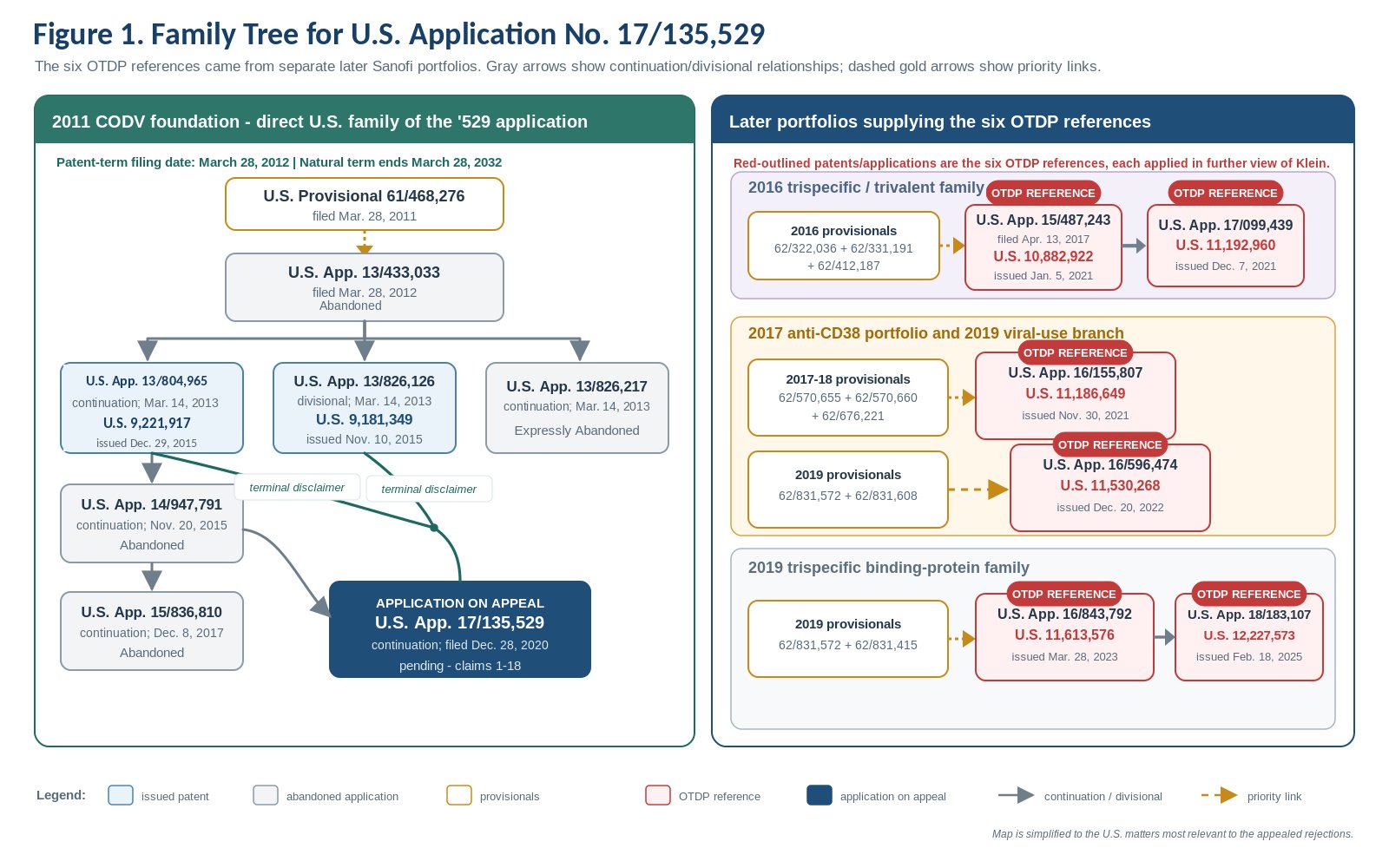
One clarification is essential for understanding the case: the six OTDP references were not all direct continuations of the '529 application. The '529 application belongs to a 2011-priority Cross-Over Dual Variable (CODV) family. The references came from three later portfolio groupings: a 2016 trispecific/trivalent family, a 2017 anti-CD38 portfolio with a 2019 viral-use branch, and a 2019 trispecific family.
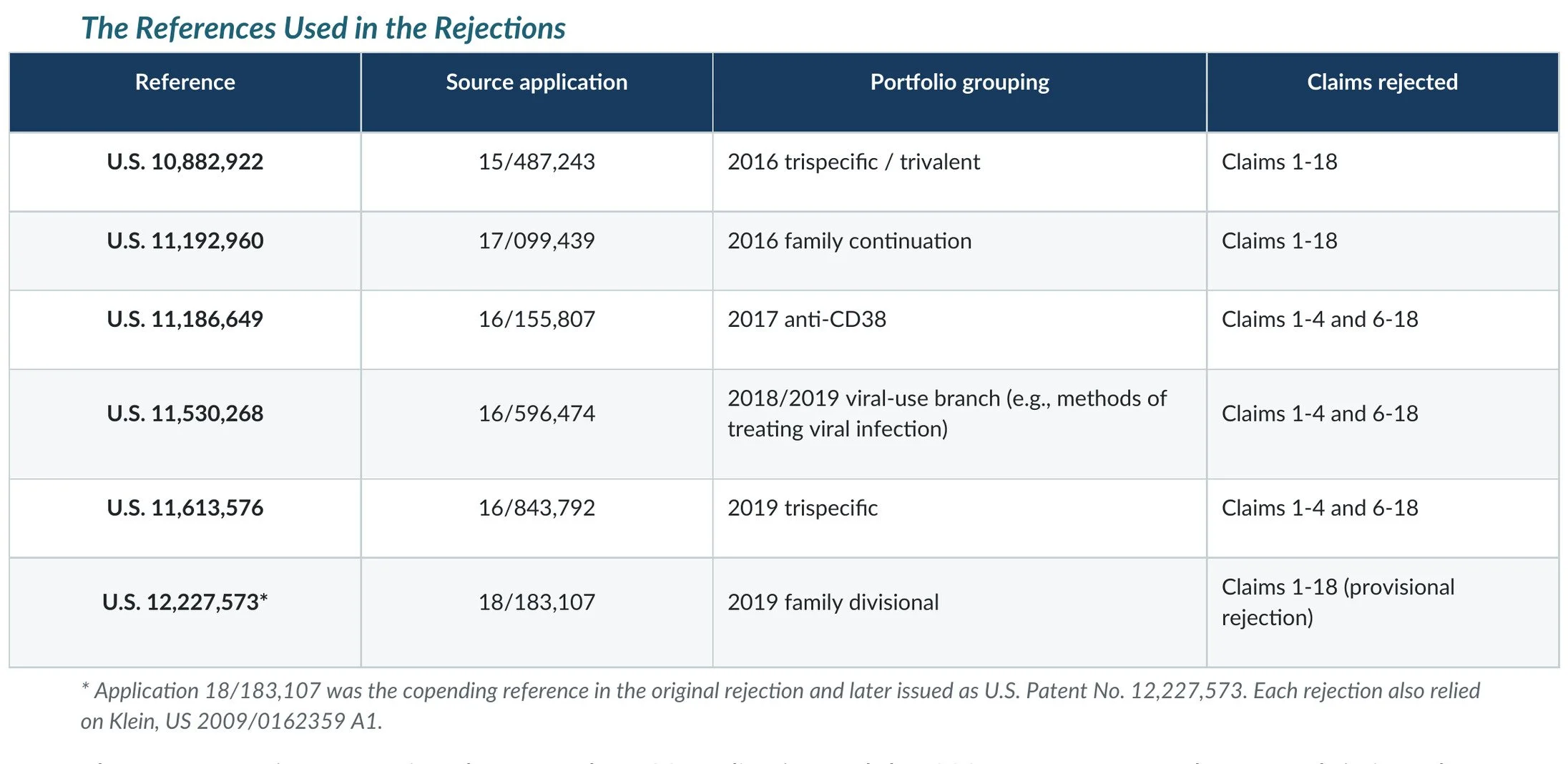
U.S. Patent No. 11,530,268 shares a provisional priority application with the U.S. Patent Nos. 11,613,576 and 12,227,573, which makes the portfolio network more complicated than a single linear family tree (See Figure 1, below).
The representative comparison between the '529 application and the '922 patent captures the unusual timing. The '529 application was actually filed in 2020, but its patent-term filing date is March 28, 2012, and its term ends in 2032. The '922 patent was actually filed in 2017, issued in January 2021, and extends into 2037 plus PTA. Therefore, the later reference could not be used to show that the pending '529 claims would prolong the '922 patent's exclusivity.
The claim comparison was also one-directional on the record. The Examiner found the pending '529 claims obvious over the '922 claims in view of Klein, while acknowledging that the '922 claims would not have been obvious over the published '529 disclosure. This asymmetry helps explain the ARP's concern that a later improvement patent could operate backward against an earlier platform application when anti-harassment is untethered from term extension.
From Initial Reversal to Precedential ARP Rehearing
The case took an unusual path through three Board decisions and extensive briefing:
• November 8, 2024 - A three-judge Board panel reversed all six OTDP rejections. It reasoned that references with later patent-term filing dates and later expiration dates were not proper references against claims that would expire in 2032 and would not extend any period of exclusivity.
• January 3, 2025 - The Examiner requested rehearing under MPEP § 1214.04, arguing that the Board had misread Allergan, departed from MPEP §§ 804 and 804.02, and wrongly dismissed the separate-ownership rationale.
• December 18, 2025 - The Board majority denied rehearing. It treated expiration and patent-term filing dates as relevant to whether a reference was proper and concluded that anti-harassment did not independently create an OTDP rejection when no term extension existed. Administrative Patent Judge Donald E. Adams dissented.
• March 5, 2026 - The USPTO Director convened the ARP sua sponte. The ARP asked the parties and amici to address the reach of Allergan, the role of projected expiration dates in examination, and whether anti-harassment can independently support OTDP. Eleven amicus briefs were entered.
• August 6, 2026 - The ARP reversed the prior Board decisions, affirmed the Examiner's six rejections, and issued guidance to USPTO personnel. The decision was designated precedential.
The ARP's Analysis
Allergan Was Narrower Than the Earlier Board Read It
Allergan involved the first application filed in its family and the first patent to issue from that family. Patent term adjustment caused that parent patent to expire after two later-filed continuation patents having the same patent-term filing date. The Federal Circuit held that the later-filed, later-issued, earlier-expiring continuation claims could not invalidate the parent. The parent itself set the maximum period of exclusivity for the family; it did not create a later timewise extension.
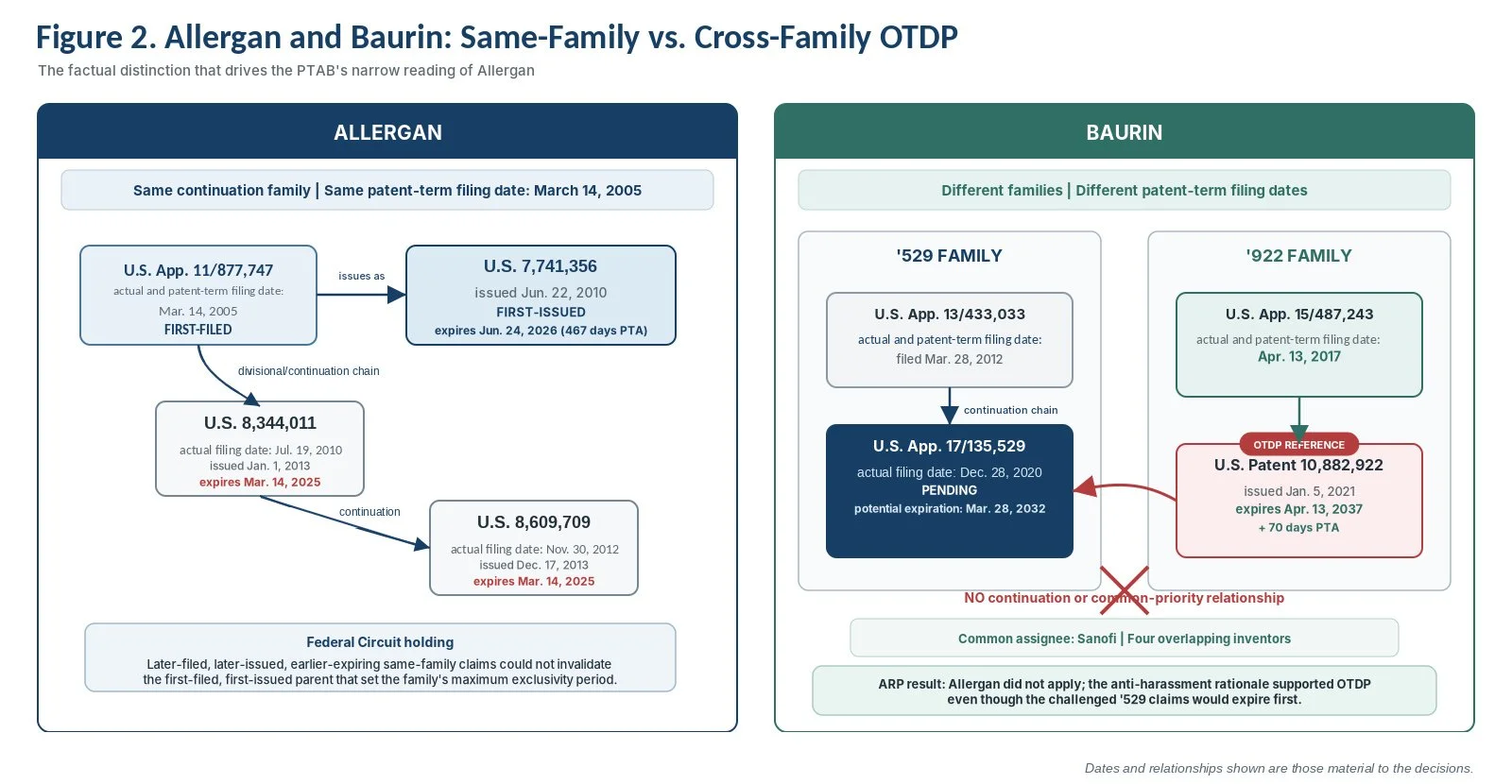
The original Baurin panel drew a broader lesson from that reasoning. It emphasized that the '529 subject matter carried an earlier patent-term filing date and would expire first, even though the '529 application and the '922 patent came from different families. The ARP rejected that broader reading and treated Allergan as a tightly bounded exception. Figure 2 illustrates the same-family posture in Allergan and the cross-family posture in Baurin.
"First-Filed" Means the Actual Filing Date
The ARP held that Allergan's "first-filed" prong refers to the actual filing date of the application containing the challenged claims, not to the patent-term filing date used to calculate the ordinary twenty-year term. The '529 application was actually filed on December 28, 2020. It was not the first actual filing in its own 2011-priority family, and it was filed after the April 13, 2017 application that produced the '922 patent.
The distinction matters. A patent-term filing date determines when the statutory term begins to run. An actual filing date identifies the chronological position of an application within a continuation family. Baurin assigns those dates different doctrinal jobs and rejects an argument that earlier term pedigree alone makes a claim "first-filed" under Allergan.
A Pending Application Cannot Be "First-Issued"
The '529 application also failed Allergan's first-issued requirement because it remained pending. In its formal guidance, the ARP stated that the relevant claim must be present in the patent having both the first actual filing date and the first issue date within the family.
That condition sharply limits the practical value of Allergan during ordinary prosecution. As the ARP observed, the full fact pattern may arise in reexamination or reissue, but will "rarely, if ever" arise in original examination because an examiner generally cannot know that a pending claim will be first-issued.
"Common Priority Date" Means a Common Patent-Term Filing Date
The ARP also read Allergan's reference to a common priority date as requiring a common patent-term filing date. The '529 application and the '922 patent do not share one: March 28, 2012 controls the '529 term, while April 13, 2017 controls the '922 term. They also are not members of the same continuation family.
The decision states that USPTO personnel are to apply Allergan only where the challenged application or patent and the OTDP reference are in the same family, share the same patent-term filing date, and the challenged claims are first-filed by actual filing date, first-issued, and later-expiring. Outside that setting, examiners are instructed to continue pre-Allergan practice.
Anti-Harassment Can Stand Alone
The original Board held that the possibility of split ownership was immaterial once it determined that the '922 patent was not a proper reference under the term-extension rationale. The ARP treated that as legal error. In its view, Federal Circuit precedent recognizes two independently sufficient rationales: preventing an unjustified extension of exclusivity and preventing multiple suits by different assignees asserting patentably indistinct claims. The ARP specifically cited In re Fallaux, In re Hubbell, and In re Cellect as supporting that conclusion.
In re Fallaux rested on the applicant's failure to qualify for the narrow two-way test; its anti-harassment discussion arose in a portfolio whose ownership had already been divided, and the court expressly declined to decide whether a common inventor alone created the required OTDP reference relationship. In re Hubbell later held that OTDP could apply despite a lack of common ownership and nonidentical inventive entities, but it did so where the patent and application were already owned by different institutions and the same conduct could trigger suits by both.
In re Cellect was also different. Its challenged claims enjoyed an actual PTA-driven extension beyond patentably indistinct reference claims. The case confirms that a terminal disclaimer serves a common-ownership function and that the patentee's declaration not to assign the patents was insufficient, but it was not an anti-harassment-only case. The ARP nevertheless read Fallaux, Hubbell, and Cellect together as compelling the conclusion that a possible future ownership split independently sustained the Baurin rejections.
The Licensee Hypothetical Made the Policy Concrete
The decision used a licensing example to show what the anti-harassment rationale is designed to prevent. A licensee to the '922 patent might reasonably believe that it has permission from the owner to practice the claimed trispecific technology. If the '529 application later issues with claims covering an obvious variant, the licensee could need a second license. If the owner sells the '529 application to another entity, the licensee could have to negotiate with a different owner or face a second enforcement action.
A terminal disclaimer addresses that risk through more than a date. Under 37 C.F.R. § 1.321(c), it also conditions enforceability on continued common ownership with the reference patent. In Baurin, that ownership tie, not any meaningful surrender of term, is the practical consequence that gives the disclaimer significance.
The Decision’s Most Striking Feature: The ARP Questions the Rule It Applies
After holding that existing precedent compelled affirmance, the ARP spent approximately ten pages describing a different framework that it would consider if the Federal Circuit clarifies that anti-harassment cannot independently support OTDP. This discussion is not the operative holding. It is nevertheless central to the decision's significance because it identifies the exact doctrinal and policy questions the Office wants the court to address.
The ARP stated that hypothetical separate ownership generally should not, standing alone, justify an OTDP rejection during examination. The Office often has no evidence that ownership will ever split or that multiple suits will occur. Yet a terminal disclaimer imposed on that speculation can create anti-alienation and anti-enforcement restrictions that last for the life of the patents. If abusive litigation actually occurs, the ARP noted, courts can address it through OTDP validity rulings, attorney-fee awards, or other appropriate remedies.
The ARP also credited concerns raised by amici about innovation. A freestanding anti-harassment rule can turn a later improvement patent backward against an earlier pending platform application. The problem is especially acute when an inventor changes employers, when a university and company divide rights, or when a collaboration produces improvements owned by different entities. The earlier applicant may be unable to file a terminal disclaimer because it cannot satisfy the common-ownership condition, even though its claims expire first and the later improvement was independently patentable over its original disclosure.
To illustrate the problem, the ARP described an earlier company pursuing a broad nucleic-acid vaccine platform while a departed inventor and a new company later obtain a narrower mRNA treatment patent. If the broad earlier claims are obvious over the later improvement in one direction, the later patent can block the earlier application under an anti-harassment-only rule. The earlier company may have no realistic cure. The ARP characterized that result as a potential "trap."
The ARP’s Proposed Future Framework
For applications and patents in different families, the ARP proposed using patent-term filing dates as a practical surrogate for projected expiration. If the putative reference has a later patent-term filing date than the application under examination, the term-extension inquiry ordinarily would end, subject to known record facts such as an existing terminal disclaimer or an already granted PTA award. Examiners would avoid speculation about future PTA, priority changes, or disclaimer withdrawal.
Within the same family, the ARP would focus on actual filing order. Child applications filed later in actual time could be rejected over earlier parent applications or patents when the claims are patentably indistinct, but the analysis would not run in reverse against the first-filed, first-issued parent. That approach tracks the core reasoning of Allergan and protects the parent patent's congressionally granted PTA.
For anti-harassment, the ARP suggested either abandoning the rationale as a standalone basis during examination or limiting it. Possible limits included requiring evidence that the applicant previously split ownership and used the portfolio to harass, or applying a two-way obviousness test before a later third-party or departed-inventor patent could block an earlier application. The ARP emphasized that none of these proposals can become Office practice without further Federal Circuit guidance.
How Baurin Fits into Modern OTDP Doctrine
Reading the cases together confirms that Baurin is not simply an application of an established expiration-date rule. Gilead Sciences, Inc. v. Natco Pharma Ltd., 753 F.3d 1208 (Fed. Cir. 2014), and AbbVie Inc. v. Mathilda & Terence Kennedy Institute of Rheumatology Trust, 764 F.3d 1366 (Fed. Cir. 2014), are term-extension cases. Gilead held that, for patents governed by the Uruguay Round Agreements Act (URAA) and arising from different priority chains, a later-issued but earlier-expiring patent may serve as a reference against an earlier-issued but later-expiring patent because expiration, not issue order, supplies the stable benchmark. AbbVie made explicit that OTDP remains viable after the URAA when patentably indistinct claims have different expiration dates.
In re Cellect likewise involved a real extension of exclusivity: patents in one family would have expired together but for differing PTA awards. The Federal Circuit measured term after PTA, rejected good-faith and no-gamesmanship arguments, and held that a promise not to divide ownership did not replace a terminal disclaimer. Cellect therefore reinforces both the term and ownership functions of a disclaimer, but it did not decide whether anti-harassment alone can support OTDP when the challenged claims expire first.
Fallaux and Hubbell provide the stronger anti-harassment authorities, but their facts were materially different from Baurin. Fallaux's actual holding concerned the narrow two-way test, and the court expressly declined to decide whether a shared inventor alone makes a patent a proper OTDP reference. Its anti-harassment discussion arose after ownership had actually been divided by assignment. Hubbell later held that OTDP could apply despite never-common ownership and nonidentical inventive entities, but there too the rights already belonged to different institutions and the record showed that the same accused conduct would expose an infringer to suits by both assignees.
Baurin extends those actual-split cases to a portfolio that remained commonly owned and in which the alleged danger was a possible future transfer. That is the doctrinal step most likely to attract Federal Circuit scrutiny. The ARP treated the anti-harassment reasoning in Fallaux and Hubbell as independently sufficient; a reviewing court could instead conclude that those cases do not resolve whether a merely hypothetical future split can create reference eligibility where there is no timewise extension.
The Boundary the ARP Drew
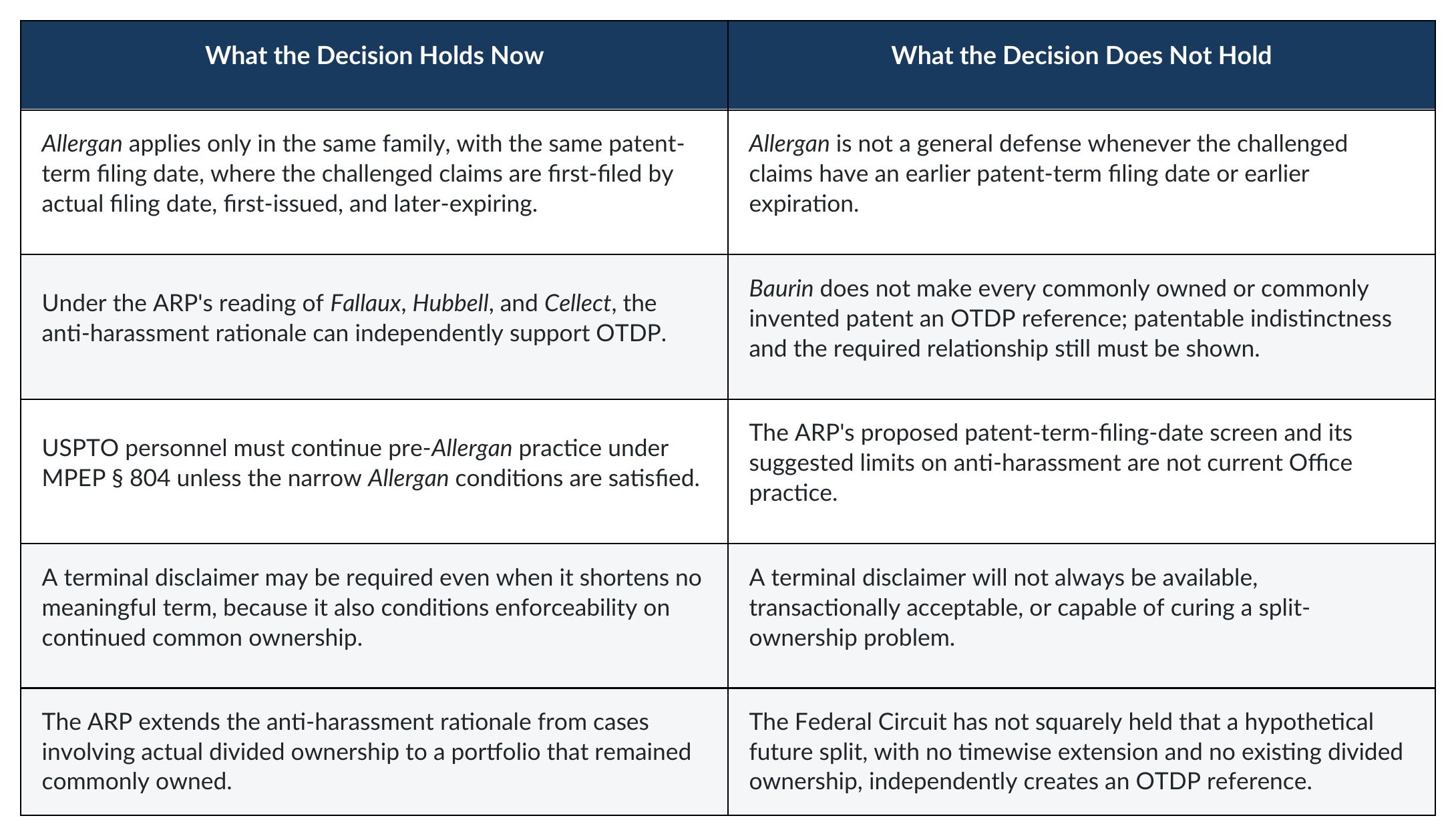
The decision is easiest to apply by separating the binding rule from propositions the ARP either rejected or reserved:
Strategic Implications for Drafting, Prosecution, and Portfolio Management
For Portfolio Architecture: Build the Family Map Before the Rejection Arrives
The most immediate lesson is procedural rather than doctrinal: complex life science portfolios need a living map that shows actual filing dates, patent-term filing dates, priority claims, continuation and divisional relationships, inventorship overlap, ownership, terminal disclaimers, PTA, and expected expiration. A conventional list of patents by title is not enough. As Figure 1 shows, the six references in Baurin came from several later portfolios and shared priority links that would be easy to miss if each family were reviewed in isolation.
The map should be updated before filing new continuations, before allowing a strategically important case to go abandoned, and before claims issue in a later improvement family. Counsel should identify whether a later-filed application could become the first-issued patent containing claims that might render claims in a still-pending earlier application obvious in one direction. The earlier application's shorter term is no longer a complete answer at the USPTO.
For Continuation Strategy: Do Not Assume the Earliest Term Pedigree Will Protect a Pending Platform Case
A long-pending platform application may have the earliest patent-term filing date in the portfolio yet still fail Allergan because it is not first-filed by actual filing date and has not issued. The decision therefore increases the strategic value of considering when a core claim should issue, when a continuation should remain pending, and how later target-specific or use-specific families may interact with that core case.
This is not a suggestion that practitioners race every foundational application to issuance. Broader claims may require longer prosecution, and premature allowance can sacrifice scope. The point is that issuance order and actual filing order now have independent OTDP significance. Portfolio decisions should weigh those consequences alongside PTA, claim breadth, product coverage, and continuation flexibility.
For Prosecution: Preserve Patentable Distinctness and Do Not Rely on Expiration Alone
After Baurin, an applicant facing a reference with a later patent-term filing date or later expiration date should not lead with only the argument that its claims expire first. The response should address whether the reference is properly related through common ownership or overlapping inventorship, whether the Examiner has made the correct one-way claim comparison, whether the cited claims plus secondary art actually render every limitation obvious, and whether amendments can preserve commercially meaningful scope.
AbbVie gives applicants a separate line of defense: OTDP requires a claim-by-claim comparison. The analysis begins by construing the competing claims and identifying their differences, then asks whether those differences render the claims patentably distinct under ordinary obviousness principles. A broad genus does not automatically dispose of every narrower species; unexpected properties or results may support distinction. Baurin did not resolve those questions because Appellant did not contest the Examiner's one-way obviousness conclusion.
Fallaux and Hubbell also confirm that the two-way test is not a general fairness exception. It applies only when the USPTO is solely responsible for the sequence that caused the later-filed improvement to issue first. Ordinary portfolio choices, delayed claiming, abandonment and refiling, or any shared applicant responsibility keep the one-way test in place. The ARP's proposed broader use of a two-way screen is therefore not current law.
For Terminal Disclaimers: The Ownership Covenant May Matter More Than the Term
Where the reference expires later, a terminal disclaimer may surrender little or no additional patent term. Its major effect may instead be the enforceability condition requiring continued common ownership. That condition can complicate assignments, partial portfolio sales, spin-outs, field-specific licensing, securitization, and transactions involving only one family.
Before filing a disclaimer, counsel should confirm who owns every relevant application and patent, whether ownership can remain aligned through expiration, whether existing licenses or security interests permit the required structure, and whether a contemplated transaction would break the enforceability condition. In a genuine split-ownership case, the disclaimer may be impossible rather than merely unattractive.
Cellect adds a timing warning: a terminal disclaimer is not a retroactive escape hatch after a patent expires. Portfolio audits should occur during prosecution and again before the earliest relevant expiration, especially where PTA has created uneven terms. A missed disclaimer can invalidate claims rather than merely reduce the extra adjusted days.
For Collaborations and Employee Mobility: Allocate Improvements With OTDP in Mind
Research agreements, sponsored-research arrangements, joint ventures, and employee-departure provisions should address more than title to the initial invention. They should allocate improvement rights, prosecution control, cooperation duties, rights to obtain assignments or cross-licenses, and the ability to align ownership if an OTDP rejection arises.
Overlapping inventorship can support an OTDP relationship even when the parties own exactly what their contract contemplated. A later improvement patent owned by a former employer, collaborator, or spin-out may block an earlier pending application that expires first. The parties should decide in advance whether they can maintain common ownership, exchange rights, coordinate claim scope, or preserve a commercially acceptable alternative.
For Licensing and Transactions: Expand the Diligence Questions
Licensees should ask whether the licensed patents are subject to terminal disclaimers tying enforceability to applications or patents outside the licensed package. They should also identify pending platform claims, later improvement families, shared inventors, and rights held by former collaborators. A license to a later-family patent may not eliminate risk from an earlier-priority application that issues afterward, which is the concern highlighted by the ARP's hypothetical.
Buyers and investors should review both directions of potential OTDP. Which patents could shorten or constrain the target portfolio? Which target patents could serve as references against retained or third-party rights? Which transactions would divide ownership of patentably indistinct claims? A diligence analysis that compares only expiration dates will miss the ownership-centered risk recognized in Baurin.
Key Takeaways
1. No term extension is not enough under the current USPTO rule.The '529 claims would expire more than five years before the representative '922 patent, but the ARP sustained the rejections because it treated anti-harassment as independently sufficient.
2. Allergan remains a narrow same-family exception. The challenged claim must be first-filed by actual filing date, first-issued, later-expiring, and in the same family with the same patent-term filing date as the reference.
3. Cross-family maps are essential.The six references in Baurin came from several later portfolios, not from one continuation chain. Actual filing order, patent-term filing dates, priority, inventorship, ownership, and disclaimer obligations must be reviewed together.
4. Patentable distinctness remains a separate battlefield. Under AbbVie, the inquiry requires claim construction, identification of differences, and an obviousness analysis. Genus/species relationships and unexpected results can matter even when a reference is otherwise eligible.
5. The two-way test remains narrow today.Fallaux and Hubbell limit it to cases in which the USPTO is solely responsible for reverse issuance. Lack of bad intent or ordinary portfolio sequencing is not enough.
6. A terminal disclaimer creates both timing and ownership consequences. It may surrender little term but still lock enforcement to continued common ownership. Under Cellect, it cannot be supplied retroactively after expiration.
7. The ARP’s proposed alternative framework is not current law.Patent-term-filing-date screens, an actual-harassment requirement, and broader use of a two-way test remain contingent proposals awaiting Federal Circuit clarification.
8. Federal Circuit review deserves close attention.Baurin cleanly presents whether a merely hypothetical future ownership split can independently sustain OTDP when there is no possible timewise extension. The related In re Ablynx N.V. appeal may address the issue first.
Conclusion and Federal Circuit Watch
Ex parte Baurin is a rare precedential PTAB decision that announces a broad operational rule while explaining at length why that rule may be undesirable. For now, the command to the Office is clear: a challenged application’s earlier patent-term filing date and earlier expiration do not prevent a patent with a later patent-term filing date and later expiration from serving as an OTDP reference when the anti-harassment rationale applies, and Allergan offers only a narrow same-family protection.
Practitioners should therefore be on the lookout for Baurin itself to go to the Federal Circuit. A notice of appeal would place before the court a fully developed record that includes the original reversal, the rehearing majority and dissent, the precedential ARP decision, and eleven amicus submissions. In the meantime, the related In re Ablynx N.V., may address the same core issue first. Portfolio owners should adjust prosecution and diligence now while preserving arguments for a legal landscape that may change again.
This post was written by Lisa Mueller.