A Priority Claim Is Not Enough: Federal Circuit Rejects the PTAB's 'Ministerial' Test in Dental Monitoring v. Align

Introduction
One word did most of the work in Dental Monitoring SAS v. Align Technology, Inc.:entitled. Under AIA § 102(d)(2), a patent or published application may reach back to an earlier filing date for prior-art purposes only if it is "entitled to claim" priority or benefit under the incorporated priority statutes. On August 10, 2026, the U.S. Court of Appeals for the Federal Circuit held that this language carries substantive weight. A reference does not obtain the filing date of a provisional application merely because it lists that provisional in its priority chain and the provisional describes the passage being cited as prior art.
The court vacated a Patent Trial and Appeal Board (PTAB) final written decision holding claims 1-15 of U.S. Patent No. 10,755,409 (the '409 patent) obvious. The Board had treated the reference application's compliance with 35 U.S.C. §§ 119 and 120 as largely "ministerial" and had asked only whether the provisional described the subject matter on which the petitioner relied. The Federal Circuit rejected that test. Because § 119(e)(1) incorporates § 112(a), the petitioner also must show that the provisional provides written-description support for at least one published claim of the reference.
The decision is important well beyond dental imaging or artificial intelligence. It directly affects how petitioners establish the effective filing date of patent-document prior art in inter partes review (IPR), how patent owners challenge references that appear facially earlier, how examiners and applicants evaluate § 102(a)(2) rejections, and how companies draft provisionals that may later serve both as priority foundations and as defensive prior art.
The Patent, the Technology, and the IPR
Dental Monitoring owns the '409 patent, which concerns acquiring and analyzing images of a patient's dental arch. The claimed method includes acquiring an image, analyzing the image with a "deep learning device" trained using a learning base, determining a value for an image attribute, comparing that value with a setpoint, and sending a message that can guide the operator to acquire a new image when needed. The disputed claim language included "analysis of the analysis image by means of a deep learning device trained by means of a learning base."
Align filed IPR2023-01369 challenging claims 1-15. The Board found the claims obvious over a three-reference combination: WIPO Patent Application Publication No. WO 2016/066651 A1 (Salah), U.S. Patent Application Publication No. 2021/0068923 A1 (Carrier), and a paper concerning convolutional neural networks (Maninis).
Carrier's date was pivotal. The Board found that the effective filing date of the '409 patent, based on a foreign priority application, fell after Carrier's provisional filing date but before Carrier's nonprovisional filing date. Carrier therefore could qualify as prior art only if § 102(d)(2) allowed the publication to use the provisional's earlier date. If Carrier was limited to the nonprovisional date, it was too late to use in the obviousness combination.
The Federal Circuit emphasized an often-overlooked distinction. Carrier was not seeking an earlier priority date to defeat a competing applicant in a priority contest. Align was invoking Carrier's provisional date to make Carrier earlier prior art against a third-party patent. Therefore, the statutory question was the reference's effective filing date under § 102(d), not the effective filing date of the challenged claimed invention under § 100(i).
The Representative Claim
Claim 1 of the '409 patent, which frames the challenged technology, recites:
1. A method for acquiring an image of a dental arch of a patient, said method comprising the following steps:
a′) activation of an image acquisition apparatus so as to acquire an image, called “analysis image”, of said arch;
b′) analysis of the analysis image by means of a deep learning device trained by means of a learning base;
c′) determination, for the analysis image, as a function of the results of the analysis in the preceding step, of a value for an image attribute;
d′) comparison of said image attribute value with a setpoint;
e′) sending of an information message as a function of said comparison, the information message being related to the quality of the image acquired or to the position of the acquisition apparatus in relation to said arch or to the setting of the acquisition apparatus or to the opening of the mouth or to the wearing of a dental appliance, or to a combination thereof,
to check whether the analysis image respects the setpoint and, if it does not respect the setpoint, to guide the operator in order for him or her to acquire a new analysis image.
Why Patent-Document Prior Art Has Two Dates
The America Invents Act (AIA) § 102(a)(2) treats certain U.S. patents and published U.S. patent applications naming another inventor as prior art if they were "effectively filed" before the effective filing date of the challenged invention. Section 102(d) determines that effective filing date. If no earlier priority or benefit claim applies, the reference generally dates from its actual filing date. If an earlier application applies, the reference may be treated as effectively filed as of the earliest application that describes the relevant subject matter, but only if the reference is "entitled to claim" that earlier date under the incorporated statutes.
This structure can make a patent publication prior art as of a date long before the public could read it. That is why the quality of the earlier application and the legal sufficiency of the priority claim matter. The face of a patent may list an early provisional date, but § 102(d)(2) asks whether that date was actually earned for prior-art purposes.
The PTAB's Penumbra Approach
Dental Monitoring relied on Dynamic Drinkware, LLC v. National Graphics, Inc., 800 F.3d 1375 (Fed. Cir. 2015), where the Federal Circuit held under pre-AIA law that a patent challenger could not use a reference patent's provisional date without showing that the provisional provided written-description support for at least one claim of the reference patent. Dental Monitoring argued that Carrier likewise could not reach back unless its provisional supported at least one published Carrier claim.
The Board disagreed. It relied on its precedential decision in Penumbra Inc. v. RapidPulse, Inc., IPR2021-01466, Paper 34 at 32 (PTAB Mar. 10, 2023), which treated Dynamic Drinkware as limited to pre-AIA § 102(e). Under Penumbra, the Board viewed AIA § 102(d)(2) as requiring only compliance with the "ministerial requirements" of §§ 119 and 120, together with a showing that the earlier application described the subject matter relied upon in the later reference.
Applying that approach, the Board found that Carrier's provisional described the subject matter Align cited from Carrier. Because the Board believed no separate claim-support inquiry was required, it treated Carrier as prior art as of the provisional date and found claims 1-15 obvious.
The Federal Circuit: 'Entitled to Claim' Means Substantively Entitled
The Federal Circuit began with the statutory text. Section 102(d)(2) does not refer to a patent or application that merely "claims" or "asserts" priority. It applies when the reference is entitled to claim priority under § 119 or benefit under § 120. In the court's view, that wording naturally incorporates the substantive prerequisites of the referenced statute rather than only the procedural act of listing an earlier application.
For a provisional application, § 119(e)(1) makes priority available only when the invention disclosed in the later application was disclosed in the provisional "in the manner provided by" § 112(a). The court focused on the written-description component of that requirement. It therefore held that § 102(d)(2) incorporates a substantive written-description inquiry and does not create a lower, prior-art-only standard.
The court also applied the familiar rule against surplusage. Reading "entitled to" as though it meant only "claims" would erase Congress's chosen language. The phrase does work: it separates a formal priority assertion from a legally valid priority entitlement.
The opinion summarized the rule in direct terms:
"To establish Carrier as prior art to the '409 patent, Align must show that Carrier's provisional application provides written description support for at least one claim of Carrier. The requirement to do so is not merely 'ministerial.'"
Dynamic Drinkware Was Reserved, Not Rejected
Align argued that Dynamic Drinkware did not apply because it addressed pre-AIA § 102(e) and expressly left AIA § 102(d) for another day. The Federal Circuit responded that Align had confused a reservation of decision with a merits holding. The 2015 panel did not decide that the AIA eliminated written-description support; it simply did not decide the AIA question because that question was not before it.
The court also found the policy concern underlying Dynamic Drinkware still persuasive: a challenger should not be able to backdate a reference through a provisional that would not have supported a patent on the claimed invention. Allowing that, the court explained, would create uncertainty about what qualifies as prior art.
Importantly, the panel did not need to hold that Dynamic Drinkware formally controls every AIA case. It concluded that the AIA's own text independently produces the same claim-support requirement.
Section 100(i) Did Not Create a Ministerial Exception
Align next relied on the AIA's distinction between the effective filing date of a claimed invention under § 100(i) and the effective filing date of a reference under § 102(d). The Federal Circuit agreed that the inquiries are different, but it rejected the proposed consequence. The distinction tells practitioners which filing-date inquiry they are performing; it does not answer what the words "entitled to claim" incorporate.
Nothing in § 100(i), the court explained, indicates that Congress intended to strip substantive entitlement requirements from § 102(d)(2). A reference may have a different effective date for prior-art purposes than a claimed invention has for its own priority analysis, but the reference still must satisfy the statutory conditions attached to the priority or benefit provision it invokes.
The Rule 36 Affirmance of Penumbra Did Not Endorse the Board's Reasoning
There was another important appellate-practice point. The Federal Circuit had previously affirmed the Board's Penumbra judgment under Federal Circuit Rule 36, without an opinion. Align relied on that result, but the panel emphasized that a Rule 36 judgment establishes only that the judgment below was correct. It does not adopt or reject any particular part of the Board's reasoning, has no precedential value, and cannot establish Federal Circuit law.
The practical consequence is straightforward: the PTAB's precedential designation of Penumbra could not acquire appellate precedential force from a silent affirmance. Once the Federal Circuit addressed the statutory question in a precedential opinion, its interpretation controlled.
Clear Text Displaced the Legislative-History Argument
Align also pointed to AIA floor statements describing priority requirements for § 102(d) as "ministerial." The court declined to use that legislative history because it found the statutory text clear. Section 102(d)(2) requires entitlement under § 119, and § 119(e)(1) requires disclosure in the manner provided by § 112(a). Extrinsic materials could not replace that enacted language with a less demanding rule.
The Decision Creates a Two-Gate Analysis
Read together, § 102(d)(2) and Dental Monitoring require two distinct support showings when a party relies on an earlier application to establish a reference's prior-art date. The PTAB had addressed the second showing but omitted the first.
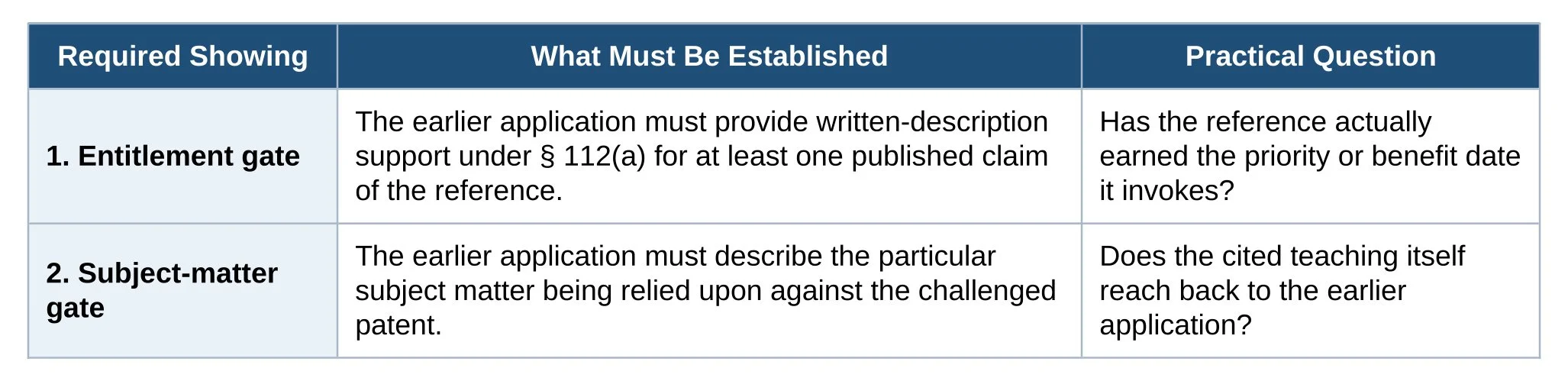
These showings should not be collapsed. A provisional might describe the particular paragraph, figure, or embodiment cited against the challenged patent yet still fail to support any complete published claim of the later reference. Conversely, a provisional might support a published claim but omit the separate disclosure on which the invalidity theory depends. The cited teaching receives the earlier date only when both links are present.
The opinion also does not say that every published claim must be supported. It requires support for at least one published claim. Nor does it state that the relied-upon teaching must itself be recited in that supported claim. Claim support establishes substantive entitlement to the earlier date; the separate subject-matter inquiry determines which disclosure receives that date.
Why the Court Vacated and Remanded Rather Than Reversing
Dental Monitoring asked the Federal Circuit to reverse. Align argued that, if the Board used the wrong standard, the proper remedy was remand. The panel chose remand because the Board had never decided whether Carrier's provisional provided sufficient written-description support for a published Carrier claim. That inquiry requires factual findings the appellate court would not make in the first instance.
Accordingly, the decision does not remove Carrier from the case. Align may still establish the required support, and the Board may still reach an obviousness determination adverse to Dental Monitoring for claims that remain live. The opinion changes the legal test and the required evidentiary showing; it does not predetermine the factual answer.
What Remains on Remand
The related decisions cited in the opinion narrow the remand more than the headline alone might suggest. The principal issues now stand as follows:
· Carrier claim support remains open. The Board must decide whether Carrier's provisional provides written-description support for at least one published Carrier claim.
· The relied-subject-matter finding already exists. The Board previously found that the provisional described the Carrier subject matter on which Align relied; the Federal Circuit identified claim support as the separate missing step.
· Maninis public accessibility is resolved. A related July 21, 2026 decision upheld the Board's accessibility finding, so the Board need not reconsider it.
· The Board need not revisit claims 1, 7, and 12. A related July 7, 2026 decision held those claims ineligible under § 101.
· The remaining obviousness issues are not finally resolved.The Board must reconsider the claims that remain relevant after applying the correct prior-art-date standard.
Accordingly, the live dispute centers on whether Carrier can retain the provisional date under the correct written-description standard and, if so, what that determination means for the remaining challenged claims.
Why the Decision Matters Beyond This IPR
Dental Monitoring turns what is often treated as a bibliographic detail into a merits issue. A priority chain printed on the face of a reference is evidence of an asserted relationship, not conclusive proof of the effective prior-art date. The party relying on the earlier date must be prepared to establish substantive entitlement and subject-matter continuity.
That point can be outcome-determinative whenever the challenged invention's filing date falls inside a reference's priority chain. In a crowded field, moving a reference forward or backward by even a few months can decide whether it is prior art at all, whether it can be combined in an obviousness challenge, and whether a validity position survives.
The decision also displaces the PTAB's broader Penumbra formulation. Parties in pending IPRs that relied on a provisional or other earlier application under a purely "ministerial" theory should reassess whether the record includes the missing claim-support showing.
Strategic Implications for Petitioners, Patent Owners, and Prosecutors
For IPR Petitioners: Build Two Support Charts, Not One
A petitioner relying on a provisional date should not stop after locating the cited disclosure in the provisional. The petition should separately identify at least one published claim of the reference and map every limitation of that claim to the provisional's written description. A second map should identify where the provisional describes the specific subject matter used in the anticipation or obviousness theory.
A disciplined submission should address at least four items:
· The claimed priority chain and relevant dates.Identify the provisional, any intermediate applications, the reference publication, and the challenged patent's effective filing date.
· A published-claim support chart. Show where the provisional conveys possession of each limitation of at least one published reference claim.
· A relied-subject-matter chart.Separately map the exact passage, figure, embodiment, or feature used against the challenged claim to the provisional.
· Technical evidence where the disclosure is not self-explanatory.Use expert testimony to explain what a skilled artisan would understand, while avoiding conclusory assertions that merely repeat the claim language.
This is especially important where the later application added terminology, a functional result, a species selection, or a combination not clearly present in the provisional. Similar words are not always enough; the written-description inquiry asks whether the provisional reasonably conveyed possession of the later claimed invention.
For Patent Owners: Challenge the Date Before Debating the Combination
Patent owners should treat a reference's effective date as a separate attack point rather than assume the date printed on the patent controls. The first question is not whether the cited passage can be found somewhere in the provisional. It is which published claim the petitioner contends is supported and where every limitation of that claim appears in the earlier disclosure.
Useful questions include:
· Did the nonprovisional add a critical structural element, parameter, use, or functional relationship that appears in every published claim?
· Is the alleged support an actual disclosure of the claimed combination, or a reconstruction assembled from unrelated passages?
· Does the provisional describe only a research goal or a broad genus while the published claim selects a narrower species without adequate identifying features?
· Is the subject matter cited in the invalidity theory actually present in the provisional, even if a different published claim is supported?
A successful date challenge can deprive a reference of the earlier date and, in some cases, remove it from the relevant prior-art universe altogether. That can dismantle an obviousness combination before the parties reach motivation to combine, reasonable expectation of success, or secondary considerations.
For Ex Parte Prosecution: Scrutinize § 102(a)(2) Rejections That Reach Back
The same statutory issue can arise during examination. When an examiner cites a U.S. patent publication under § 102(a)(2) and relies on an earlier provisional or benefit date, applicants should evaluate whether the cited date is supported under Dental Monitoring. A response may appropriately ask the Office to identify both the published claim supported by the earlier application and the location of the relied-upon subject matter in that application.
This is not an invitation to challenge every priority claim reflexively. It is a targeted strategy for cases in which the rejection depends on an earlier application and the later reference appears to contain material added after that filing. Where the date is dispositive, the support analysis deserves the same attention as the substantive prior-art comparison.
For Provisional Drafting: Preserve Both Priority and Defensive Prior-Art Value
The decision has a less obvious implication for applicants drafting their own provisionals. A provisional may later matter not only as the priority foundation for the applicant's claims, but also as the date that determines when the resulting publication becomes prior art against third parties. A thin provisional can therefore reduce both offensive patent rights and defensive prior-art value.
Provisionals are not required to contain claims, and Dental Monitoring does not change that rule. But the disclosure should be robust enough to support at least one claim that will appear in the later publication. Where defensive prior art is strategically important, applicants should consider preserving in the published claim set at least one claim fully supported by the provisional, rather than adding a new feature to every claim.
The practical drafting lesson is familiar but newly consequential: describe complete combinations, meaningful alternatives, functional relationships, and implementation details at the provisional stage. A list of aspirations or disconnected components may not support a later claim even if it contains some of the same vocabulary.
For Continuation Practice and Portfolio Audits: Do Not Assume the Earliest Date Travels Automatically
Section 102(d)(2) also addresses benefit under § 120. Because this case involved provisional priority under § 119(e), the panel did not separately decide a continuation-chain dispute. Still, its reasoning focuses on substantive entitlement under the incorporated statute. In our assessment, practitioners should expect the same insistence on earned, rather than merely asserted, dates when a reference relies on a continuation or another earlier application.
Portfolio audits should therefore identify which published claims are supported at each link in a chain and which disclosed teachings can reach back to which dates. This can affect freedom-to-operate analyses, invalidity opinions, licensing diligence, and the expected defensive effect of a company's own publications.
For Litigation and Due Diligence: Treat the Face of the Patent as the Starting Point
In district court litigation, a § 102(a)(2) reference may look comfortably earlier until the priority chain is tested. Counsel should obtain the provisional and intermediate applications early, create the two support maps, and determine whether the relevant date changes for different portions of the disclosure. The same reference may have an early date for some subject matter and a later date for other material.
For diligence teams, the lesson runs in both directions. A seemingly blocking reference may not be as early as it appears, while a company's own publication may have less defensive reach than expected if the provisional was thin or the published claims all depend on later-added matter. Date analysis can materially change the value assigned to both third-party and owned portfolios.
What the Decision Does and Does Not Establish
The most useful way to apply Dental Monitoring is to keep its holding narrow but its workflow broad.
· It establishes that § 102(d)(2) incorporates substantive entitlement under § 119(e)(1), including written-description support for at least one published claim of the reference.
· It establishes that showing only that the provisional describes the cited subject matter is insufficient.
· It establishes that a Rule 36 affirmance does not transform PTAB reasoning into precedential Federal Circuit law.
· It does not requirea provisional to include formal claims, but it makes the sufficiency of the provisional disclosure consequential in a new and concrete way.
Key Takeaways
1.A priority claim is not self-executing for prior-art purposes.The reference must be substantively entitled to the earlier date; listing a provisional on the face of a publication is not enough.
2. Petitioners need two support showings.They must establish written-description support for at least one published reference claim and separately show that the earlier application describes the subject matter relied upon against the challenged patent.
3. The AIA did not create a ministerial shortcut.The Federal Circuit held that §§ 102(d)(2) and 119(e)(1) carry the written-description gate into the AIA framework, even though Dynamic Drinkware itself addressed pre-AIA law.
4. Patent owners should attack dates early and specifically.A reference-date challenge should identify missing limitations in the allegedly supported published claim and any later-added material in the cited disclosure.
5. Rule 36 affirms judgments, not reasoning.The silent affirmance of Penumbra did not endorse its ministerial test or give that reasoning precedential appellate force.
6. Provisionals have defensive as well as offensive consequences. A well-supported provisional can preserve an earlier prior-art date for a later publication; a thin provisional can forfeit that advantage even when the priority chain looks correct on paper.
This post was written by Lisa Mueller.