Different Sequences, One Claimed Function: PTAB Reverses Improper Markush Rejection in Ex parte Chowdhury
Introduction
Markush practice is often taught through chemical genus claims: a core structure, a list of substituents, and a dispute over whether the alternatives belong together. Ex parte Chowdhury (Appeal 2025-002261) examines the doctrine into a very different setting - a life sciences method claim using a panel of microRNAs as biomarkers to guide treatment after radiation exposure.
The Patent Trial and Appeal Board (PTAB) issued the decision on February 5, 2026, and the USPTO designated it informative on August 25, 2026. The Office summarizes the decision as recognizing a proper Markush grouping where subgenus members perform similar functions. An informative decision is not binding precedent, but it sets a Board norm that should ordinarily be followed in similar cases absent a reasoned justification for departing from it.
The decision is particularly useful for biotechnology, diagnostics, and precision-medicine claims. Its central lesson is not that structure no longer matters. Rather, the inquiry must be tied to the claimed relationship. An examiner cannot defeat a process-based Markush group merely by identifying differences in the alternatives' underlying biology when those differences do not affect the job the claim assigns them.
Chowdhury gives applicants a disciplined framework for defending heterogeneous biomarker lists: define the relevant subgenus, identify the common claimed use, show why the alternatives are interchangeable for that use, and keep the argument focused on the claim rather than on scientific differences the claim does not require.
The Application and the Claimed Technology
The appeal arose from U.S. Application No. 17/005,548, filed August 28, 2020, naming Dipanjan Chowdhury and Chandan Guha as inventors. Dana-Farber Cancer Institute, Inc. and Albert Einstein College of Medicine, Inc. were identified as the real parties in interest. The application concerns methods of determining radiation exposure and using radiation-responsive microRNA signatures in clinical decision-making.
MicroRNAs (miRNAs) are small non-coding RNAs, typically about 19 to 22 nucleotides long, that participate in regulation of gene expression. The specification reported that serum levels of particular miRNAs change after total body irradiation, that the changes are radiation-dose dependent, and that the measured levels correlate with a subject's risk of radiation disease, prognosis, and response to treatment.
The disclosed assay workflow was comparatively conventional: isolate and amplify miRNAs from a biological-fluid sample, contact the amplified products with a substrate, and detect the bound products. The claimed contribution lay in using selected miRNA levels as an early quantitative signature of radiation exposure and as a basis for treatment decisions before symptoms necessarily appear.
Representative claim 60 used that signature dynamically. It required measuring selected miRNAs before treatment, administering a treatment for radiation-induced damage, measuring the same miRNAs again, determining whether specified miRNAs increased or decreased, and then continuing the first treatment or switching to a different treatment. Although claim 60 also contains a separate closed list of possible treatments, the appealed rejection analyzed by the Board focused on the miRNA groupings.
The Representative Claim
Claim 60, which the Board treated as representative, recites:
60. A method of treating radiation-induced damage in a human subject in need thereof, the method comprising:
(a) determining at a first time point a first level of one or more miRNAs in a first serum sample obtained from the human subject, wherein the one or more miRNAs is selected from the group consisting of miR-130a-3p, miR-150-5p, miR-142-5p, miR-706, miR-342-3p, miR-136-5p, miR-17-3p, miR-126-3p, miR-322-3p, miR-34b-3p, miR-187-3p, miR-194-5p, miR-27a-3p, miR-30a-3p, and miR-30c-5p;
(b) after the first time point and before a second time point, administering a first treatment for reducing radiation-induced damage to the human subject, wherein the first treatment for reducing radiation-induced damage is selected from the group consisting of: a cytokine, potassium iodide, Prussian blue, diethylenetriamine pentaacetic acid, bone marrow transplantation, blood transfusion, and surgery to remove damaged tissues;
(c) determining a second level of the one or more miRNAs of step (a) in a second serum sample obtained from the human subject at the second time point; and
(d)(i) determining that the first treatment administered in step (b) was effective and administering one or more additional doses of the first treatment for reducing radiation-induced damage to the human subject; or
(d)(ii) determining that the first treatment administered in step (b) was not effective and administering a second treatment for reducing radiation-induced damage to the human subject, wherein the first treatment for reducing radiation-induced damage is not the same as the second treatment for reducing radiation-induced damage;
wherein one or more of:
(i) an elevation in the second level of one or more miRNAs selected from the group consisting of miR-136-5p, miR-322-3p, miR-142-5p, miR-706, miR-150-5p, miR-342-3p, miR-17-3p, miR-187-3p, miR-194-5p, and miR-27a-3p, and
(ii) a decrease in the second level of one or more miRNAs selected from the group consisting of miR-130a-3p, miR-126-3p, miR-34b-3p, miR-30a-3p, and miR-30c-5p,
as compared to the first level(s) of one or more miRNAs selected from the group consisting of miR-136-5p, miR-322-3p, miR-142-5p, miR-706, miR-150-5p, miR-342-3p, miR-17-3p, miR-187-3p, miR-194-5p, miR-27a-3p, miR-130a-3p, miR-126-3p, miR-34b-3p, miR-30a-3p, and miR-30c-5p, indicates that the treatment for reducing radiation-induced damage administered to the human subject was effective.
The claim architecture matters. The miRNAs are not administered to produce a therapeutic effect, and the method does not depend on each miRNA regulating the same gene, pathway, or cellular process. They are measured. Their claimed role is to provide a quantitative before-and-after signal from which treatment efficacy is inferred.
The Legal Framework for Improper Markush Grouping
A Markush claim recites a closed list of alternatives, commonly introduced by "selected from the group consisting of." MPEP § 2117 describes a Markush group as a list of alternatively usable members. The Office may reject a claim for improper Markush grouping when the alternatives do not share the required structural relationship or do not share a common use.
For a recognized physical, chemical, or art-recognized class, the operative question is whether the art supplies an expectation that the members will behave the same way in the context of the claimed invention. Put differently, each alternative must be capable of replacing the others with the expectation that the same intended result will occur. Where the alternatives are chemical compounds outside a recognized class, the MPEP separately asks whether they share a substantial structural feature essential to their common use.
The Board drew on three authorities. In re Harnisch, 631 F.2d 716 (CCPA 1980) approved a group of coumarin compounds that formed a scientifically coherent subgenus and shared utility as dyes. In re Jones, 162 F.3d 479 (CCPA 1947) treated compounds sharing a plant-growth-stimulant function as a proper group. And Multilayer Stretch Cling Film Holdings, Inc. v. Berry Plastics Corp., 831 F.3d 1350 (Fed. Cir. 2016) emphasized that members of a process or combination Markush group must be alternatively usable for the purposes of the invention.
The MPEP §2117.II.A illustrates the same point with a nonchemical example: pressure-sensitive adhesive, hook-and-loop material, a snap, and a buckle may all form a proper class of diaper fasteners. Their structures are very different, but each is interchangeable for the claimed purpose of making the diaper repositionable and refastenable. The analogy became central to the Board's analysis of the miRNA panel.
The Examiner's Rejection
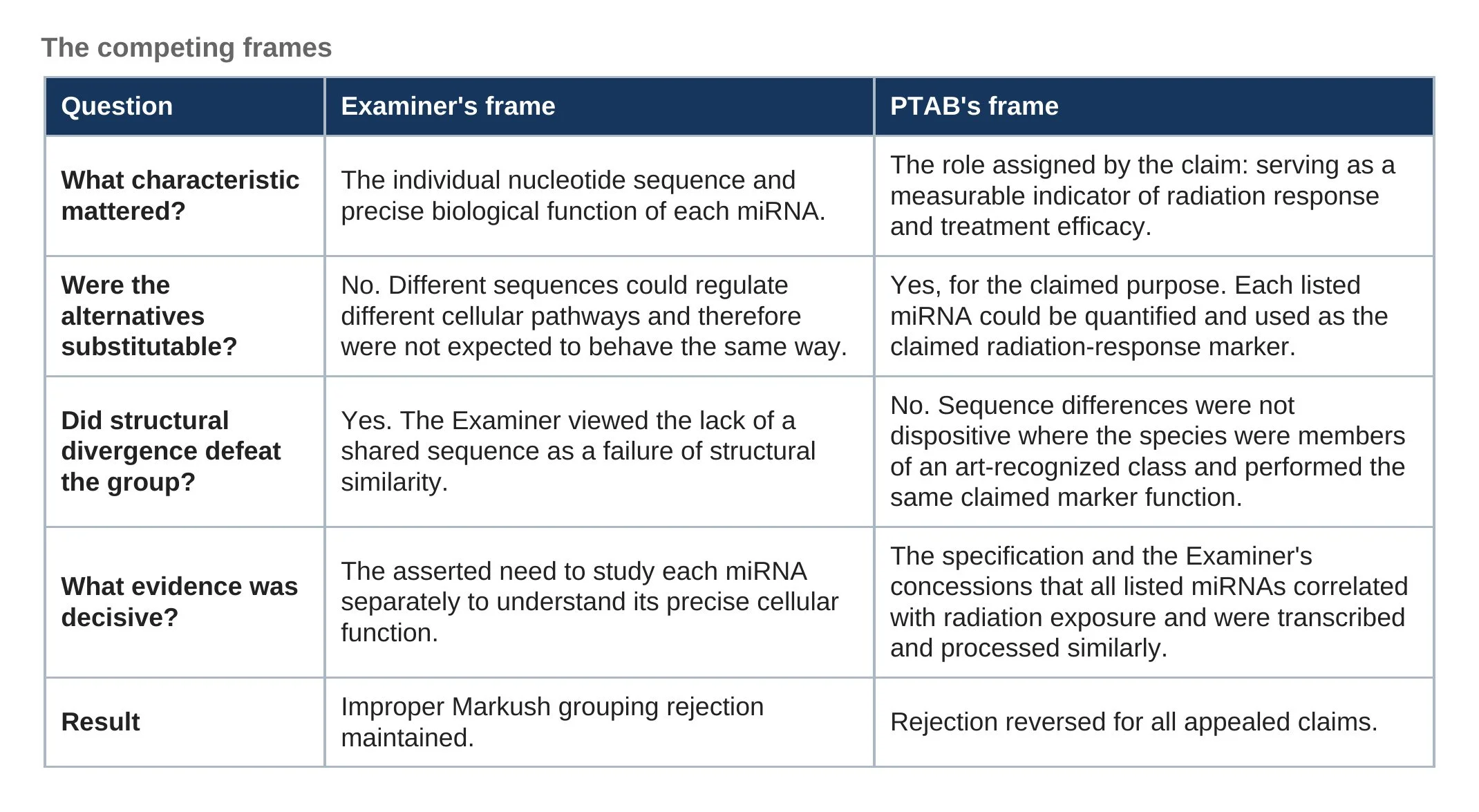
The Examiner focused on sequence and function. Each listed miRNA had a different nucleotide sequence, and the only structural feature common to all of them was that each comprised nucleotides. The Examiner also reasoned that the prior art did not establish that the miRNAs would behave in the same manner or could be substituted for one another with the same intended result.
Although the Examiner acknowledged that the claimed miRNAs were disclosed as correlated with radiation exposure, the Examiner concluded that they lacked a substantial structural similarity essential to that activity and did not belong to the same recognized physical, chemical, or art-recognized class. The Answer further relied on the proposition that the precise function of each miRNA must be studied individually in its cellular context.
That analysis treated the miRNAs as though the claim required them to perform the same regulatory biology. The Applicant responded that the claims were not directed to the miRNA molecules as compounds per se. They were treatment methods using a radiation-responsive cellular state or signature. The listed miRNAs served as markers whose presence or relative amount triggered the next step of the method.
The PTAB's Analysis
The Claimed Context Was the Controlling Frame
The Board opened with the examiner's prima facie burden under In re Oetiker, 977 F.2d 1443 (Fed. Cir. 1992) and then focused the Markush analysis on the actual method. Its central statement was direct: "the context of the claimed invention is of paramount importance."
The relevant question was therefore not whether miR-130a-3p and miR-150-5p regulate the same genes, participate in the same pathway, or produce the same intracellular effect. The question was whether each could be used in the claim as a quantifiable indicator of radiation response and treatment efficacy.
The miRNAs Were Markers, Not Molecular Effectors
The Board found that the Examiner had misinterpreted or overlooked the invention by insisting on the miRNAs' individual biological functions. The method did not require any listed miRNA to perform its natural regulatory function in a particular way. As the Board explained, the species "need not function as miRNAs, in the same way, to the same end, or at all, for the invention to work." They needed to be measurable and to provide the specified radiation-related signal.
Structural Divergence Was Not Dispositive
The Board did not hold that structure is irrelevant. It noted the Examiner's acknowledgment that the molecules were all miRNAs and were transcribed and processed in the same way. More importantly, the specification treated the listed species as a coherent radiation-response subgenus and disclosed their common use as quantitative markers.
Like the structurally diverse diaper fasteners in the MPEP example, the different miRNA sequences could still be grouped because they were substitutable for the purpose the claim required. The Board concluded that they all reportedly functioned as quantitative representatives of patient radiation exposure and were common members of an art-recognized class in that context.
The Specification and the Record Did the Work
The outcome was not based on claim language alone. The specification expressly identified the listed miRNAs as radiation-responsive species, described increases and decreases in their serum levels, and connected those changes to exposure, prognosis, and treatment efficacy. The Examiner also conceded that all claimed miRNAs were disclosed as correlated with radiation exposure.
Those facts made it difficult to sustain a prima facie case that the alternatives lacked a common use or could not substitute for one another in the claimed method. The Board reversed the improper Markush grouping rejection of claims 60, 66, 67, 88, 90-95, and 101-104.
Strategic Implications for Patent Drafting and Prosecution
For Patent Drafting: Define the Common Role Before Listing the Alternatives
A long biomarker list is much easier to defend when the specification explains why the members belong together. Practitioners should identify the operative class or subgenus and connect the shared property to the function each member performs in the claimed invention.
For a biomarker panel, useful disclosure may include a table identifying each marker, sample type, direction of change, relevant time point, dose or disease correlation, and the decision triggered by the measurement. The specification should say expressly that, for the disclosed method, each listed marker is usable as the relevant indicator and can be substituted for the others, individually or in specified combinations, to produce the claimed analytical result.
The drafting should also distinguish the claimed marker function from the molecules' endogenous functions. A sentence explaining that the invention relies on measurable abundance rather than shared regulatory targets can prevent an examiner from importing unnecessary mechanistic uniformity into the grouping analysis.
· State the class. Identify the alternatives as miRNAs, antibodies to a defined target, capture reagents, expression markers, treatment-response markers, or another scientifically coherent class.
· State the common use. Explain the precise claimed result each alternative is expected to achieve.
· State the interchangeability. Describe whether each species may be used alone, in pairs, or in panels, and why substitution preserves the intended result.
· Preserve narrower fallbacks. Use dependent claims directed to validated subsets, direction-of-change groups, sample types, thresholds, and combinations with the strongest data.
· Do not mix roles casually. A single list that combines markers, therapeutic agents, controls, and detection reagents may be difficult to defend because the alternatives do not perform the same claimed job.
For Responding to an Improper Markush Rejection: Build a Claim-Role Map
A persuasive response should start with the claim, not with an abstract taxonomy of the alternatives. For every disputed member, identify the exact role it performs, the intended result, and the specification passage or art showing that the result is common across the group.
The most effective sequence of argument is often:
· Identify the claimed relationship. Is the alternative administered, measured, bound, detected, used as a fastener, or incorporated as a structural layer?
· Define the same intended result. State the result at the level required by the claim, without silently adding a mechanistic limitation.
· Map every alternative to that result. Use the specification, examples, data tables, and the examiner's own findings or concessions.
· Address structure through the correct route. Show membership in a recognized physical, chemical, or art-recognized class, or identify the substantial structural feature tied to the common use where that route applies.
· Separate irrelevant differences. Explain why different sequences, epitopes, targets, pathways, or mechanisms do not matter to the role actually recited.
· Use technical evidence when necessary. A declaration may help establish art recognition, expected interchangeability, or why a skilled artisan would understand the common function.
For Appeals: Preserve the Context Error
Improper Markush grouping is a merits rejection and may be appealed to the PTAB. Chowdhury shows the value of identifying a discrete legal error: the examiner evaluated precise molecular biology rather than the function recited by the process claim. Applicants should preserve that distinction in the Appeal Brief and connect it to the prima facie burden.
Practitioners should also separate the grouping issue from restriction and election practice. A proper Markush group does not necessarily eliminate an election-of-species requirement, and the Office may still examine whether alternatives are patentably distinct. Nor does a proper grouping resolve written description, enablement, indefiniteness, eligibility, novelty, or obviousness.
Broader Significance Beyond miRNA Claims
The reasoning can extend beyond miRNAs whenever a claim recites heterogeneous alternatives as components of a process or combination. Potential examples include antibody panels used only for capture or detection, nucleic-acid probes used to identify the same target, imaging agents used to produce the same diagnostic readout, biomarkers used to stratify the same patient population, and treatment options grouped by the same claimed clinical role.
The analogy should be used carefully. If a claim depends on a particular binding mechanism, pathway, epitope, catalytic activity, or therapeutic mode of action, the alternatives' biological differences may become central rather than irrelevant. The more the claim asks the members to do, the stronger the showing of common structure, class membership, and function must be.
Key Takeaways
1. The claimed context controls.For a process or combination claim, the relevant question is whether the alternatives are interchangeable for the role the claim assigns them.
2. Different sequences do not automatically create an improper group. The miRNAs could have distinct nucleotide sequences and biological functions yet still form a proper group as quantitative radiation-response markers.
3. The specification must build the subgenus.Express disclosure of the common class, common function, direction of change, and expected interchangeability can be decisive.
4. Mechanistic diversity may be irrelevant - but only when the claim makes it irrelevant.If the claimed result depends on a shared mechanism, pathway, or structural feature, those differences may again control.
This post was written by Lisa Mueller.