Active Means Affirmative: Supreme Court Rejects the Federal Circuit's 'Could Be Read' Test for Skinny-Label Inducement in Hikma v. Amarin

Introduction
On June 4, 2026, a unanimous U.S. Supreme Court reversed the Federal Circuit in Hikma Pharmaceuticals USA Inc. v. Amarin Pharma, Inc., 146 S. Ct. 1391 (2026), and held that Amarin's induced-infringement complaint could not survive a motion to dismiss. The Court did not ask only whether physicians might read Hikma's skinny label, website, and press releases as suggesting use of generic icosapent ethyl for Amarin's patented cardiovascular indication. It asked the more demanding statutory question: had Amarin plausibly alleged that Hikma itself took affirmative steps to encourage that infringing use?
The distinction is consequential. In recent years, skinny-label disputes have often focused on the message a healthcare professional could infer from a generic label or related commercial communications. The Supreme Court rejected that reader-centered formulation. Section 271(b) requires active inducement. A statement that could prompt infringement is not enough unless the statement or conduct is plausibly designed to bring infringement about. In the Court's formulation, statements designed to stimulate infringement form a narrower category than statements that merely could stimulate it.
At the same time, Hikma is not a categorical safe harbor for section viii carve-outs. The Court expressly declined Hikma's invitation to require an express instruction to infringe. Implicit encouragement remains actionable when it is clear to the relevant audience and affirmative in character. The decision therefore preserves liability for purposeful campaigns while giving generic manufacturers meaningful breathing room for legally required labeling, ordinary product-distribution activity, and standard industry terminology.
The Hatch-Waxman Framework: Paragraph IV or Section viii
The case sits at the intersection of the Hatch-Waxman Amendments, state generic-substitution laws, and 35 U.S.C. § 271(b). A new drug application identifies the approved uses of a brand drug and the patents covering the drug or methods of using it. Those patents are listed in the Orange Book. A generic applicant that seeks approval through an abbreviated new drug application (ANDA) generally must address each listed patent.
Where a generic applicant wants approval for all labeled uses, it may submit a paragraph IV certification under 21 U.S.C. § 355(j)(2)(A)(vii)(IV), asserting that a listed patent is invalid or will not be infringed. The filing is an act of infringement under 35 U.S.C. § 271(e)(2)(A), allowing the patent dispute to be litigated before commercial launch. The generic applicant is effectively wagering that it will obtain freedom to market for every approved use.
Section viii, 21 U.S.C. § 355(j)(2)(A)(viii), provides a different route when only some approved uses remain patented. The applicant may state that it will market the generic for one or more unpatented methods of use and submit a proposed “skinny label” that removes the patented indication. FDA regulations permit the omission of protected-use language, but the generic label otherwise remains subject to the statutory duty of sameness. That regulatory structure matters because text common to both the patented and unpatented uses may remain in the generic label even after a proper carve-out.
The commercial reality is more complicated than the label. Every state and the District of Columbia permits or requires some form of generic substitution. Physicians may prescribe a generic off label, and pharmacists may dispense it in place of the brand product. A generic manufacturer may therefore know - and may even expect - that some units will be used for a patented indication. Hikma confirms that this knowledge does not itself establish active inducement. Section 271(b) is not a strict-liability rule for foreseeable substitution; the manufacturer must take affirmative steps to encourage the infringing use.
Vascepa, the Two Indications, and the Asserted Patents
Amarin markets icosapent ethyl under the brand name Vascepa. FDA first approved Vascepa in 2012 as an adjunct to diet for adults with severe hypertriglyceridemia - the 'SH indication,' generally involving triglyceride levels of at least 500 mg/dL. Because the drug had not yet been approved to reduce cardiovascular events, the original label included a limitation stating that its effect on cardiovascular mortality and morbidity in patients with severe hypertriglyceridemia had not been determined.
In 2019, FDA approved a broader and commercially more important cardiovascular-risk-reduction use - the “CV indication” - for certain patients with elevated triglycerides who were already receiving statin therapy. Amarin removed the earlier cardiovascular limitation from the brand label and listed U.S. Patent Nos. 9,700,537 (the ‘537 patent) and 10,568,861 (the ‘861 patent) in the Orange Book. Both patents claimed methods directed to the cardiovascular indication.
Claim 1 of the '861 patent provides a concise representative example:
1. A method of reducing risk of cardiovascular death in a subject with established cardiovascular disease, the method comprising administering to said subject about 4 g of ethyl icosapentate per day for a period effective to reduce risk of cardiovascular death in the subject.
Claim 2 added baseline triglyceride and LDL-C ranges. Claim 1 of the '537 patent was more detailed: it required identifying a defined hypercholesterolemia patient population and administering ethyl icosapentate in combination with one of several recited statins at specified dose ranges. The infringement theory therefore depended on use of Hikma's generic to reduce cardiovascular risk, not merely on use for the unpatented SH indication.
Hikma's ANDA and the Alleged Inducement Mosaic
Hikma filed its ANDA in 2016, when Vascepa was approved only for the SH indication. It initially challenged Amarin's SH-indication patents through a paragraph IV certification. After those patents were held invalid, and after FDA approved Vascepa's separate CV indication, Hikma supplemented its ANDA with a section viii statement and sought a skinny label limited to SH. FDA approved the ANDA in May 2020 and assigned the product an AB rating, reflecting therapeutic equivalence to Vascepa when the generic is used according to its approved labeling.
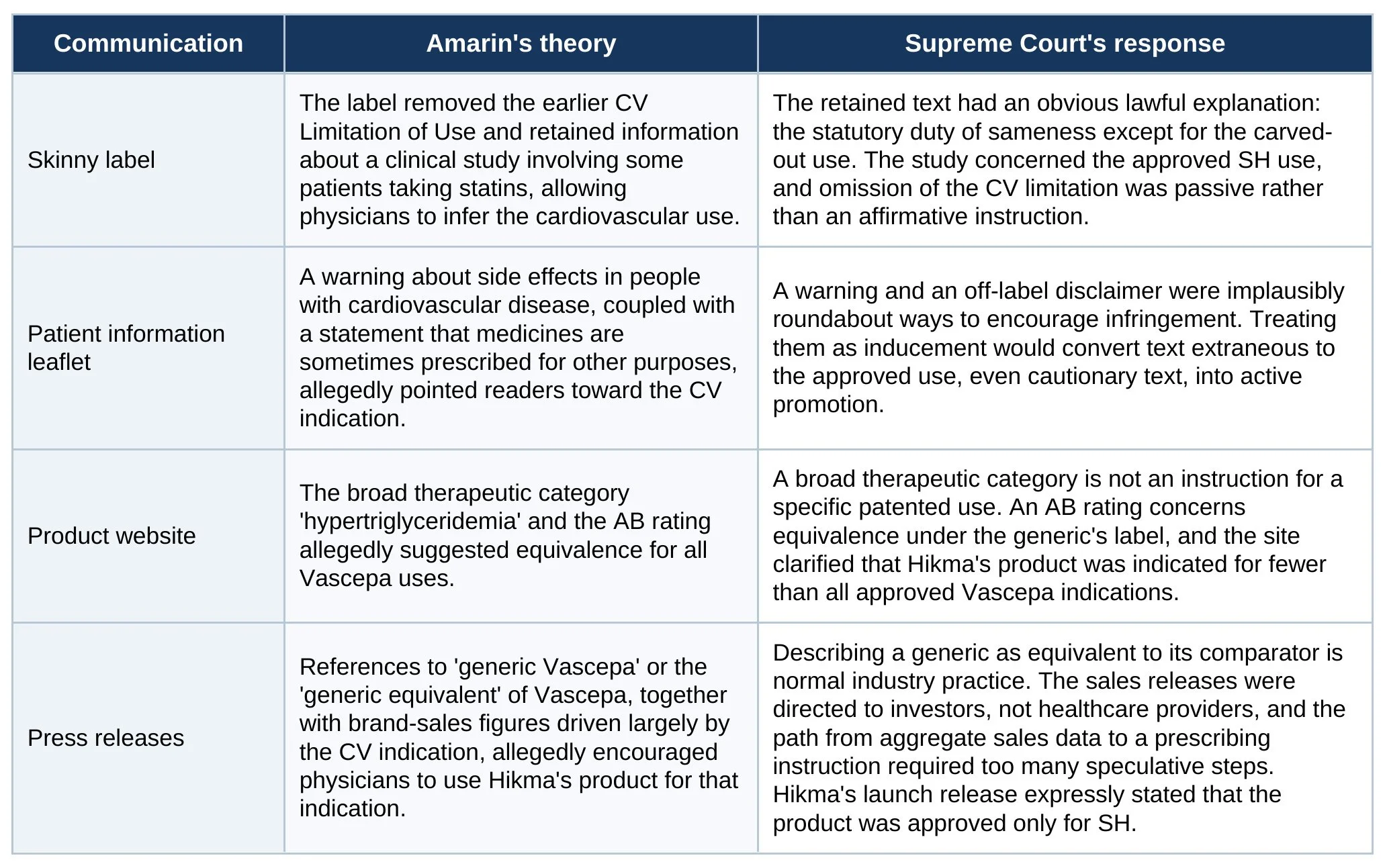
Amarin did not contend before the Supreme Court that Hikma's Indications and Usage section, standing alone, instructed the patented cardiovascular use. Instead, Amarin assembled what it viewed as a cumulative message from four categories of communications. The Court examined each category, and the alleged totality, through the lens of affirmative encouragement.
From the District Court to a Unanimous Supreme Court
· August 2021 - Magistrate judge recommendation. The magistrate judge concluded that Amarin had pleaded a plausible inducement claim based on the alleged totality of Hikma's label and public statements.
· January 2022 - District court dismissal. The District of Delaware declined to adopt the magistrate’s recommendation and granted Hikma's Rule 12(b)(6) motion, holding that neither the label nor the public statements plausibly alleged active steps to encourage the patented use. Amarin Pharma, Inc. v. Hikma Pharmaceuticals USA Inc., 578 F. Supp. 3d 642 (D. Del. 2022).
· June 2024 - Federal Circuit reversal. The Federal Circuit held that it was at least plausible that a physician could read the label, website, and press releases as an instruction or encouragement to prescribe generic icosapent ethyl for any approved Vascepa use. Amarin Pharma, Inc. v. Hikma Pharmaceuticals USA Inc., 104 F.4th 1370 (Fed. Cir. 2024), rev'd, 146 S. Ct. 1391 (2026).
· June 4, 2026 - Supreme Court decision. Justice Jackson, writing for a unanimous Court, held that the Federal Circuit had asked the wrong question and that Amarin failed to plead affirmative encouragement.
· July 15, 2026 - Federal Circuit remand. The Federal Circuit recalled its mandate, vacated its June 2024 opinion and judgment, reinstated the appeal, and remanded to the District of Delaware for proceedings consistent with the Supreme Court's decision.
The Supreme Court's Active-Steps Framework
The Three Elements Remain Distinct
The Court began with the familiar elements of induced infringement: (1) direct infringement by a third party; (2) knowledge that the induced acts constitute patent infringement; and (3) active steps to encourage the direct infringement. The case concerned only the third element. Hikma did not dispute before the Court that Amarin had plausibly pleaded direct infringement and specific intent.
That procedural point is easy to overlook but strategically important. Knowledge and intent cannot substitute for conduct. A manufacturer may understand that substitution will lead to use of its product for a patented indication and may know that such use would infringe. Without an affirmative act directed toward bringing that use about, however, the active-steps element remains unsatisfied.
'Designed to Stimulate' Is Narrower Than 'Could Stimulate'
The Federal Circuit had focused on whether physicians could read the challenged communications (e.g., label, website, and press releases) as instructions or encouragement. The Supreme Court held that this formulation diluted the word 'actively' in § 271(b). Drawing on Metro-Goldwyn-Mayer Studios Inc. v. Grokster, Ltd., 545 U.S. 913 (2005), the Court distinguished a communication designed to stimulate unlawful conduct from one that could, through inference, stimulate it. Only the former category supports active inducement.
The communication must be assessed in context, including its content, audience, and function. But a reader's possible interpretation is not enough. The plaintiff must plausibly connect an affirmative statement or action by the defendant to the objective of bringing about the infringing use.
Implicit Encouragement Remains Actionable
Hikma argued for a rule requiring express inducement. The Court rejected that position. A suggestive name, targeted solicitation, coordinated messaging, or another indirect communication can amount to inducement. The limiting principle is that, whether express or implicit, the encouragement must be clear to the relevant audience and affirmative. Audience understanding therefore remains relevant, but it is evidence of an inducing act - not a replacement for one.
Ordinary Commerce and Obvious Lawful Explanations Matter at the Pleading Stage
The Court integrated the active-steps requirement with the plausibility framework of Bell Atlantic Corp. v. Twombly, 550 U.S. 544 (2007), and Ashcroft v. Iqbal, 556 U.S. 662 (2009). A complaint must plead more than facts merely consistent with liability. Where the challenged conduct has an obvious lawful explanation, such as compliance with FDA's labeling rules or routine use of generic-equivalence terminology, the complaint must contain facts that make purposeful encouragement a plausible inference rather than speculation.
The Court also invoked Twitter, Inc. v. Taamneh, 598 U.S. 471 (2023), to emphasize that omissions, inaction, and nonfeasance are not affirmative steps. The point was not that context and silence are always irrelevant. Rather, a plaintiff cannot build the affirmative-conduct element of inducement out of what the defendant failed to say and then rely on a downstream audience to fill in the missing message.
Totality Still Matters - but Aggregation Cannot Create an Act
Amarin emphasized the totality of the label, website, leaflet, and press releases. The Supreme Court considered the allegations together as well as separately, but found no affirmative encouragement in either view. That does not make a totality analysis obsolete. A coordinated campaign may communicate an inducing message that no single statement conveys by itself. But adding several passive, legally required, or vague communications does not transform them into a purposeful promotional act.
Applying the Framework to Hikma
The Duty of Sameness Supplied an Obvious Alternative Explanation
Amarin argued that Hikma's label retained a clinical-study description involving statin use and omitted the earlier CV Limitation of Use. The Court treated the retained text as a consequence of the statutory duty of sameness: after carving out the patented indication, the generic label generally must match the brand label. It also emphasized that the referenced study involved patients with severe hypertriglyceridemia, the approved off-patent use.
The lesson is broader than this particular study. Where FDA requires shared safety, clinical, or administration text to remain in a skinny label, that regulatory explanation can defeat an inference that the text was included to promote the carved-out use. A patent owner will need additional facts showing that the generic affirmatively deployed the residual text as a promotional tool.
Standard Generic Terminology Was Not Purposeful Promotion
Hikma's prelaunch releases called its product 'generic Vascepa' and the 'generic equivalent' of Vascepa. The Court viewed those descriptions as ordinary and truthful industry terminology, not a coded instruction to prescribe for all Vascepa indications. The Court declined to place generic manufacturers in a position where adherence to conventional product terminology itself becomes evidence of illegal conduct.
The holding is contextual rather than talismanic. 'Generic equivalent' is not protected language regardless of surrounding facts. If the phrase appears in provider-directed promotion tied to the patented population, dosage, or clinical endpoint, it may form part of an affirmative message. Here, however, Amarin's complaint did not allege that kind of targeted use.
Omissions Could Not Carry the Inducement Theory
Two omissions were central to Amarin's theory: Hikma did not retain the former CV Limitation of Use, and some press releases did not foreground that the approved generic use was limited to the less familiar SH indication. The Court held that these omissions could not constitute active steps. Even if some readers might draw an improper inference by reading between the lines, § 271(b) requires affirmative conduct by the alleged inducer.
For pleadings, this means that a complaint should not define the inducing message primarily as the absence of a disclaimer, qualifier, or warning. The stronger theory will identify what the defendant said or did, to whom, and why that affirmative act was designed to prompt the claimed method.
The Leaflet and Website Were Too Indirect
The patient leaflet warned about potential effects in people with cardiovascular disease and noted that drugs are sometimes prescribed for purposes not listed in the leaflet. The Court characterized those statements as a warning and a disclaimer. Converting them into a message encouraging the patented CV indication would require an implausibly indirect chain of inference.
The website fared no better. Listing 'hypertriglyceridemia' as the therapeutic category was comparable, in the Court's analogy, to describing a leukemia drug as a 'cancer drug': a broad category does not instruct a particular use. The AB rating represented equivalence under the conditions of the generic label, not equivalence for an unapproved off-label use. And the website expressly stated that Hikma's generic was indicated for fewer than all approved uses of Vascepa.
Investor-Facing Sales Figures Required Too Many Inferential Steps
The press releases included Vascepa sales figures attributable to both indications, and Amarin alleged that the CV indication accounted for most of those sales. But the releases were directed to investors. To derive an inducing message, a healthcare provider would have to locate the releases, understand the composition of the reported sales, infer that Hikma sought sales beyond its approved indication, and translate that inference into a prescribing decision. The Court regarded that chain as possible but not plausible.
Investor communications are not automatically outside § 271(b), and provider communications are not automatically inducing. The relevant inquiry is whether the communication, in context, is directed toward stimulating the infringing conduct. Hikma's launch release also expressly stated that the product was approved only for SH and not for any other Vascepa indication, further weakening Amarin's theory.
What Does Hikma Mean for GSK v. Teva?
The most consequential doctrinal passage may be footnote 3. The Court observed that the Federal Circuit had increasingly focused on whether challenged statements could be read by healthcare providers as instructions to infringe, citing GlaxoSmithKline LLC v. Teva Pharmaceuticals USA, Inc., 7 F.4th 1320, 1336-37 (Fed. Cir. 2021). It then stated that it rejected that trend and emphasized the need to ask whether the defendant actively encouraged infringement through its statements.
The Court did not formally overrule GSK, and the records differ. GSK followed a jury trial and involved a carved label and marketing evidence that the Federal Circuit viewed as affirmatively promoting the branded drug for uses that overlapped the patented method. Hikma arose on a motion to dismiss, and all parties agreed that Hikma's label standing alone did not induce infringement. Those distinctions leave room for inducement findings on more direct records.
Future plaintiffs cannot prevail merely by showing that a physician could read residual label language or an equivalence statement as encouragement. They must show that the defendant's own affirmative conduct was designed - expressly or implicitly - to stimulate the patented use. Future courts applying GSK will need to separate the result supported by that record from the reader-centric formulation the Supreme Court has now rejected.
In our opinion, Hikma does not end skinny-label inducement litigation. It narrows it to cases with a discernible promotional act: a label that actually directs the claimed use, provider-facing materials tied to the patented population or regimen, sales training or detailing aimed at the carved-out indication, responses that guide providers to the patented use, or another coordinated message that is clear and affirmative. Whether any particular conduct satisfies the standard will remain intensely fact dependent.
The Boundary the Court Drew
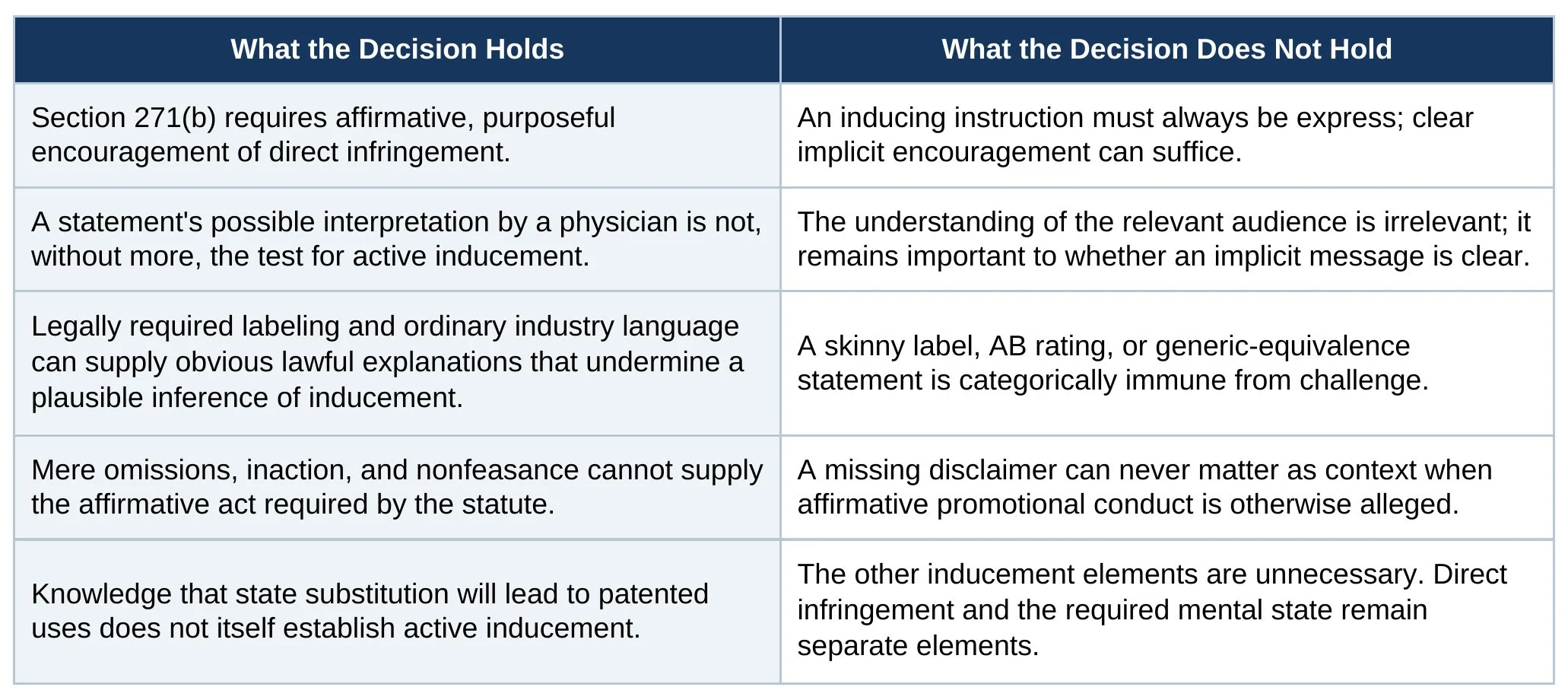
The decision is easiest to apply by distinguishing the propositions the Court adopted from broader rules it did not announce:
Strategic Implications for Generic Manufacturers
Audit Every Communication Channel, Not Just the Label
A compliant skinny label is essential, but it is not the end of the analysis. The complaint in Hikma reached across the patient leaflet, product website, launch communications, investor releases, and therapeutic-category descriptions. Generic manufacturers should conduct a coordinated review involving regulatory, medical, legal, commercial, investor-relations, and digital teams before approval and launch.
The review should ask whether each communication accurately describes the approved indication, whether references to the brand product are necessary and conventional, whether an AB-rating statement is presented in its as-labeled context, and whether the overall message could be understood as affirmatively promoting a carved-out use. Website metadata, downloadable materials, speaker decks, reimbursement tools, formulary submissions, call-center scripts, and responses to medical inquiries should be included where relevant.
Use Clarifying Language Consistently - but Do Not Treat Disclaimers as Magic Words
Hikma's website stated that its generic was indicated for fewer than all approved Vascepa indications, while its launch release stated that the product was approved only for SH and not for any other Vascepa indication. Those statements supported the lawful explanation for its communications. Consistent, prominent indication-limiting language can therefore be valuable, especially in launch materials and provider-facing content.
A disclaimer is not an automatic safe harbor. A company cannot affirmatively target a patented patient population or regimen and expect boilerplate to erase the campaign's message. The objective is substantive alignment: the label, website, sales strategy, medical communications, and public statements should all point in the same use-limited direction.
Document the Lawful Purpose Behind Residual Label Text and Standard Terminology
Because Hikma gives weight to obvious lawful explanations, contemporaneous records can be important. Regulatory correspondence may show why shared text had to remain. Internal review memoranda can explain why 'generic equivalent' or similar terminology was used and how the company limited the statement to approved uses. Training materials can show that commercial personnel were instructed not to promote the carved-out indication. These records may become central if a patent owner later alleges that ordinary distribution activity masked an inducing purpose.
Keep the Relevant Audience in View
The Court emphasized that Hikma's sales releases were directed to investors rather than physicians or pharmacists. Audience does not categorically resolve inducement, but it affects the plausibility of a promotional inference. Provider-directed communications, formulary presentations, and reimbursement support may receive closer scrutiny than general investor disclosures. Companies should tailor review intensity to both the content and the audience.
Strategic Implications for Brand Companies and Patent Owners
Plead the Affirmative Act with Particularity
After Hikma, a successful complaint should identify the affirmative statement or action, the relevant audience, the patented use it allegedly promotes, and the reason the act was designed to bring that use about. It is no longer enough to allege that physicians could combine scattered facts and infer encouragement. The complaint should explain what the defendant communicated, how the communication reached those positioned to perform the claimed method, and why the message is promotional rather than merely descriptive or legally required.
Potentially probative facts may include indication-specific provider materials, dosage or monitoring instructions matching the claims, sales training directed to the carved-out population, incentives tied to use beyond the approved indication, responses to provider questions that affirmatively guide the patented method, or coordinated communications that make the intended use clear. These examples are not categorical rules; their significance will depend on the claims, the message, and the surrounding record.
Do Not Collapse Intent and Conduct
Amarin was permitted, for purposes of Supreme Court review, to proceed on the premise that direct infringement and specific intent had been plausibly pleaded. The claim still failed because the active-step allegations were insufficient. Patent owners should therefore organize the complaint element by element. Evidence that the generic knew of substitution, the patent, or the commercial value of the carved-out indication may support intent, but it does not identify the inducing act.
Invest in Pre-Suit Investigation
The decision increases the importance of obtaining concrete promotional facts before filing. Public websites, archived launch pages, payer materials, conference presentations, product catalogs, job postings, investor calls, medical-information content, and other lawfully available sources may reveal affirmative conduct.
Align Patent and Regulatory Strategy Earlier
Method-of-use protection is strongest when the claimed use corresponds to label language that can be identified, listed, and defended as a discrete regulatory use. During prosecution and Orange Book planning, counsel should examine whether the patented patient population, regimen, endpoint, or combination can be cleanly distinguished from unpatented uses. A claim whose infringement depends on shared safety text or a broad therapeutic category may be harder to enforce against a properly carved label after Hikma.
Where the disclosure supports it, applicants should consider layered claim strategies directed to named combinations, dosage regimens, formulations, patient subgroups, biomarkers, and other commercially relevant features. Not every claim type will be Orange Book listable or equally enforceable, but portfolio diversity can reduce reliance on a single inducement theory tied to a carve-out that FDA permits.
Litigation and Due-Diligence Implications
Build a Communication-to-Claim Map
In litigation and transactional diligence, practitioners should map each alleged communication against the steps of the asserted claim. Which limitation does the communication encourage? Who receives it? Does it address the patented population, dose, combination, timing, or therapeutic result? Is the content required by FDA, conventional in the industry, or affirmatively added by the company? This disciplined mapping helps distinguish an actual inducing message from a collection of facts that merely make infringement foreseeable.
Reassess Existing GSK-Based Theories
Pending and threatened cases that rely heavily on GSK should be revisited. Arguments framed around how physicians could read a label or equivalence statement should be recast around affirmative conduct and promotional design. The same is true in portfolio diligence: an enforcement opinion that assumes any residual reference to a patented use defeats a skinny label is no longer reliable without a separate active-steps analysis.
Key Takeaways
1. The 'could be read' formulation is not the governing test. The question is whether the defendant took affirmative steps to encourage infringement, not whether a provider might infer it.
2. Active conduct is separate from knowledge and intent.Foreseeable substitution and knowledge of off-label use do not substitute for an affirmative inducing act.
3.Required and ordinary communications receive meaningful breathing room.The sameness duty, an AB rating, and conventional generic-equivalence language can support obvious lawful explanations.
4.Omissions cannot do the statute's work. Failure to retain a limitation or emphasize a narrow approval is not itself active inducement.
5. Implicit inducement survives. The message need not be express, but it must be clear, affirmative, and plausibly designed to stimulate the patented use.
This post was written by Lisa Mueller.