Chemical Name, Formula, and Crystallinity Were Enough: Federal Circuit Upholds Cabometyx® Salt-Genus Claims in Exelixis v. MSN
Introduction
On August 31, 2026, the U.S. Court of Appeals for the Federal Circuit issued a precedential opinion in Exelixis, Inc. v. MSN Laboratories Private Ltd., No. 2025-1236 (Fed. Cir. Aug. 31, 2026). Judge Stoll, writing for a unanimous panel, affirmed the District of Delaware's finding that claims in three related Cabometyx® patents satisfied the written-description requirement of 35 U.S.C. § 112(a).
The decision protects a strategically important layer of Exelixis's cabozantinib portfolio. The common specification expressly described two crystalline forms, N-1 and N-2, but the asserted claims were not limited to either form. They covered crystalline cabozantinib (L)-malate more broadly. MSN used a different crystalline form, Form S, and had obtained its own patent on that form, yet it conceded infringement of the broader Malate Salt Patent claims (discussed below) and attacked them instead for lack of written description.
The Federal Circuit rejected that challenge. Applying Ariad Pharmaceuticals, Inc. v. Eli Lilly & Co., 598 F.3d 1336 (Fed. Cir. 2010) (en banc), and GlaxoSmithKline LLC v. Banner Pharmacaps, Inc., 744 F.3d 725 (Fed. Cir. 2014), the panel held that the district court did not clearly err in finding that the chemical name and formula of cabozantinib (L)-malate, together with the requirement that the material be crystalline, supplied common structural features by which a skilled artisan could recognize the claimed genus.
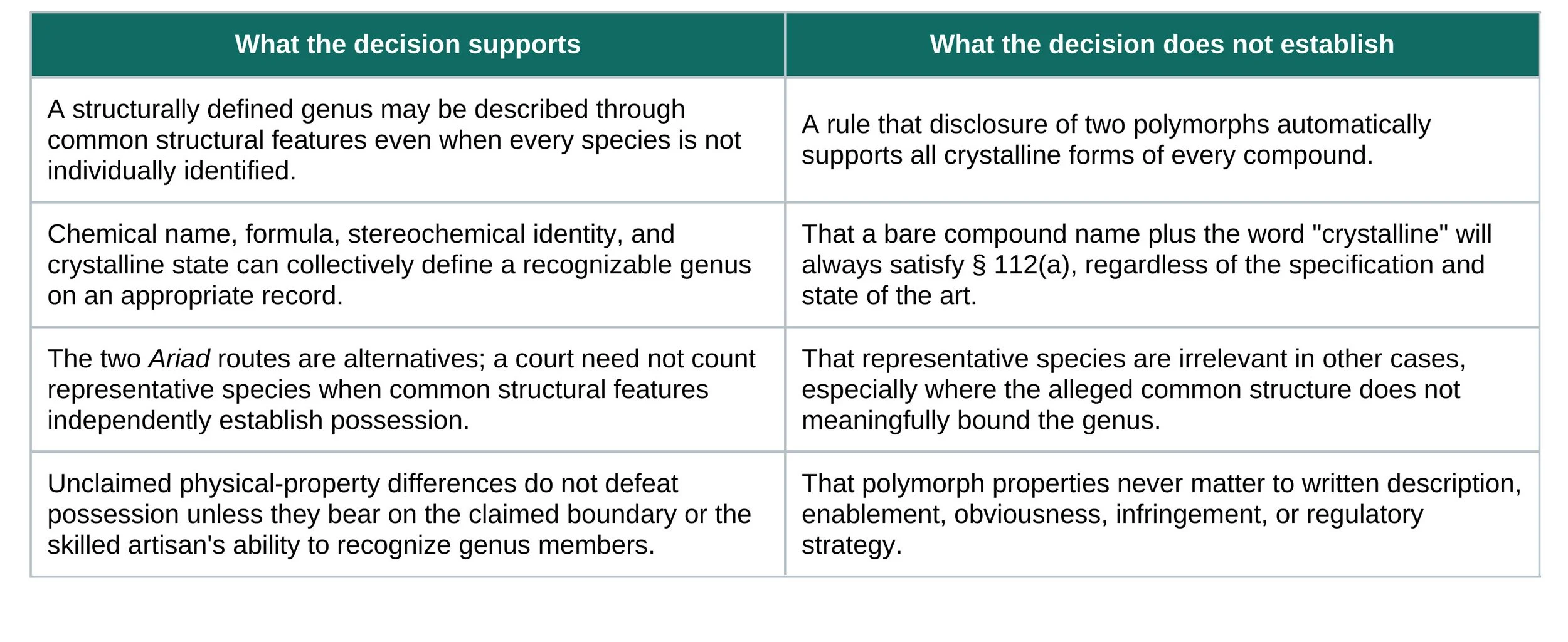
The holding is meaningful, but it is also carefully bounded. Exelixis is not a rule that disclosure of two polymorphs always supports every crystalline form of a compound. The disputed genus was structurally defined rather than functionally bounded; the district court found that it had a limited potential size; the specification described ways to prepare the material; and the appeal followed a bench trial, so the Federal Circuit reviewed the underlying written-description findings of fact only for clear error.
The opinion also contains a separate appellate lesson. The court dismissed as moot MSN's validity appeal involving a fourth patent after Exelixis abandoned its cross-appeal from noninfringement. Because Exelixis's unilateral action prevented review of the adverse validity ruling, the Federal Circuit vacated the district court's nonobviousness judgment for that claim.
Cabometyx®, Cabozantinib Salts, and the Solid-State Problem
Exelixis holds the New Drug Application for Cabometyx®, a tablet containing the active pharmaceutical ingredient cabozantinib (L)-malate. Cabometyx® is indicated to treat kidney, liver, and differentiated thyroid cancer. In the early 2000s, Exelixis evaluated free-base cabozantinib and then partnered with a research organization to conduct a salt screen for commercial development.
In solid-state chemistry, a single salt can exist as amorphous material or in one or more crystalline forms. In an amorphous salt, the molecules lack a regular long-range arrangement; in a crystalline salt, they form a regular repeating array. Different crystalline arrangements of the same compound are known as polymorphs. Those polymorphs share the same chemical name and formula, but they can differ in density, melting point, solubility, hygroscopicity, vapor pressure, stability, and other physical properties.
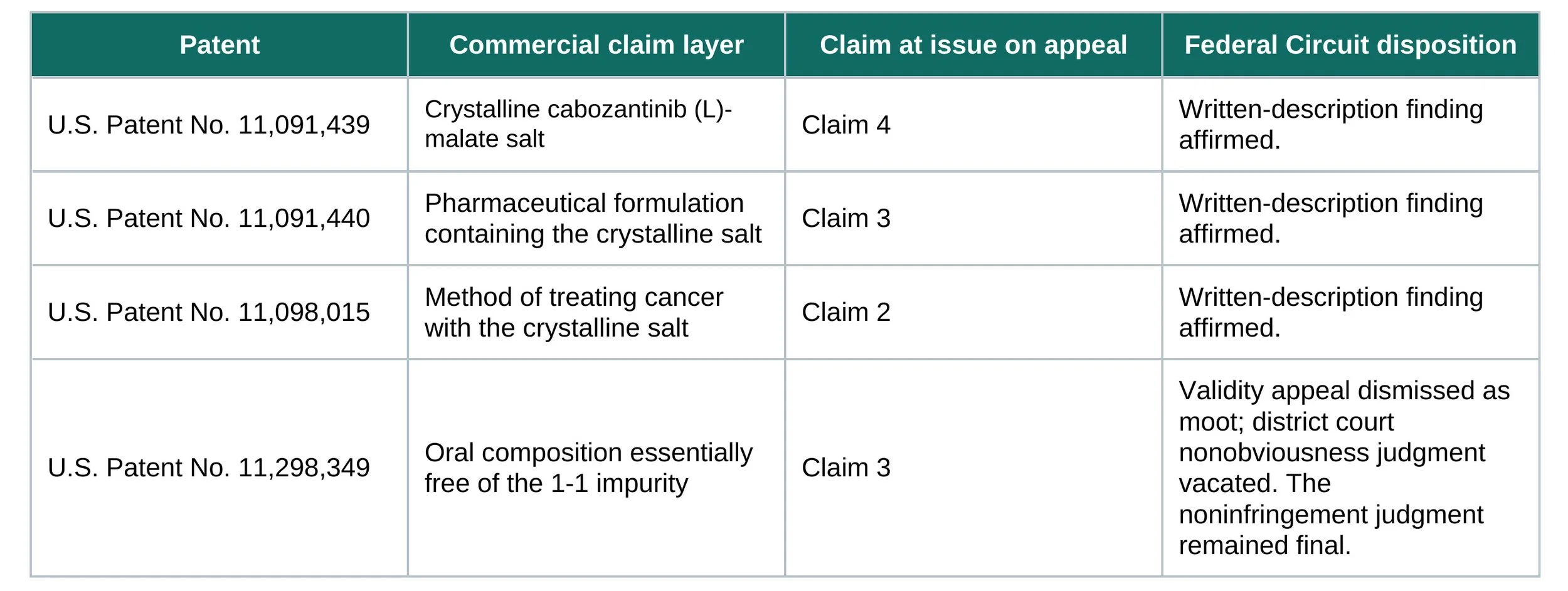
Exelixis reported to FDA in 2015 that cabozantinib (L)-malate existed in two closely related crystalline forms, N-1 and N-2, and that it had not identified other crystalline forms. Exelixis obtained U.S. Patent Nos. 8,877,776 and 9,809,549 on N-2 and N-1, respectively. It later obtained the three patents at the center of the written-description appeal—U.S. Patent Nos. 11,091,439, 11,091,440, and 11,098,015 (collectively, the “Malate Salt Patents”)—which share the same specification and claim crystalline cabozantinib (L)-malate at different commercial layers.
Each of those three patents is subject to a terminal disclaimer tied to the term of the earlier ’776 patent, which the opinion states expires in 2030. That family structure is important. The portfolio included narrow claims to identified forms, broader claims to the crystalline salt genus, formulation claims, and treatment claims. MSN's Form S therefore presented the classic blocking-patent scenario: a later party may obtain a patent on a particular improvement or species and still fall within an earlier party's broader genus claim.
The Patents and Appellate Disposition
The Representative Claims
The Federal Circuit treated dependent claim 4 of the ’439 patent as illustrative of the written-description dispute and reproduced its dependency chain. Read together, claims 1, 3, and 4 claim crystalline cabozantinib (L)-malate without limiting the salt to the disclosed N-1 or N-2 form:
1. N-(4-{[6,7-bis(methyloxy)quinolin-4-yl]oxy}phenyl)-N'-(4-fluorophenyl) cyclopropane-1,1-dicarboxamide, malate salt, wherein said salt is crystalline.
3. The N-(4-{[6,7-bis(methyloxy)quinolin-4-yl]oxy}phenyl)-N'-(4-fluorophenyl) cyclopropane-1,1-dicarboxamide, malate salt according to claim 1, wherein said salt is the (L)-malate salt or (D)-malate salt.
4. The N-(4-{[6,7-bis(methyloxy)quinolin-4-yl]oxy}phenyl)-N'-(4-fluorophenyl) cyclopropane-1,1-dicarboxamide, malate salt according to claim 3, wherein said salt is the (L)-malate salt.
The claim architecture framed the dispute. Every member of the claimed genus had to satisfy three structural boundaries: it had to be the identified cabozantinib compound, it had to be paired with malate in the specified stereochemical form, and it had to be crystalline. The claims did not require a particular polymorph, diffraction pattern, melting point, stability profile, or therapeutic-performance property for the crystal form itself.
Independent Claim 3 of the ’349 Patent
Because the appeal involved a separate impurity-control patent, the Federal Circuit also reproduced asserted claim 3 of the ’349 patent, which recites:
3. A pharmaceutical composition for oral administration comprising Compound IB;
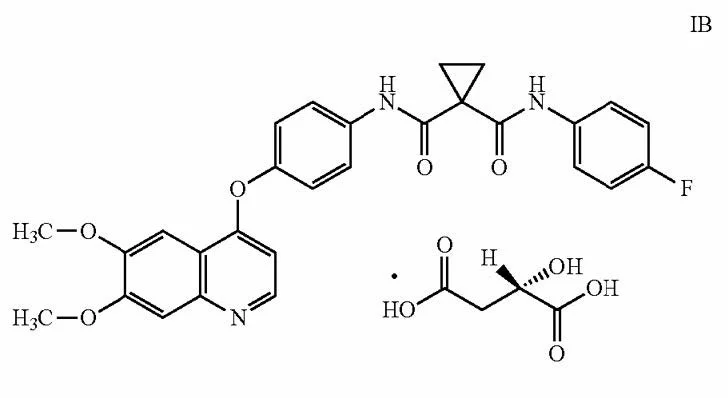
one or more fillers; one or more disintegrants; one or more glidants; and one or more lubricants,
wherein the pharmaceutical composition is a tablet or capsule pharmaceutical composition; and
wherein the pharmaceutical composition is essentially free of 6,7-dimethoxy-quinoline-4-ol.
The specification defines "essentially free" as 200 ppm or less of the 1-1 impurity. This claim belongs to a different branch of the portfolio and did not present the crystalline-salt written-description issue. Instead, it framed the separate infringement, inherency, mootness, and vacatur issues discussed later in the opinion.
From ANDA Filing to Federal Circuit Appeal
In August 2019, MSN submitted ANDA No. 213878 seeking approval for generic cabozantinib (L)-malate tablets. MSN used Form S of cabozantinib (L)-malate and had obtained its own patent covering that form. Exelixis filed two actions in the District of Delaware, which were consolidated for a bench trial before Judge Richard G. Andrews.
· Malate Salt Patents. MSN conceded infringement of the asserted claims but argued that claims 4, 3, and 2 of the ’439, ’440, and ’015 patents, respectively, lacked written-description support because the specification specifically described N-1 and N-2 rather than every possible crystalline form.
· The ’349 impurity patent. MSN disputed both infringement and validity of claim 3, which required an oral tablet or capsule composition essentially free of 6,7-dimethoxy-quinoline-4-ol, known as the 1-1 impurity. The specification defined "essentially free" as 200 ppm or less.
The district court held the Malate Salt Patent claims infringed and not invalid. It found that the common specification identified the structural features of the crystalline cabozantinib (L)-malate genus and that a skilled artisan could distinguish crystalline material from amorphous material. The court also noted that the specification disclosed processes for preparing both crystalline and amorphous cabozantinib malate.
For the ’349 patent, the district court held claim 3 not infringed and not invalid. MSN's inherency theory relied on a prior-art process disclosed in International Patent Application Publication No. WO 2010/083414 (“Brown”). The district court found that MSN had not shown that Brown necessarily produced material containing 200 ppm or less of the 1-1 impurity, in part because MSN had not shown that the three relied-upon API batches were made by the Brown process.
MSN appealed the no-invalidity rulings. Exelixis initially cross-appealed the ’349 noninfringement judgment but dismissed that cross-appeal before briefing. That procedural choice became decisive for the fourth patent, as discussed below.
The Federal Circuit's Written-Description Analysis
Ariad Means Either Representative Species or Common Structural Features
The Federal Circuit began with the familiar Ariad framework. A genus can be adequately described in either of two ways: the specification may disclose a representative number of species, or it may disclose structural features common to genus members that allow a skilled artisan to visualize or recognize them. A precise definition can be supplied through structure, formula, chemical name, physical properties, or other distinguishing properties.
That disjunctive formulation mattered. MSN focused heavily on whether N-1 and N-2 were representative of every crystalline cabozantinib (L)-malate form. The Federal Circuit held that the district court did not need to reach the representative-species route because it had permissibly relied on the alternative common-structural-features route. This is one of the opinion's most useful practice points: a challenger cannot collapse Ariad's two routes into a single requirement that every genus must be justified by a representative-species count.
The Chemical Identity and Crystalline State Supplied the Boundary
The panel found no clear error in the district court's conclusion that the chemical name and formula of cabozantinib (L)-malate, plus the requirement that the material be crystalline, identified structural features possessed by all members of the claimed genus. A skilled artisan could determine whether a candidate material had the specified chemical identity and could distinguish a crystalline material from an amorphous one.
The court also emphasized claim-to-disclosure fit. The specification described cabozantinib malate, expressly identified crystalline forms as an aspect of the disclosure, stated that each form was a separate aspect, and provided six examples for preparing crystalline and amorphous material. The asserted genus claims did not reach a different salt, a free base, an amorphous form, or an unidentified compound. In the panel's formulation, what was claimed was no broader than the crystalline cabozantinib (L)-malate described in the specification.
The disclosed preparation processes were supportive but not dispositive. The court did not hold that a method for generating candidate polymorphs automatically proves possession of every result. Rather, the processes reinforced a record in which the genus already had an objective structural identity.
GSK Was the Closest Analogy
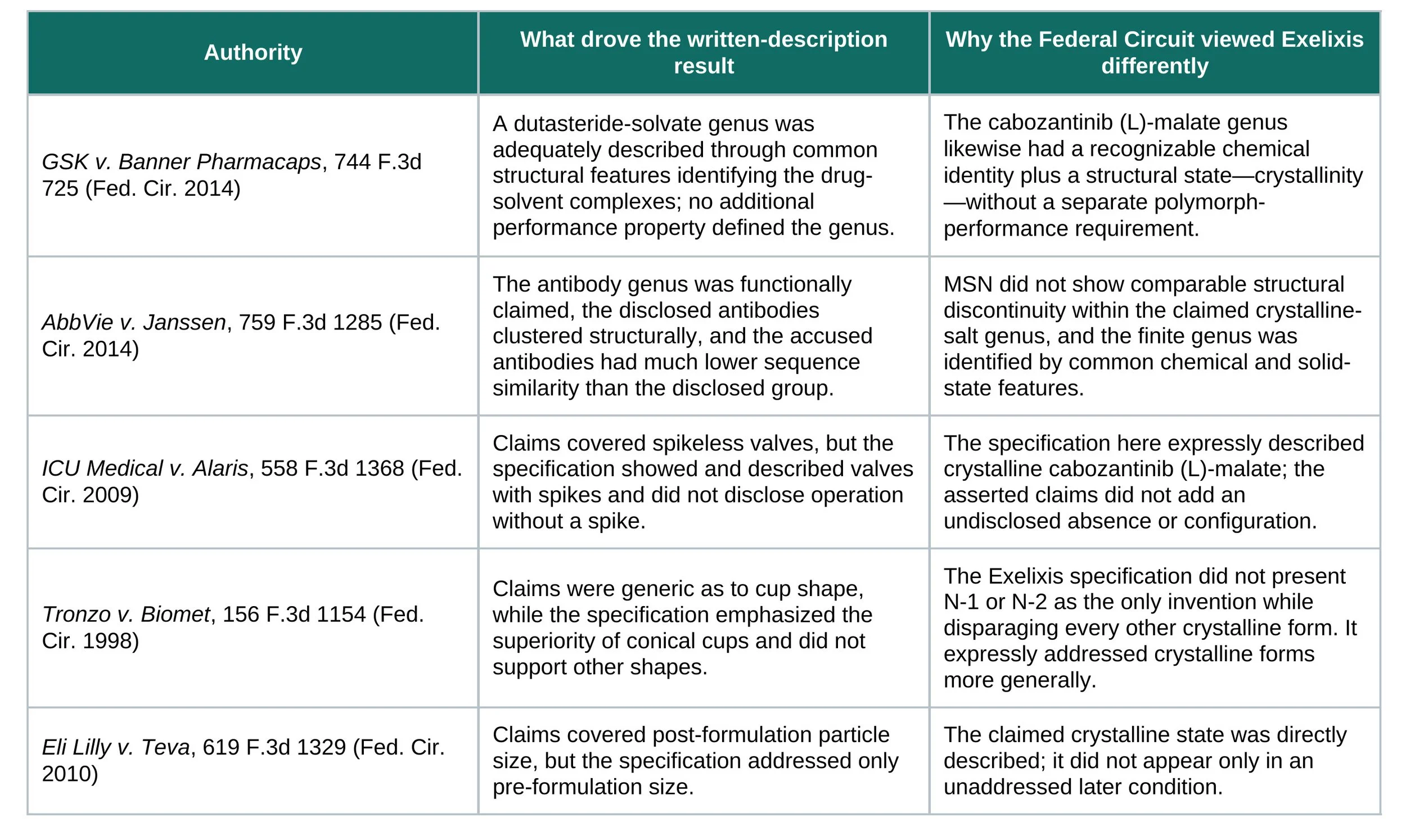
The district court and Federal Circuit treated GlaxoSmithKline LLC v. Banner Pharmacaps, Inc., 744 F.3d 725 (Fed. Cir. 2014), as the closest precedent. GSK involved a genus of dutasteride solvates. The court there concluded that describing the complex formed by dutasteride and solvent molecules identified structural features common to the genus and allowed skilled artisans to recognize its members.
The key similarity was that the disputed genus boundary was structural, not a demand that every member achieve a separately stated performance result. In Exelixis, the claimed crystal form did not have to meet a particular stability, solubility, melting-point, or bioavailability threshold. The structural category itself did the boundary work.
Unclaimed Property Differences Did Not Redefine the Genus
MSN argued that N-1 and N-2 could differ from other polymorphs in density, melting point, solubility, hygroscopicity, vapor pressure, and stability. The panel did not dispute that polymorphs can have different properties. Instead, it asked why those differences mattered to the claim actually written.
They did not. The listed properties were not claim limitations, and the district court had not used the shared properties of N-1 and N-2 to extrapolate to other forms. It used the chemical identity and crystalline structure to define membership. Because MSN did not connect the property differences to an inability to identify members of that structural genus, those differences did not establish clear error.
This point should not be overread. Property differences can be central when a claim requires a specified dissolution profile, stability threshold, purity, bioavailability, particle-size behavior, or other performance result. Exelixis teaches that differences outside the claim boundary do not defeat written description merely because they are scientifically important.
Genus Size and Appellate Posture Narrow the Holding
Two contextual features limit the opinion's reach. First, the district court found—and MSN did not challenge—that the maximum potential size of the pure-polymorph genus at issue was fourteen forms. The Federal Circuit contrasted that finite setting with cases involving potentially vast numbers of species. The panel did not announce a numerical safe harbor, but genus size plainly influenced why the case did not present the same possession concerns as broad functional antibody claims.
Second, written description is a question of fact. Because the ruling followed a bench trial, the Federal Circuit reviewed the district court's factual findings for clear error. The panel therefore asked whether the trial court had made a definite mistake on the record, not whether the appellate judges would have made every finding identically in the first instance. Practitioners should treat the result as meaningful precedent on the governing framework while recognizing that its application remains record dependent.
Structural Claims Did Not Receive a Lower Legal Standard
MSN argued that the district court had effectively applied a relaxed written-description standard to structural claims and a more rigorous one to functional claims. The Federal Circuit disagreed. It read the district court as applying the same statutory requirement while recognizing a practical reality already reflected in Ariad: a vast genus bounded by function can be more difficult to describe because the function may sweep together structurally diverse and unpredictable species.
That distinction is important after Amgen Inc. v. Sanofi, 598 U.S. 594 (2023), and the Federal Circuit's functional-genus cases. Exelixis does not provide an escape from the demanding disclosure requirements applicable to claims defined by what members do. It addresses a genus defined by what the material is, a specified chemical salt in crystalline form, and supported by a record showing that skilled artisans could recognize that class.
Why the Comparison Cases Came Out Differently
The Separate ’349 Patent Issue: Mootness and Vacatur
The opinion's second half concerns a different patent and a different doctrine. Claim 3 of the ’349 patent required an oral tablet or capsule composition containing Compound IB and conventional excipient categories, with the composition essentially free of the genotoxic 1-1 impurity. The district court found claim 3 not infringed and not invalid, rejecting MSN's argument that Brown inherently produced the claimed low-impurity composition.
Under Cardinal Chemical Co. v. Morton International, Inc., 508 U.S. 83 (1993), a validity controversy does not automatically disappear whenever a court finds noninfringement. Here, however, Exelixis dismissed its cross-appeal from the noninfringement judgment, making that judgment final. MSN then acknowledged that it no longer had an Article III controversy supporting appellate review of validity.
Exelixis argued that the validity ruling could have collateral consequences in separate litigation involving U.S. Patent No. 12,128,039, a continuation of the ’349 patent. The Federal Circuit found those consequences too speculative. The ’039 claims did not include the limitation on which the ’349 noninfringement ruling had rested, and potential collateral effects alone were insufficient to create standing.
The remaining question was what to do with the unreviewed district court judgment of nonobviousness. Applying United States v. Munsingwear, Inc., 340 U.S. 36 (1950), and U.S. Bancorp Mortgage Co. v. Bonner Mall Partnership, 513 U.S. 18 (1994), the panel ordered vacatur. Exelixis, the party that had prevailed below, unilaterally dismissed the cross-appeal and thus prevented MSN from obtaining merits review. Vacatur removed the unreviewed nonobviousness judgment and cleared the path for future litigation of the issue.
The court did not decide whether Brown inherently disclosed the 200-ppm impurity limitation. The correct description of the disposition is therefore narrow: the validity appeal was dismissed as moot, and the district court's nonobviousness judgment was vacated. The noninfringement judgment, which Exelixis no longer challenged, remained final.
The Boundary the Court Drew
Strategic Implications for Patent Drafting and Prosecution
For Salt and Polymorph Applications: Define the Structural Genus Expressly
The strongest feature of the Exelixis record was not simply that the inventors had made N-1 and N-2. The specification supplied an express structural genus: cabozantinib (L)-malate in crystalline form. For future applications, practitioners should identify the genus in the specification with the same precision they expect to use in the claims.
· State the chemical identity completely. Specify the active compound, counterion, stoichiometry, stereochemistry, hydration or solvation status, and any other feature intended to bound the genus.
· Explain how genus membership is recognized. Depending on the technology, the specification may discuss powder X-ray diffraction, differential scanning calorimetry, thermogravimetric analysis, solid-state NMR, spectroscopy, microscopy, or another technique by which skilled artisans distinguish crystalline, amorphous, solvated, hydrated, and polymorphic forms.
· Separate genus-defining features from optional properties. If stability, solubility, dissolution, hygroscopicity, melting point, purity, or bioavailability is intended to limit the claim, define and support that property. If it is merely an advantage of selected embodiments, avoid language suggesting that every genus member must possess it.
· Disclose preparation routes and analytical confirmation. The Federal Circuit treated preparation processes as supportive rather than dispositive. Multiple routes, seeding conditions, solvents, temperatures, drying protocols, and characterization data can strengthen the possession record and provide fallback positions.
· Do not rely on a species count alone. There is no two-polymorph safe harbor. The relevant question is whether the disclosure, read through the knowledge of a skilled artisan, demonstrates possession of the claimed boundary.
For Continuation and Lifecycle Strategy: Layer Species, Genus, Formulation, and Use Claims
The Exelixis family illustrates the value of layered claim architecture. Specific N-1 and N-2 patents protected identified forms; later patents claimed the crystalline salt genus, pharmaceutical formulations, and methods of treatment. That structure preserved a route to infringement even when a generic developer selected a different patented polymorph.
A continuation strategy should therefore evaluate at least four levels of protection: claims to characterized species; claims to a structurally defined solid-form genus; formulation claims that capture the commercial dosage form; and method claims tied to approved or clinically important uses. Each layer should be assessed independently for written description, enablement, prior art, obviousness-type double patenting, and enforceability. Terminal disclaimers may align expiration and common ownership, but they do not cure disclosure defects and can affect transfer and enforcement planning.
The case also reinforces a familiar but commercially important distinction: a patent on a later species does not create freedom to operate under an earlier genus patent. Licensing and diligence teams should map both directions—whether a later-developed form is independently patentable and whether practicing it still requires rights under broader blocking claims.
For Prosecuting Broad Structural Claims: Build the Ariad Record
When an examiner argues that a genus lacks enough representative examples, the response should identify which Ariad route the application satisfies. If common structural features are the stronger route, practitioners should map each claim boundary to the specification and explain how a skilled artisan recognizes genus members. Declarations can be useful when they address the art's ability to identify the class, the finite or predictable nature of the genus, and the analytical tools available at the filing date.
At the same time, Exelixis should not be cited as though structural language is self-validating. The applicant still must show possession in the four corners of the specification, viewed from the skilled artisan's perspective. A generic statement that "all forms are contemplated" is unlikely to do the work that the detailed chemical identity, crystallinity disclosure, examples, and preparation teachings performed here.
Strategic Implications for Litigation, Post-Grant, and Appeals
For Patent Owners: Tie the Defense to the Claim Boundary
The patent owner's written-description story should begin with the claim. Identify the features that place a candidate species inside or outside the genus, then show where the specification describes those features and how the skilled artisan would apply them. Exelixis succeeded because the district court could articulate a clean boundary: chemical identity plus crystalline structure.
Patent owners should also preserve favorable fact findings with expert testimony directed to recognizability, genus size, and the state of analytical science. Because written description is factual, the standard of review can become outcome determinative after trial.
For Challengers: Scientific Difference Is Not Enough Without Claim Relevance
MSN identified real scientific differences among polymorphs, but the panel found the argument disconnected from the claimed genus. A stronger challenge must explain why the differences prevent skilled artisans from recognizing members, reveal a structural discontinuity that the specification does not possess, or show that the claim includes subject matter the specification affirmatively excludes or never addresses.
In functional-genus cases, property and performance variation may be central because the function is the boundary. In structural-genus cases, a challenger should focus on whether the alleged common structure is sufficiently precise, whether the genus includes materially different categories that cannot be visualized from the disclosure, and whether the specification actually describes the claimed state or only a narrower subset.
For Appeal Planning: Coordinate Infringement and Validity Issues
The ’349 portion of the opinion is a reminder that appellate jurisdiction turns on a live controversy, not on the parties' preference for an advisory validity ruling. A patent owner considering dismissal of a noninfringement cross-appeal should evaluate whether that decision will moot the accused infringer's validity appeal and whether vacatur may erase a favorable district court judgment.
The potential effect on related continuation litigation was not enough here. Parties relying on collateral consequences should identify a concrete, non-speculative injury and explain how the appealed judgment will affect the live dispute. Differences in claim language between parent and continuation patents can be decisive.
Broader Significance
Exelixis is a welcome reminder that genus claiming is not monolithic. The disclosure needed for a vast functional antibody genus is not necessarily the disclosure needed for a finite genus bounded by a fixed chemical identity and an objectively recognizable solid-state characteristic. Section 112(a) remains contextual: the nature of the invention, the claim boundary, the predictability of the art, and the skilled artisan's ability to recognize members all matter.
The decision is a reminder that a court may rely on common structural features without conducting a representative-species count. It also confirms that unclaimed differences do not automatically undermine possession. However, it does not weaken Ariad, AbbVie, Amgen, or other decisions demanding more where functional language sweeps across structurally diverse or unpredictable territory.
For pharmaceutical portfolios, the most practical message is that solid-form drafting should be intentional from the beginning. The application should not merely catalogue the forms currently in hand. It should explain the broader structural categories the inventors possess, the methods by which those categories are recognized and made, and the fallback species and property combinations that preserve value if the broadest genus later narrows.
Key Takeaways
1. Ariad provides alternative routes. A genus may be described through a representative number of species or through common structural features that allow skilled artisans to recognize its members. The district court did not need to conduct a separate representative-species analysis once the structural route was satisfied.
2. The claim boundary drove the result. Chemical name, formula, stereochemical identity, and crystallinity defined the disputed genus. The claims did not require every polymorph to share a particular stability, solubility, melting point, or other performance property.
3. Two examples were not a magic number. N-1 and N-2 supported the record, but the decision does not create a rule that two polymorphs always describe an entire crystalline genus. The finite genus, preparation teachings, skilled-artisan evidence, and clear-error posture all mattered.
4. Unclaimed differences must be tied to possession. A challenger should explain why species differences undermine the skilled artisan's ability to identify the claimed class or expose undisclosed subject matter. Scientifically important differences are not enough when the claim does not invoke them.
5. Structural and functional genera remain different in practice. The Federal Circuit did not apply a lower statutory standard. It recognized that functionally bounded genera can require more disclosure because they may encompass structurally diverse and unpredictable members.
6. Layered family claims can have real blocking value. Claims to specific polymorphs, a structural genus, formulations, and therapeutic methods can protect different commercial layers. A later patent on a new polymorph does not provide freedom to operate under an earlier genus patent.
7. Appeal choices can determine whether validity judgments survive. Exelixis's dismissal of its noninfringement cross-appeal mooted MSN's validity appeal for the ’349 patent and led the Federal Circuit to vacate the district court's nonobviousness judgment.