Teva v Lilly After Denial of Rehearing En Banc

Introduction
Since the Supreme Court decided Amgen Inc. v. Sanofi, 598 U.S. 594 (2023), broad functionally defined antibody claims have faced an increasingly difficult Section 112 landscape. Baxalta Inc. v. Genentech, Inc., 81 F.4th 1362 (Fed. Cir. 2023), reinforced that a patent cannot claim a vast antibody class and leave skilled artisans to generate candidates and screen for the very functions that define the class. Idenix Pharmaceuticals LLC v. Gilead Sciences Inc., 941 F.3d 1149 (Fed. Cir. 2019), showed that recasting broad functional subject matter as a method of treatment does not itself solve the problem when the claimed therapeutic class still contains many unproven members.
In the Federal Circuit's April 16, 2026, decision in Teva Pharmaceuticals International GmbH v. Eli Lilly & Co., 172 F.4th 1367 (Fed. Cir. 2026), a jury found that Lilly willfully infringed Teva's anti-CGRP "headache patents" and had not proved the asserted claims invalid. The District of Massachusetts granted judgment as a matter of law (JMOL), holding the claims invalid for both lack of written description and lack of enablement. The Federal Circuit reversed and remanded, restoring the jury's verdict.
The decision should not be understood as teaching that composition claims are vulnerable while method claims are safe. The panel focused on claim scope, the contents of the specification, and what was known in the prior art. According to the panel, a reasonable jury could find that anti-CGRP antagonist antibodies and methods of making them were known; that humanization was routine and expressly disclosed; and that all humanized members worked for the claimed use of treating headache. The panel treated that use as a different invention from the antibody genus itself. While its analysis was fact-dependent, its treatment of the underlying genus has been questioned: Judge Dyk’s subsequent dissent argues that the panel failed to require enablement of every limitation of the method claim.
On September 30, 2026, the Federal Circuit denied both panel rehearing and rehearing en banc. Judge Dyk dissented from the denial of en banc rehearing, challenging the panel’s enablement analysis and warning that it could permit overly broad method claims to circumvent Amgen. The denial supplies no majority merits analysis and should not be characterized as an en banc endorsement of every aspect of the panel’s reasoning. (Rehearing order at 2–3; Dyk dissent at 1–5.)
The Patents, the Technology, and the Claimed Method
The patents at issue were U.S. Patent Nos. 8,586,045, 9,884,907, and 9,884,908, which the court collectively called the "headache patents." The patents share a substantively identical specification and claim priority to November 2006. The asserted claims were claim 30 of the '045 patent and claims 5 and 6 of each of the '907 and '908 patents.
Calcitonin gene-related peptide (CGRP) is a protein involved in headache physiology and vasodilation. Anti-CGRP antagonist antibodies bind CGRP and inhibit its activity. Such antibodies may originate in mice. Humanization modifies a murine antibody to make it more suitable for administration to humans and reduce the risk of an immune response.
The specification stated that anti-CGRP antagonist antibodies were known in the art, cited prior-art murine antibodies, and identified antibody 4901 as commercially available. It also stated that anti-CGRP antagonist antibodies could be made by methods known in the art. The specification disclosed several murine examples, prior-art humanization methods, and one humanized anti-CGRP antagonist antibody, G1, the active ingredient in Teva's Ajovy® product. Lilly's accused Emgality® product uses a different humanized anti-CGRP antibody.
The asserted claims did not claim G1, Lilly's antibody, or the genus of humanized anti-CGRP antagonist antibodies as compositions of matter. The claims recited a therapeutic method that used an effective amount of a member of that class to reduce the incidence of, or treat, headache.
The Representative Claim
Claims 17 and 30 of the '045 patent recite:
17. A method for reducing incidence of or treating headache in a human, comprising administering to the human an effective amount of an anti-CGRP antagonist antibody, wherein said anti-CGRP antagonist antibody is a human monoclonal antibody or a humanized monoclonal antibody.
30. The method of claim 17, wherein said anti-CGRP antagonist antibody is a humanized monoclonal antibody.
The claims contain two separate functional concepts. "Anti-CGRP antagonist antibody" identifies the class by what its members do to CGRP. "Treating headache" states the use for which the class is administered. The Federal Circuit treated that separation as legally significant because the treatment use was not merely a restatement of the function that defined the antibody class.
Two Patent Groups and One Strategically Important Record
There was a related inter partes review (IPR) proceeding between the parties that helps to explain the record in this case. Between August and October 2018, Lilly challenged two sets of Teva patents. The headache patents and a separate group of “antibody patents” claimed humanized anti-CGRP antagonist antibodies themselves.
In seeking to invalidate the antibody patents as obvious, Lilly argued that anti-CGRP antagonist antibodies were well known, that the prior art contained many exemplary disclosures, that methods of making such antibodies were extensively described, and that humanization was a well-established and routine procedure as of the priority date of November 2006. The Patent Trial and Appeal Board ultimately found the antibody-patent claims unpatentable, while upholding the headache patent claims. The Federal Circuit affirmed the decisions in 2021.
Lilly’s earlier positions became powerful evidence in the later litigation. While Lilly was not estopped from making its invalidity arguments, its prior-art characterizations in support of obviousness of the composition claims during the IPR supported Teva's argument that the genus used in the method claims was known, accessible, and routinely humanized.
From Jury Verdict to JMOL and Back
· September 2018 - Complaint. Teva sued Lilly in the District of Massachusetts, alleging that Lilly induced infringement of the headache patents through its Emgality® product.
· Jury trial. The jury found willful infringement and found that Lilly had not proved the asserted claims invalid for lack of written description or enablement.
· September 2023 - Post-trial JMOL. The district court granted Lilly's motion and held the asserted claims invalid under both written description and enablement.
· April 16, 2026 - Federal Circuit. A unanimous panel reversed the JMOL and remanded. Judge Prost wrote for the panel, joined by Judge Cunningham and District Judge Andrews, sitting by designation.
· September 30, 2026 — Rehearing denied. After receiving Teva’s response and permitting multiple amicus briefs, the court denied both panel rehearing and rehearing en banc. Judge Dyk filed a dissent addressing enablement. (Rehearing order at 2–3.)
Written Description: A Known Genus Used in a Different Invention
The Court Returned to Ajinomoto, Herschler, and Fuetterer
Written description asks whether the specification reasonably conveys that the inventors possessed the claimed subject matter as of the filing date. For a genus, the familiar routes are disclosure of a representative number of species or disclosure of structural features common to the genus that allow skilled artisans to recognize its members. But the required showing is contextual; there is no fixed number of species that is representative in every invention.
The panel focused on a line of authority addressing claims in which a known genus appears as one element of a different invention. In Ajinomoto Co. v. ITC, 932 F.3d 1342 (Fed. Cir. 2019), the claimed invention used a class of more potent promoters in a bacterial amino-acid-production method. In In re Herschler, 591 F.2d 693 (CCPA 1979), the claimed method used dimethyl sulfoxide to enhance skin penetration of a physiologically active steroidal agent. In the In re Fuetterer, 319 F.2d 259 (CCPA 1963), a plurality opinion, the claimed tire-tread composition used a functionally described inorganic salt. These authorities supported assessing possession of the claimed combination or use in light of the known genus. The Teva panel expressly recognized that the Fuetterer plurality was persuasive rather than binding authority, while Herschler was binding. (Panel opinion at 9–13.)
Teva fit that framework on the jury-supporting view of the evidence. Anti-CGRP antagonist antibodies and methods of making them were known. The specification identified and discussed members of that class. Humanization was routine and disclosed. The method claims then used the resulting humanized antibodies for a different invention: treating headache.
The Humanization Limitation Did Not Defeat Representativeness
Lilly emphasized that the prior art did not disclose humanized anti-CGRP antagonist antibodies and that the specification contained only one humanized example. It also argued that murine antibodies could not represent a genus limited to humanized antibodies because the murine species were outside the literal claim scope.
The Federal Circuit rejected that as the only permissible view of the record. The court stated that a reasonable jury could find that the murine antibodies were well known, that several were disclosed, and that they were only a routine, expressly taught humanization step away from the claimed form. Written description does not require actual reduction to practice of every claimed embodiment. The specification did more than suggest that humanization would have been obvious: it expressly identified humanized embodiments and taught prior-art methods that the jury could find routine.
Lilly argued that humanization required amino-acid sequence information not disclosed in the specification. The record, however, included evidence that a skilled artisan possessing an antibody could determine its sequence through known techniques, and that anti-CGRP antagonist antibodies were accessible before the priority date. Therefore, the jury could find that the inventors possessed starting antibodies and the information needed to humanize them.
The Method Limitation Was a Real Difference, Not a Semantic One
In University of Rochester v. G.D. Searle & Co., 358 F.3d 916 (Fed. Cir. 2004), labeling a claim a method did not cure the failure to identify compounds capable of performing the method. In Rochester, the specification disclosed no usable compounds, and there was no evidence that such compounds were known in the art. Ariad Pharmaceuticals, Inc. v. Eli Lilly & Co., 598 F.3d 1336 (Fed. Cir. 2010) (en banc), presented a related problem. Its specification hypothesized three types of molecules but did not adequately disclose examples or establish the required activity. In both cases, the method depended on operative substances that the specification had not sufficiently described. Merely claiming the use of those substances did not fill that disclosure gap. (Panel opinion at 16–17.)
Teva’s claims were different in the panel’s view. They did not recite a method of antagonizing CGRP using an antibody that antagonizes CGRP. They recited treating headache using humanized members of a known antibody class. The panel therefore treated the therapeutic use as distinct from the function defining the class. Judge Dyk later challenged the enablement significance of that distinction, emphasizing that both functions remained limitations of the claim.
The distinction was central to the panel’s reasoning, but adding treatment language alone does not establish adequate disclosure. Applicants must support the claimed use and the recited antibody limitations. Whether the panel properly applied that full-scope requirement is the central disagreement addressed in Judge Dyk’s dissent.
Structural Differences Did Not Defeat Possession of This Claimed Method
Lilly also argued that the disclosed antibodies bound only one region of CGRP and differed structurally and functionally from Lilly's Emgality® antibody. The panel held that a reasonable jury could find antibodies binding different CGRP regions were known and still treated headache. For the claimed method, those binding-region differences did not prevent the species from performing the same therapeutic role.
The court likewise declined to turn AbbVie (AbbVie Deutschland GmbH & Co. v. Janssen Biotech, Inc., 759 F.3d 1285 (Fed. Cir. 2014)) into a universal structural-similarity rule. AbbVie found no representative disclosure on its record, in part because no disclosed antibody was structurally similar to the accused product. Teva explained that representativeness remains tied to the particular invention. Where a known class is used for a different purpose and the evidence supports common performance of that purpose, lack of structural similarity to the accused product is not automatically fatal.
Enablement Under the Panel’s Analysis
Enablement requires the specification to teach skilled artisans to make and use the full scope of the claimed invention without undue experimentation. The Federal Circuit asked what the full scope of the method claims required skilled artisans to do.
For purposes of its analysis, and solely for argument’s sake, the panel assumed that a jury could find that making all anti-CGRP antagonist antibodies would require screening and testing a very large number of candidates, and that the time and expense of making and humanizing all of them would constitute undue experimentation. Those were assumptions in Lilly’s favor, not affirmative factual findings that every individual antibody was difficult to make. The panel acknowledged that a claim to the genus itself would resemble Amgen and Baxalta, but distinguished claims to the genus’s use for treating headache. (Panel opinion at 21–23.)
Therefore, the more relevant research assignment was not cataloging the entire antibody universe. It was determining which humanized anti-CGRP antagonist antibodies treated headache. On the verdict-supporting view of the record, that assignment was complete because the specification disclosed that all the antibodies worked for that purpose. Skilled artisans did not have to screen class members for the therapeutic property that the method required. Instead, they could use known and accessible antibodies, employ routine humanization methods, and administer a member for the disclosed treatment purpose.
That is why the court said finding or making every member would be "more akin to extra credit than a necessary research assignment." This statement should not be read to excuse a missing method of making or using a claimed invention. It reflects the panel's conclusion that an exhaustive census of all possible antibodies was not part of practicing this particular method when usable class members were known and every member performed the claimed use.
Why Teva Is Not Amgen, Baxalta, or Idenix
The most useful way to read Teva is not as an escape from modern enablement doctrine, but as an explanation of when the research assignment identified in those cases is, and is not, part of the claimed invention. Claim type matters because it helps define what must be made and used, but claim type is not dispositive. Idenix, itself a method-of-treatment case, makes that clear.
Amgen v. Sanofi: The Undisclosed Antibody Genus Was the Claimed Invention
Amgen claimed the entire genus of antibodies that bound specified PCSK9 residues and blocked PCSK9 from binding LDL receptors. The patents disclosed 26 antibody sequences, while the claims extended to a vast number of additional sequences. To reach those undisclosed species, skilled artisans could follow a roadmap that generated and tested antibodies or make conservative substitutions and test the resulting variants.
The Supreme Court held that those approaches were research assignments, not a general teaching that enabled the full class. The claimed monopoly was the antibody genus itself, and identifying which undisclosed candidates satisfied both functional limitations was necessary to practice its breadth. The specification disclosed no common predictive quality that reliably separated working antibodies from the much larger universe of candidates.
Teva did not dispute Amgen's full-scope rule. It applied that rule to a different claimed invention. The jury could find that the class serving as the treatment tool was already known and accessible, and that every class member worked for the distinct claimed use. Thus, the undisclosed antibody universe was not the therapeutic research assignment left to the public.
Baxalta v. Genentech: Routine Screening Still Left the Functional Class Undisclosed
Baxalta claimed antibodies or fragments that both bound Factor IX or IXa and increased the procoagulant activity of Factor IXa. The patent disclosed 11 working antibody sequences. The inventors had screened thousands of antibodies, and only about 1.6% displayed the claimed increase in procoagulant activity.
Baxalta argued that the disclosed hybridoma-and-screening technique was routine and predictably produced at least some successful antibodies. The Federal Circuit held that this did not enable the full genus. The only way to identify new members was still to make candidates and test which ones performed the two claimed functions. The patent offered no common structural or other feature that predicted success. Under Amgen, reliably finding some hits did not teach the boundaries or full scope of the class.
The panel distinguished Baxalta by focusing on the claimed treatment use. It did not hold that every antagonist antibody had already been identified or that discovering additional antibodies required no screening. Rather, given the known antibodies and methods, routine humanization, and the supported finding that all humanized antagonists treated headache, it concluded that finding or making every member was unnecessary for this method’s enablement. Judge Dyk’s objection is that this approach leaves the underlying antibody limitation insufficiently enabled.
Idenix v. Gilead: A Method Claim Still Failed Because Efficacy Had to Be Discovered
Idenix is an important comparison because it involved method-of-treatment claims. The patent claimed treating hepatitis C with a broad class of 2'-methyl-up nucleosides. The claimed space contained at least many thousands of candidates. The working examples were narrow, the art was highly unpredictable, and small structural changes could alter both antiviral activity and toxicity.
The decisive problem was that skilled artisans did not know which members actually treated HCV. The evidence showed that candidates had to be synthesized and screened for efficacy, and Idenix's own witnesses and counsel acknowledged that not all members worked. The patent left the public looking for a small operative subset within a much larger class - the classic needle-in-a-haystack problem. The Federal Circuit also held the chemical-genus disclosure inadequate for written description.
Teva reached the opposite result because a reasonable jury could find that all humanized anti-CGRP antagonist antibodies treated headache, eliminating the additional therapeutic-efficacy screening that was necessary in Idenix. That distinction was central to the panel’s analysis. It does not mean that efficacy screening is the only relevant enablement inquiry Judge Dyk emphasized that identifying and making the recited antagonist antibodies remained a separate problem.
Comparison Matrix
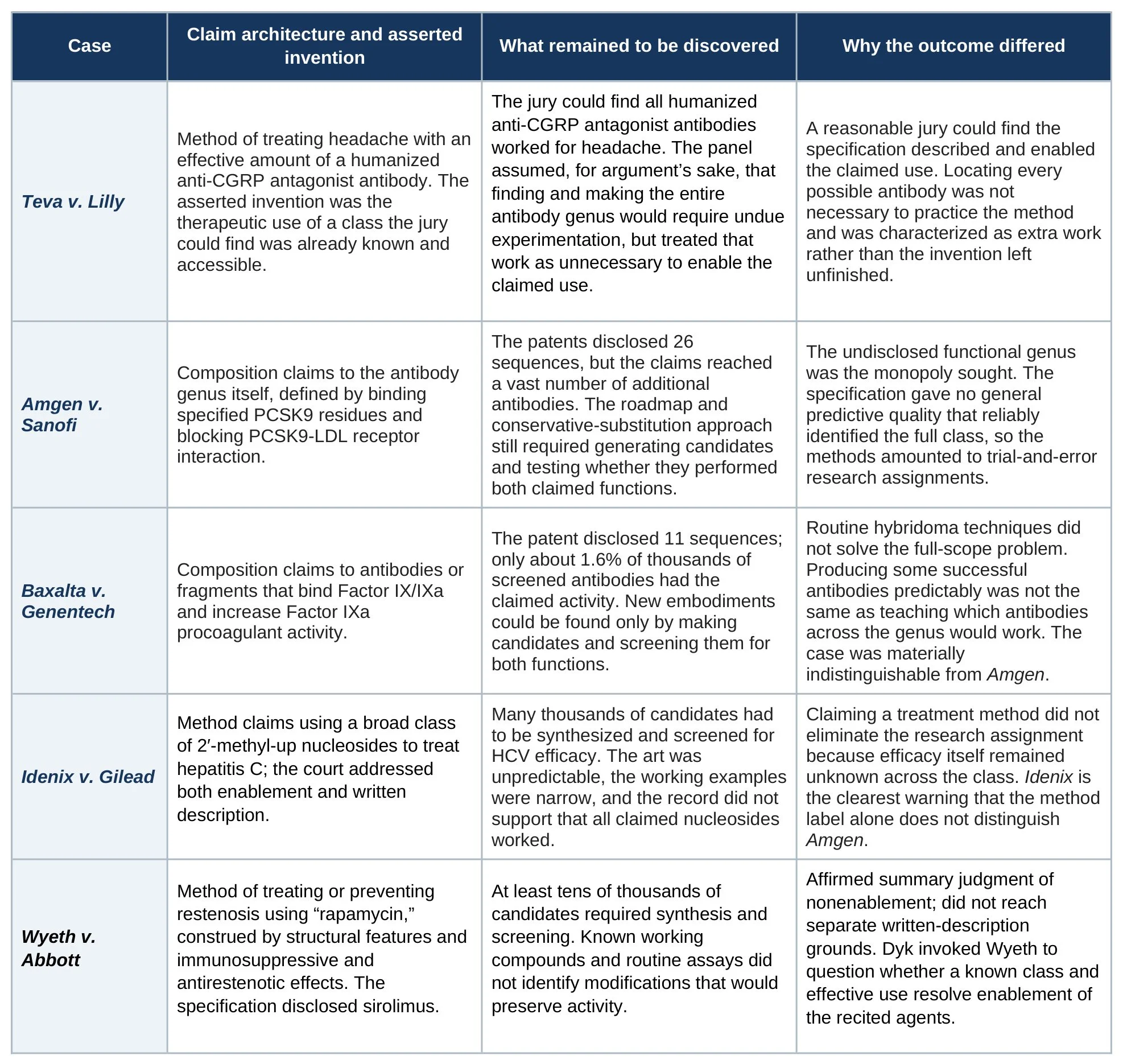
The Four Factual Predicates That Carried Teva
· The class was known and accessible. Anti-CGRP antagonist antibodies, examples, methods of making them, and sources for obtaining them were in the prior art and the specification.
· The conversion step was routine and expressly taught. Humanization was not left as an unexplained aspiration; the patent identified humanized embodiments and disclosed known methods the jury could find routine.
· The panel treated the claimed use as different. It distinguished treating headache from the antagonism function defining the antibody class. Judge Dyk disputed whether that distinction meaningfully narrowed the enablement burden.
· The record supported universal performance for the claimed use. A reasonable jury could find that every humanized anti-CGRP antagonist antibody treated headache, eliminating the efficacy-screening assignment.
Remove any one of these predicates and the analysis may change substantially. A poorly characterized genus, a nonroutine conversion, a use that merely restates the genus-defining function, or evidence that only some members work can return the case to the Amgen-Baxalta-Idenix side of the line.
What the Decision Holds - and What It Does Not Hold
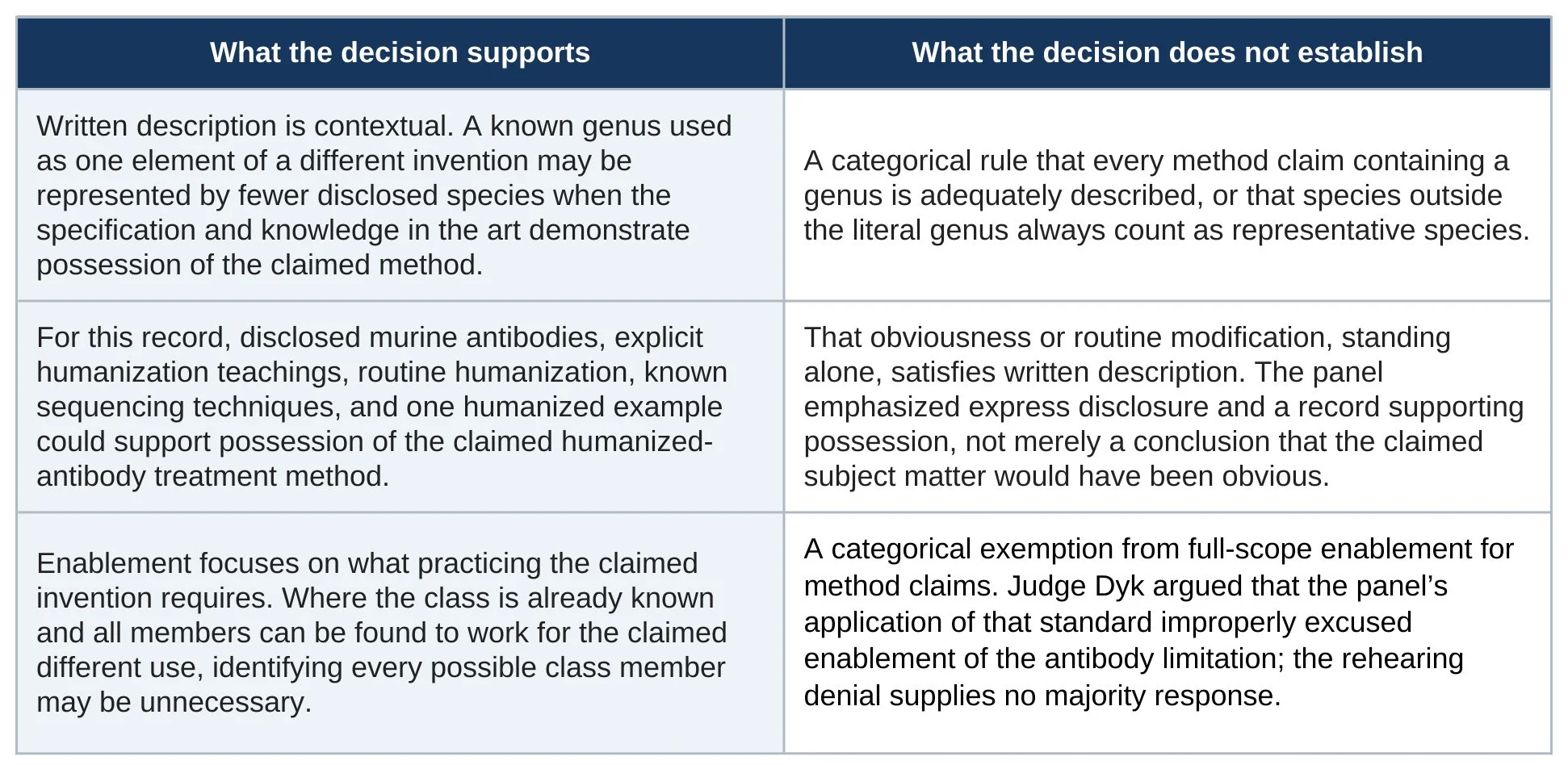
Strategic Implications for Patent Drafting and Prosecution
Define the Invention at the Correct Level
When the scientific contribution is a new therapeutic use of an existing class, the specification should say so clearly. Identify which parts of the claim reflect known tools and which relationship, population, disease state, dosing concept, biomarker, or outcome constitutes the new use. That framing cannot manufacture support that does not exist, but it can prevent the application from treating the known genus and the new use as one undifferentiated functional aspiration.
Build the Known-Class Record Into the Specification
Teva benefited from express statements that anti-CGRP antagonist antibodies were known, citations to specific examples, a commercial source for antibody 4901, and references describing methods of making antibodies. For a method claim relying on a known genus, practitioners should identify representative prior-art members, recognized class definitions, sources or repositories, methods of preparation, and the state of structural and functional knowledge as of filing.
There is a tradeoff. Describing a component as conventional may affect novelty and obviousness positions in related composition claims. The Teva litigation shows that a position useful against one set of claims can become evidence in another.
Do Not Rely on a Bare Assertion That Every Member Works
The universal-use finding was the hinge of Teva's enablement analysis. Future applicants should support that proposition with more than conclusory language. Useful support may include multiple species across meaningful structural diversity, dose-response or mechanistic data, a validated class-wide relationship, predictive assays, comparative examples, and an explanation of why variation within the class does not change the claimed therapeutic result.
Where class-wide activity cannot be supported, consider narrower claims supported by the disclosure. A sequence-defined subgenus, supported epitope limitation, patient subgroup, or other technically meaningful restriction may reduce the required experimentation. An assay or functional threshold alone may simply restate the desired result and leave the same screening burden. Idenix illustrates the risk of leaving skilled artisans to determine which members are therapeutically active.
Explain Every Required Transformation
Teva's humanization analysis depended on explicit disclosure of humanized embodiments and methods the jury could find routine. If a claim requires converting a known starting class into a claimed format - humanized, bispecific, conjugated, pegylated, formulated, sustained-release, or otherwise modified - the specification should teach that conversion and explain why it preserves the property needed for the claimed use. Do not assume that labeling the conversion "routine" will be enough without disclosure and technical context.
Strategic Implications for Litigation and Post-Grant Proceedings
Create a Claim-Specific Research-Assignment Map
For each asserted claim, identify what a skilled artisan must discover before practicing the full scope. Is the unresolved task finding members of the genus, making them, converting them, determining which members have the class-defining function, or determining which members perform the claimed new use? Amgen, Baxalta, Idenix, and Teva produced different results because the unanswered scientific task sat in a different place relative to each claim.
Treat the Trial Record as Part of the Doctrine
Section 112 disputes are often described through legal rules, but Teva turned on what the jury could find. Parties should develop evidence on the prior-art status of the class, accessibility of representative members, predictability of preparation, class-wide efficacy, structural diversity, failure rates, and the amount and nature of experimentation. A one-sided record can support JMOL, as in Idenix; a genuinely disputed and supportable record can preserve a jury verdict, as in Teva.
Coordinate Positions Across Forums
Lilly's IPR statements did not disappear when the composition claims fell. Patent challengers should review obviousness, enablement, written-description, and infringement theories across related patents before characterizing a field as known, replete, routine, or predictable. Patent owners should likewise anticipate that statements made to preserve novelty may complicate later arguments that the same technology was conventional enough to support broad method claims.
Due Diligence and Licensing: Separate Making the Tool From Using the Tool
For technology-transfer offices, investors, and licensees, Teva suggests a practical two-part diligence inquiry. First, can skilled artisans obtain or make members of the recited class without undue experimentation? Second, once they have a member, does the specification establish that the member will perform the claimed new use across the claim scope? A strong answer to one question does not cure a weak answer to the other.
The review should also account for procedural risk. A broad method claim may appear stronger after Teva, but its enforceability may depend on preserving evidence that the class was known, the required modification was routine, and the use was class-wide. Those are factual propositions that should be documented at filing, licensing, and litigation stages rather than reconstructed years later.
Rehearing Denied and Judge Dyk’s Dissent
The September 30 order denied both forms of rehearing after a requested poll on rehearing en banc failed. Judge Dyk was the only judge identified as filing a dissent. Judge Newman did not participate, and District Judge Andrews participated only in the panel-rehearing decision. The order leaves the panel’s written-description and enablement rulings undisturbed, but contains no substantive majority response to the dissent. (Rehearing order at 2–3.)
Judge Dyk’s dissent focuses on enablement, not a separate written-description analysis. He identifies two functional limitations: the antibody must antagonize CGRP, and its administration must reduce or treat headache. In his view, the principal difficulty lies in identifying antibodies that meet the first limitation. Establishing that all qualifying antagonists will treat headache does not establish how to obtain the full genus of qualifying antagonists. He points to evidence of laboratory and animal testing taking months and costing tens of thousands of dollars per antibody, and to the panel’s express assumptions about undue experimentation. (Dyk dissent at 1–3.)
Known Genus Does Not Necessarily Mean Enabled Genus
Wyeth & Cordis Corp. v. Abbott Laboratories, 720 F.3d 1380 (Fed. Cir. 2013), is a useful comparison because it also involved method-of-treatment claims and an express argument that the invention was a new use of an existing class rather than a new genus. The claims concerned treating or preventing restenosis by administering an effective amount of “rapamycin.” Under the unchallenged construction adopted at Wyeth’s request, that term encompassed compounds with a specified macrocyclic triene ring structure and both immunosuppressive and antirestenotic effects. The specification disclosed only sirolimus as a species. The Federal Circuit affirmed summary judgment of nonenablement; it did not reach the separate written-description grounds or the other enablement ground. Wyeth, 720 F.3d at 1382 & n.1, 1383–86.
Known working compounds did not resolve the full-scope problem. For summary judgment, the court accepted Wyeth’s assertion that four additional compounds known at filing had the required effects, as well as its evidence that skilled artisans could use routine assays and restrict candidates by molecular weight. Even so, at least tens of thousands of candidates remained. The specification did not explain which structural modifications would preserve the required activity, and each candidate would have to be synthesized and screened. The court held that the resulting experimentation was undue despite the availability of routine assays. Id. at 1385–86.
The claim construction makes Wyeth especially relevant to Dyk’s objection. Because “rapamycin” already required antirestenotic activity, the claim was limited to compounds that worked for the treatment purpose. That functional restriction nevertheless did not teach skilled artisans which compounds qualified. One possible distinction is that antirestenotic activity both helped define the compounds in Wyeth and supplied the treatment result, whereas the Teva panel treated headache treatment as different from the antagonism function defining the antibody class. The Teva panel also relied on known antibodies and preparation methods, routine humanization, and the supported finding that all humanized antagonists treated headache. This is a comparison of the two opinions, not a distinction the Teva panel expressly drew in addressing Wyeth. (Panel opinion at 21–24.)
That possible distinction does not eliminate the tension Dyk identified. Even if every qualifying antagonist treats headache, a skilled artisan must still identify and make antibodies that satisfy the antagonist limitation. The Teva panel assumed, solely for argument’s sake, that making and humanizing the entire genus would require undue experimentation, but treated that work as unnecessary to enable the claimed use. Dyk’s reliance on Wyeth challenges that step: knowing that a class exists and that qualifying members work does not necessarily enable the full range of members recited in a method claim. Therefore, Wyeth strengthens the warning against reading Teva as a general exemption for new uses of known classes. Its summary-judgment posture differs from Teva’s review of JMOL following a jury verdict, but that procedural difference alone does not resolve the disagreement over what the full-scope enablement inquiry must include.
Why a Method Limitation Did Not Resolve the Problem for Dyk
Dyk also rejected the panel’s narrower-use rationale. He stated that the record did not suggest uses for the underlying antibodies other than treating headache, so the method claim’s practical scope was equivalent to a claim to the compounds. Even if the method were narrower, he reasoned, the antibody remained a claim limitation that had to be enabled. His objection was more fundamental than a disagreement over the amount of experimentation: enabling the treatment function could not excuse inadequate enablement of the antagonist-antibody function. (Dyk dissent at 4.)
The Amgen Analogy and Innovation Concerns
Dyk illustrated his concern with Amgen’s PCSK9-blocking antibodies. In his view, claiming a cholesterol-lowering method using those antibodies would not meaningfully narrow their practical scope, yet the panel’s reasoning could permit such drafting to avoid Amgen’s enablement result. He also cited pharmaceutical-industry amici’s concerns that broad method claims could block independent research and discourage investment in undeveloped treatments. These are arguments advanced by the dissent and the amici it cites, not findings adopted by the court denying rehearing. (Dyk dissent at 5.)
What the Denial Means for the Written Description Analysis
The panel’s separate holding on representative species also remains undisturbed. Its reasoning depended on disclosed murine antibodies, express humanization teachings, routine conversion, accessible antibodies, and the particular claimed treatment use. The denial does not establish a categorical rule that species outside a claimed genus always provide adequate representation. Nor should Dyk’s enablement-focused dissent be described as a separate holding or analysis rejecting the panel’s written-description conclusion.
For practitioners, the result and the criticism must be kept distinct. The panel opinion remains the operative precedent; Judge Dyk’s dissent is not the court’s holding. At the same time, the dissent identifies the precise vulnerability that future drafting, prosecution, and litigation should address: whether the disclosure enables the antibody limitation across the method’s scope, as well as the therapeutic use. A known class label and class-wide efficacy do not, by themselves, answer every question about access to, identification of, and preparation of the recited agents.
Key Takeaways
1. Teva remains intact after rehearing was denied. The September 30 order leaves the panel’s written-description and enablement rulings in place, without adding a majority merits explanation or an en banc endorsement of the reasoning.
2. Separate the two scientific tasks. Identify what is required to obtain members of the recited genus and what is required to use them therapeutically. The panel emphasized the completed treatment inquiry; Judge Dyk argued that the antibody-identification inquiry could not be excused.
3. A method-of-treatment claim can still fail for lack of enablement. Idenix and Wyeth required extensive screening to identify compounds with the claimed therapeutic activity. Wyeth also rejected reliance on a new use of an existing class and routine assays. Merely drafting a claim as a treatment method does not cure those disclosure problems.
4. Written-description representativeness is context dependent. A known genus, routine and disclosed conversion methods, accessible starting materials, and a genuinely different claimed use can make a limited set of examples representative for that method.
5. Universal efficacy must be supported, not merely asserted. Data, mechanistic reasoning, predictive relationships, and examples across relevant diversity should substantiate why every claimed member performs the new use.
6. Prior-art characterizations travel. Statements that a class is known, methods are routine, or the art is predictable may support one invalidity theory while undermining another. Coordinate positions across IPR, prosecution, litigation, and licensing diligence.
7. Address the dissent’s concern in the application itself. Teach how to obtain and prepare the recited agents, support their claimed therapeutic use, and preserve narrower fallback claims. Avoid treating Teva as permission to place an insufficiently enabled genus inside a method claim.
This post was written by Lisa Mueller.