When "2" Cannot Mean "1": The Federal Circuit Holds Enanta to the Exact Words of Its Provisional in the Paxlovid Patent Fight

Introduction
Enanta Pharmaceuticals, Inc. v. Pfizer Inc., No. 2025-1427 (Fed. Cir. June 23, 2026), is a decision that should give every patent drafter pause. The U.S. Court of Appeals for the Federal Circuit affirmed a District of Massachusetts summary-judgment ruling invalidating all claims of Enanta Pharmaceuticals' U.S. Patent No. 11,358,953. The patent was asserted against Pfizer's Paxlovid® product. The appeal turned on whether Enanta could rely on a July 20, 2020 provisional application for priority.
The dispute came down to a single carbon-count change. The provisional listed a substituent as -NHC(O)-C2-C12-alkyl. The issued patent listed the corresponding substituent as -NHC(O)-C1-C12-alkyl, thereby reaching the one-carbon version. Enanta argued that the C2 in the provisional was an obvious typographical error and should have read C1. Pfizer responded that the provisional said what it said.
Judge Lourie, joined by Judges Bryson and Chen, affirmed for Pfizer. The Court held that the provisional did not disclose the one-carbon -NHC(O)-C1-alkyl substituent and therefore did not provide written-description support for the later C1 coverage. Once the earlier priority date was unavailable, Pfizer's April 6, 2021 public disclosure of nirmatrelvir, which had an "A" group substituted with a -NHC(O)-C1-alkyl group, anticipated the claims. The Federal Circuit affirmed the invalidity judgment.
For life-sciences practitioners, the decision is a sharp reminder that provisional applications are not immune from exacting written-description scrutiny. A later expert declaration that characterizes language as a typographical error will not supply disclosure that the earlier application itself does not contain.
The Patent and Priority Claim at Issue
The dispute centered on U.S. Patent No. 11,358,953 (the '953 patent), directed to compounds and methods of inhibiting coronavirus replication activity. The patent issued from a non-provisional application filed on November 9, 2021.
The critical priority document was U.S. Provisional Patent Application No. 63/054,048 (the '048 provisional), filed July 20, 2020. The '953 patent claimed priority to that provisional. Enanta also filed a non-provisional application on July 19, 2021, which led through a series of continuations to the application that issued as the '953 patent.
The '048 provisional and the '953 patent both defined the term "substituted" and listed several dozen chemical compounds and moieties that qualify as "substituents." The definitions were substantially the same but for one critical difference: the '048 provisional recited "-NHC(O)-C2-C12-alkyl," whereas the '953 patent recited "-NHC(O)-C1-C12-alkyl."
That procedural sequence mattered because Pfizer publicly disclosed nirmatrelvir on April 6, 2021. If the '953 patent could rely on the July 20, 2020, provisional date, Pfizer's disclosure would not be prior art. If the patent could not rely on that date, Pfizer's disclosure came first.
For clarity, the Federal Circuit did not say that Claim 1 literally recited -NHC(O)-C1-C12-alkyl. Claim 1 recited an A group that could be optionally substituted, and the relevant C1/C2 issue arose from how the patent and provisional defined the substituents available for that A group.
What Is the Technology?
The case sits in the small-molecule antiviral space. The '953 patent covers compounds and methods of using them to inhibit coronavirus replication. Pfizer's nirmatrelvir is a protease inhibitor that was eventually incorporated into Paxlovid® to treat coronavirus infection.
The chemistry that decided the case lived in the definitional language. Both the provisional and the patent defined "substituted" and listed numerous chemical compounds and moieties that could qualify as substituents. Those definitions were substantially the same, except for one key difference:
- The '048 provisional recited -NHC(O)-C2-C12-alkyl.
- The '953 patent recited -NHC(O)-C1-C12-alkyl.
The subscripted numbers identify how many carbon atoms are in the alkyl group. C2-C12 means two to twelve carbon atoms. C1-C12 additionally includes a one-carbon alkyl group. The Federal Circuit treated that one-carbon difference as dispositive because nirmatrelvir has an A group substituted with -NHC(O)-C1-alkyl.
The validity question therefore collapsed into a priority question: did the provisional's disclosure of a range beginning at C2 support later coverage of the one-carbon C1 substituent? The Federal Circuit answered no.
The Representative Claim
Claim 1 of the '953 patent was treated as representative. It claims:
1. A compound represented by Formula (VI-6a),
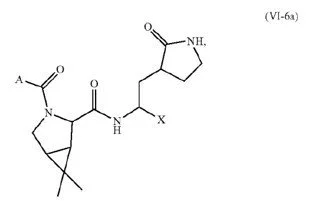
or a pharmaceutically acceptable salt thereof, wherein
X is -CN; and
A is optionally substituted C1-C8 alkyl or optionally substituted heteroaryl.
The Federal Circuit noted in a footnote that the parties did not specify which claims had been invalidated below. Because the District Court held that the '953 patent was invalid for anticipation, the Federal Circuit interpreted the ruling as invalidating all claims of the patent.
Procedural History
The alleged typographical error and refiling. Enanta contended that, on July 9, 2021, it realized the '048 provisional contained a typographical error: the C2 in -NHC(O)-C2-C12-alkyl should have been C1. Enanta then filed a non-provisional application on July 19, 2021, using -NHC(O)-C1-C12-alkyl rather than the C2-C12 language in the provisional.
The lawsuit. In June 2022, Enanta sued Pfizer in the U.S. District Court for the District of Massachusetts, alleging that Pfizer's Paxlovid® product infringed the claims of the '953 patent.
Pfizer's counterclaim and summary-judgment motion. Pfizer counterclaimed that the patent was invalid and moved for summary judgment that the asserted claims were anticipated. Pfizer argued that the '953 patent could not claim priority to the '048 provisional because the provisional did not support the C1 substituent language. Without that earlier date, Pfizer's April 2021 disclosure of nirmatrelvir anticipated the claims.
Enanta's response. Enanta argued that the patent was entitled to the provisional's priority date because the change merely corrected an obvious typographical error and added no new matter beyond what the provisional disclosed.
The District Court's ruling. On December 23, 2024, Judge Denise J. Casper granted Pfizer's motion. The District Court analyzed the issue through the lens of whether it could correct an obvious typographical error and concluded that it could not. The Court held that the change from -NHC(O)-C2-C12-alkyl in the provisional to -NHC(O)-C1-C12-alkyl in the patent impermissibly broadened the patent relative to the provisional and left the patent without the July 2020 priority date.
Enanta timely appealed. The Federal Circuit had jurisdiction under 28 U.S.C. Section 1295(a)(1).
Key Issues and Standards on Appeal
The appeal presented three principal questions:
1. Priority entitlement. Whether the '953 patent could claim the benefit of the '048 provisional's July 20, 2020, filing date.
2. Written-description support. Whether the provisional's disclosure of -NHC(O)-C2-C12-alkyl adequately described later C1 coverage under 35 U.S.C. Section 112. The Federal Circuit distilled this to the question whether "2" provides written-description support for "1."
3. Summary judgment. Whether Enanta's expert declaration created a genuine dispute of material fact by asserting that a skilled artisan would understand the C2 language as an obvious typographical error for C1.
The standard of review mattered. The Federal Circuit reviewed the summary-judgment grant de novo under First Circuit law and applied Federal Circuit law to substantive patent issues. The Court acknowledged that written description is generally a question of fact, but held that no genuine factual dispute existed on this record.
Enanta did not dispute a key conditional point: if the '953 patent was not entitled to a pre-April 2021 priority date, Pfizer's nirmatrelvir disclosure anticipated the claims. The appeal therefore rose or fell on priority and written description.
The Federal Circuit's Analysis and Holding
The Federal Circuit reframed the case as written description, not error correction.The Federal Circuit began by explaining "what this case is not." It was not the type of broad genus written-description dispute addressed in Ariad Pharms., Inc. v. Eli Lilly & Co., 598 F.3d 1336 (Fed. Cir. 2010) (en banc), or the genus-to-species issue in In re Ruschig, 379 F.2d 990 (CCPA 1967). Nor was it an error-correction case under In re Oda, 443 F.2d 1200 (CCPA 1971), or Novo Industries, L.P. v. Micro Molds Corp., 350 F.3d 1348 (Fed. Cir. 2003).
In re Oda involved the Patent Office's reissue authority under 35 U.S.C. Section 251. Novo Industries addressed a district court's narrow ability to correct an error in an issued patent by interpretation when the correction is not subject to reasonable debate based on the claim language and specification and the prosecution history does not suggest a different interpretation of the claims. The Federal Circuit said neither line of authority controlled. This case involved priority to a provisional application, and the existence of the alleged error was at least subject to reasonable debate.
Although the District Court had focused on whether it could correct a typographical error, the Federal Circuit applied the written-description standard itself because summary judgment is reviewed de novo. Under Lockwood v. American Airlines, Inc., 107 F.3d 1565 (Fed. Cir. 1997) and New Railhead Mfg., LLC v. Vermeer Mfg. Co., 298 F.3d 1290 (Fed. Cir. 2002), a later patent gets the benefit of an earlier filing date only for subject matter that the earlier application describes in enough detail to show possession as of that earlier date.
The C2 range did not describe C1.The Court held that the '048 provisional did not convey to a skilled artisan that Enanta possessed -NHC(O)-C1-alkyl in July 2020. The provisional expressly disclosed -NHC(O)-C2-C12-alkyl and did not include the one-carbon -NHC(O)-C1-alkyl group. As the court put it, C2 is simply different from C1.
The expert declaration did not create a genuine dispute.Enanta's expert pointed to the provisional's general definition of "alkyl," which listed "C2-C12 alkyl" in numerals but then described the range in words as "one to twelve" carbon atoms. The expert opined that, when a numeral and written number conflict, a skilled artisan would likely treat the numeral as the typographical error and would extend that conclusion to other uses of C2-C12 in the provisional.
The Court found that reasoning insufficient. The alleged inconsistency appeared in the general definition of "alkyl," not in the specific substituent -NHC(O)-C2-C12-alkyl within the definition of "substituted." The expert did not identify anything in that specific substituent disclosure showing that a skilled artisan would read C2-C12 as support for C1.
The Federal Circuit also rejected Enanta's related arguments that other C1-containing substituents and the separate listing of C1-C12 alkyl in the definition of "substituted" would lead a skilled artisan to view the disputed C2-C12 entry as erroneous. The Court emphasized that the provisional was a highly detailed chemical specification listing dozens of moieties; the applicants were held to what they specifically disclosed and not credited with what they did not disclose.
The ethanol/methanol analogy drove the point home. The Court analogized the issue to asking whether disclosure of ethanol, a two-carbon alcohol, provides written-description support for methanol, a one-carbon alcohol that is highly toxic to people. The example illustrated that disclosure of one chemical compound, or one carbon-count integer, is not necessarily disclosure of a structurally close neighbor.
The result was affirmance. Because the provisional did not disclose -NHC(O)-C1-alkyl, it did not provide written-description support for the later C1 coverage. The '953 patent therefore could not claim the July 20, 2020 provisional priority date. Pfizer's April 6, 2021 disclosure of nirmatrelvir anticipated the claims, and summary judgment of invalidity was affirmed.
Key Takeaways
1. Written description governs priority. A provisional supports priority only for subject matter it actually describes in sufficient detail to show possession. For priority purposes, a range beginning at C2 did not support C1.
2. A typographical error theory is not a substitute for disclosure. The Federal Circuit refused to treat the priority question as a general error-correction exercise.
3. Expert testimony must connect to the operative text. The expert declaration failed because it relied on an alleged inconsistency elsewhere in the provisional, not on the specific substituent that needed written-description support.
4. Chemical drafting leaves little margin for imprecision. In small-molecule cases, a single carbon can change the legal and scientific analysis. Ranges, substituent definitions, Markush groups, examples, and claims should be reconciled before filing.
5. Provisionals should be treated as priority-critical documents. Provisional applications are often prepared quickly, but this case shows that their exact wording can determine whether a later patent survives.
6. Intervening disclosures can turn drafting defects into invalidity.Pfizer's April 2021 nirmatrelvir disclosure fell between Enanta's provisional and Enanta's later C1-containing filing. Once the provisional date was unavailable, that disclosure became anticipatory prior art.
7.A correct result can be affirmed on a different legal path.The District Court focused on error correction; the Federal Circuit affirmed under written description. De novo review allowed the appellate court to apply the governing standard directly.
This post was written by Lisa Mueller.