The Clock Tightens: USPTO Cuts the “Unintentional Delay” Threshold from Two Years to One

The U.S. Patent and Trademark Office has redrawn a consequential line in everyday patent practice. In a final rule published in the Federal Register on June 24, 2026, the USPTO will require additional information and will apply the higher petition fee under 37 CFR 1.17(m)(1) for covered petitions based on “unintentional delay” once the delay exceeds one year. The rule is effective August 13, 2026, and applies to new petitions filed after the effective date.
For anyone who manages a U.S. patent portfolio, and especially for life-sciences and chemistry teams running long-lived, high-value assets across multiple jurisdictions, this is a small regulatory edit with outsized practical consequences. It does not eliminate unintentional-delay relief, but it moves the evidentiary and fee consequences forward by a full year. Here is what changed, why it matters, and what to do about it.
What actually changed
U.S. practice has long allowed applicants and patentees to seek relief for certain missed patent deadlines on a showing that the delay was “unintentional,” typically by filing a petition with a signed statement to that effect. In March 2020, the USPTO clarified that it would require additional information when petitions were filed more than two years after key trigger dates: the application’s abandonment, the patent’s expiration for nonpayment, or the date a priority or benefit claim was due. Separately, under the pre-amendment fee rule, the higher fee under 37 CFR 1.17(m)(1) applied at the same more-than-two-year threshold.
The new rule moves the automatic additional-information threshold, and the higher-fee trigger, from more than two years to more than one year. For new petitions filed after the effective date, a covered petition filed more than one year after the operative date must include an additional explanation of the circumstances surrounding the entire delay that establishes that the delay was unintentional. That explanation is required in addition to the standard unintentional-delay statement, and the petition also falls under the higher § 1.17(m)(1) fee.
Critically, this is a floor, not a ceiling. The one-year mark is simply when the heightened showing becomes automatic under the new practice. The Office reiterated that it may require additional information whenever a question arises about whether a delay was unintentional, regardless of how short the delay was.
Which petitions are caught
The change reaches across the full menu of unintentional-delay petitions:
• Revival or delayed issue-fee relief under 37 CFR 1.137—including revival of an abandoned application, delayed payment of an issue fee, and revival of a reexamination proceeding terminated or limited due to a delayed patent-owner response. The trigger is abandonment for abandoned applications, and termination or limitation for reexaminations.
• Acceptance of a delayed maintenance fee payment under 37 CFR 1.378—measured from the patent’s expiration date for nonpayment.
• Acceptance of a delayed priority or benefit claim under 37 CFR 1.55(e) and 1.78(c) and (e)—measured from the date the claim was due.
• Excusing a failure to act within prescribed time limits in connection with an international design application under the Hague Agreement, under 37 CFR 1.1051. The preamble describes the additional-information trigger by reference to the applicable prescribed time limit/date the action was required; the amended fee note for § 1.1051 refers to petitions filed more than one year after abandonment of the application.
The money: same rates, earlier trigger
The fee schedule under 37 CFR 1.17(m)(1) itself is unchanged. What changes is when it applies. The higher fee now applies to covered petitions filed more than one year after the relevant trigger date specified for the petition type—such as the priority-claim due date, benefit-claim due date, abandonment, reexamination termination or limitation, or patent expiration for nonpayment of a maintenance fee.
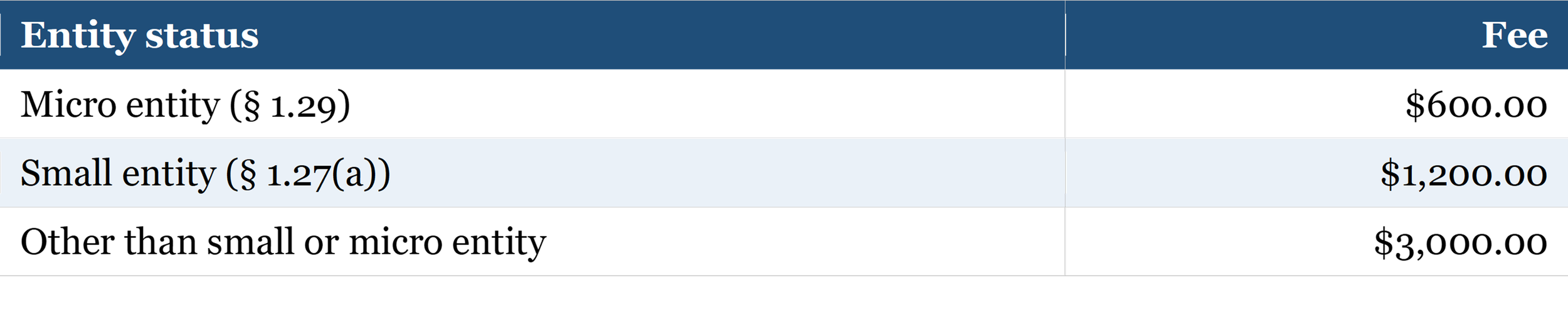
In practice, a petition filed at, say, the 18-month mark that would have remained below the higher-fee threshold under the old regime now falls squarely within it.
Why the USPTO did it
The Office frames the change as a certainty-and-predictability measure. The longer an application sits abandoned, a patent sits expired, a priority or benefit claim sits unfiled, or an international design-application deadline remains unaddressed, the more third parties may have ordered their affairs around that status, and the greater the likelihood that the delay was not, in fact, entirely unintentional. Shortening the threshold, the USPTO reasons, gets a reliable explanation onto the record sooner, discourages applicants from sitting on lapses, and nudges everyone toward more disciplined file monitoring and prompt corrective action. The Office concluded that the benefit of the earlier showing outweighs the added burden on applicants and patentees.
Notably, the USPTO issued this as a final rule without prior notice and comment, stating that the amendment is procedural and/or interpretive and does not alter the substantive criteria of patentability—an approach it grounded in the APA’s procedural-rule exception and supporting authority (including In re ChestekPLLC, 92 F.4th 1105, 1110 (Fed. Cir. 2024) and Cooper Technologies Co. v. Dudas, 536 F.3d 1330, 1336-37 (Fed. Cir. 2008)).
The real risk isn’t the fee—it’s enforceability
It would be a mistake to read this as merely a fee bump. The deeper signal is the USPTO’s continued emphasis on the integrity of the unintentional-delay statement. The standard demands that the entire delay, from the trigger date all the way to the filing of a grantable petition, be unintentional. A petitioner cannot satisfy it if the original miss was accidental but a later portion of the delay reflects a deliberate or strategic decision not to act.
And the stakes for getting this wrong reach well beyond the petition. The Office pointedly cited In re Rembrandt Technologies LP Patent Litigation, 899 F.3d 1254 (Fed. Cir. 2018), where patents were held unenforceable for inequitable conduct tied to an improper unintentional-delay representation. A statement made loosely to clear a docketing problem can resurface years later as a litigation-ending defense. The duty of candor and the Rule 11.18 obligation to inquire into the underlying facts are not formalities here, they are the whole game.
By compressing the timeline, the new rule means more petitions will require a documented, defensible narrative of the delay, earlier, and on the record. The corollary is that practitioners will need contemporaneous records explaining why a deadline slipped, when the lapse was discovered, and what happened during the entire period through filing of a grantable petition.
Practical takeaways
For prosecution and portfolio teams, the to-do list is straightforward but urgent:
1. Re-tune your docketing alerts. Any internal “petition risk” flag previously keyed to the 24-month mark should be moved up. The meaningful inflection point is now 12 months from the relevant trigger date, abandonment, patent expiration, priority/benefit due date, reexamination termination or limitation, or the applicable Hague/§ 1.1051 trigger.
2. Audit pending lapses now. Files with delays between roughly 12 and 24 months sit in a transition zone. If a revival, delayed maintenance fee, delayed issue-fee, delayed priority/benefit, or § 1.1051 petition is contemplated, filing before August 13, 2026, may avoid the automatic one-year heightened explanation requirement and higher fee, because the rule applies to new petitions filed after the effective date. That said, the USPTO can still require additional information in any case where unintentionality is in question.
3. Build the delay record as you go. Don’t reconstruct the story after the fact. Capture, in real time, the facts and circumstances that establish unintentionality—personnel changes, payment failures, miscommunications, docketing errors, discovery of the lapse, and corrective steps—so any eventual petition is supported by a record for the entire delay.
4. Treat the “unintentional” statement as a litigation document. Because it can be tested in enforcement, draft it with the same rigor you’d apply to a declaration. When in doubt, gather more facts before signing.
5. Brief your clients on the cost-and-timing shift, particularly portfolio managers used to the old two-year threshold.
The global lens
For Patent Panorama’s cross-border readers, the change is a reminder that “deadline restoration” is one of the least harmonized corners of international patent law. The U.S. “unintentional” standard remains comparatively forgiving in concept, but the USPTO is now requiring more factual support earlier. The European Patent Office, by contrast, applies the stricter “all due care” test for re-establishment of rights under Article 122 EPC, while PCT restoration of priority allows Offices to apply either “due care,” “unintentional,” or both, depending on the Office. Many emerging-market systems impose their own, often less flexible, reinstatement regimes.
The strategic upshot for a global life-sciences team is that a single missed deadline can carry very different remediation costs and evidentiary burdens depending on where the asset lives. The USPTO’s tightening narrows the U.S. practical cushion without eliminating relief—but it raises the premium on coordinated, jurisdiction-aware docketing across a worldwide portfolio. The teams that fare best will be those that treat every deadline as if no restoration mechanism exists, in every country, and keep the unintentional-delay petition as a genuine last resort rather than a routine backstop.
This post was written by Lisa Mueller