
Introduction
If your practice involves Patent Cooperation Treaty (PCT) national stage filings, there is a reasonable chance that one of your applications will be selected for the United States Patent and Trademark Office’s (USPTO) newest backlog-reduction initiative: the PCT Informed Examination Request (PIER) Pilot Program. Announced in a Federal Register notice published April 9, 2026, the program is already live, and the first requirements for information are arriving in applicants’ dockets. The pilot is scheduled to run for twelve months from publication, through April 9, 2027, although the USPTO may extend it to select additional applications, or terminate it earlier at its sole discretion.
We have now received one of these requirements, and the experience confirms what a close reading of the Federal Register notice suggests: the PIER program is unlike any of the USPTO’s other recent pilots. It is not an opt-in acceleration tool. It is an involuntary requirement, issued at the Office’s sole discretion, that forces the applicant to make a binding prosecution decision, proceed, delay, or abandon, under threat of abandonment, and with significant and easily overlooked consequences for patent term adjustment (PTA).
In this post, we walk through exactly what a PIER requirement looks like when it lands in your docket, dissect each of the three response options and their consequences, analyze the PTA trap embedded in the delay option in detail, reproduce and annotate the reply form (PTO/SB/478), and close with a step-by-step response playbook and best-practices checklist.
Background: Why the USPTO Created the PIER Program
The PIER program is a direct response to a backlog that has reached crisis proportions. From fiscal year 2020 to early 2025, the inventory of unexamined U.S. patent applications grew roughly 45%, from approximately 576,000 to nearly 838,000 applications. Average first action pendency climbed from under 15 months to more than 22 months, and national stage applications under 35 U.S.C. § 371 have fared far worse, with first action pendency exceeding 36 months in some art units. The USPTO’s own budget documents have described an “unexamined patent application inventory exceeding 800,000 applications” as a “pendency emergency.”
Director John Squires has made inventory reduction a defining priority, launching or expanding a suite of programs: the Streamlined Claim Set Pilot, the Automated Search (ASAP!) pilot, an expanded Track One cap, and continued Patent Prosecution Highway agreements. The PIER program is the most aggressive of these because it does not wait for applicants to volunteer. Instead, it leverages the work product that already sits in every PCT national stage file, the International Search Report (ISR), the Written Opinion of the International Searching Authority (WO/ISA), and, where a Chapter II demand was filed, the International Preliminary Report on Patentability (IPRP), and compels the applicant to engage with that work product and decide whether examination is still wanted.
On its face, the premise is reasonable. A national stage file frequently contains a searching authority’s prior art citations and a preliminary, non-binding patentability assessment. The USPTO’s theory is that requiring applicants to review this material and affirmatively elect to proceed will cause some applicants to delay or abandon applications they no longer value, freeing examiner capacity. The execution, however, raises real concerns for applicants acting in good faith, concerns that crystallize the moment the requirement arrives.
Which Applications Can Be Selected—and Which Cannot
Not every application is exposed to this program. Eligible applications are international applications that entered the U.S. national stage under 35 U.S.C. § 371. Applications filed under 35 U.S.C. § 111(a), including plant patent applications, design applications, and reissue applications are not eligible for the program.
Selection is at the USPTO’s sole discretion. The Office will not grant any petition to participate, abstain, or be removed from the program. In practical terms, an applicant cannot volunteer a case into the program, cannot opt out of it, and cannot petition its way back out once selected, the only levers available are the three response options discussed below.
How the USPTO plans to select cases. The Office has indicated that it will select applications across high-pendency technology areas based on the age of the application. Initially, it plans to target a subset of applications expected to be docketed to an examiner for substantive examination within the next five to six months. Within that pool, selection will favor applications whose international phase work products cite at least one reference carrying an “X” or “Y” relevancy classification, that is, prior art the searching authority flagged as relevant to novelty or inventive step, whether alone (X) or in combination (Y).
This § 371-only scope itself is strategically significant. An application that reaches the United States by a different route, most notably a bypass continuation filed under § 111(a), discussed later in this post, falls outside the program’s reach altogether.
Anatomy of a PIER Requirement: What You Will Actually Receive
A PIER requirement arrives as a two-part electronic communication. The first part is a standard PTOL-90A transmittal cover sheet identifying the application; the second part is the substantive requirement itself, issued on new Form PTO-2357 (Rev. 04-2026) and titled “PIER Pilot Program – Requirement for Information under 37 CFR 1.105.” Notably, the requirement issues from the Office of Patent Application Processing (OPAP), not from an examining art unit, which underscores that this is an administrative inventory-management action rather than a substantive examination event. The table below reproduces, in genericized form, the key elements of the requirement we received.
Table 1. Representative PIER Requirement for Information (PTO-2357)
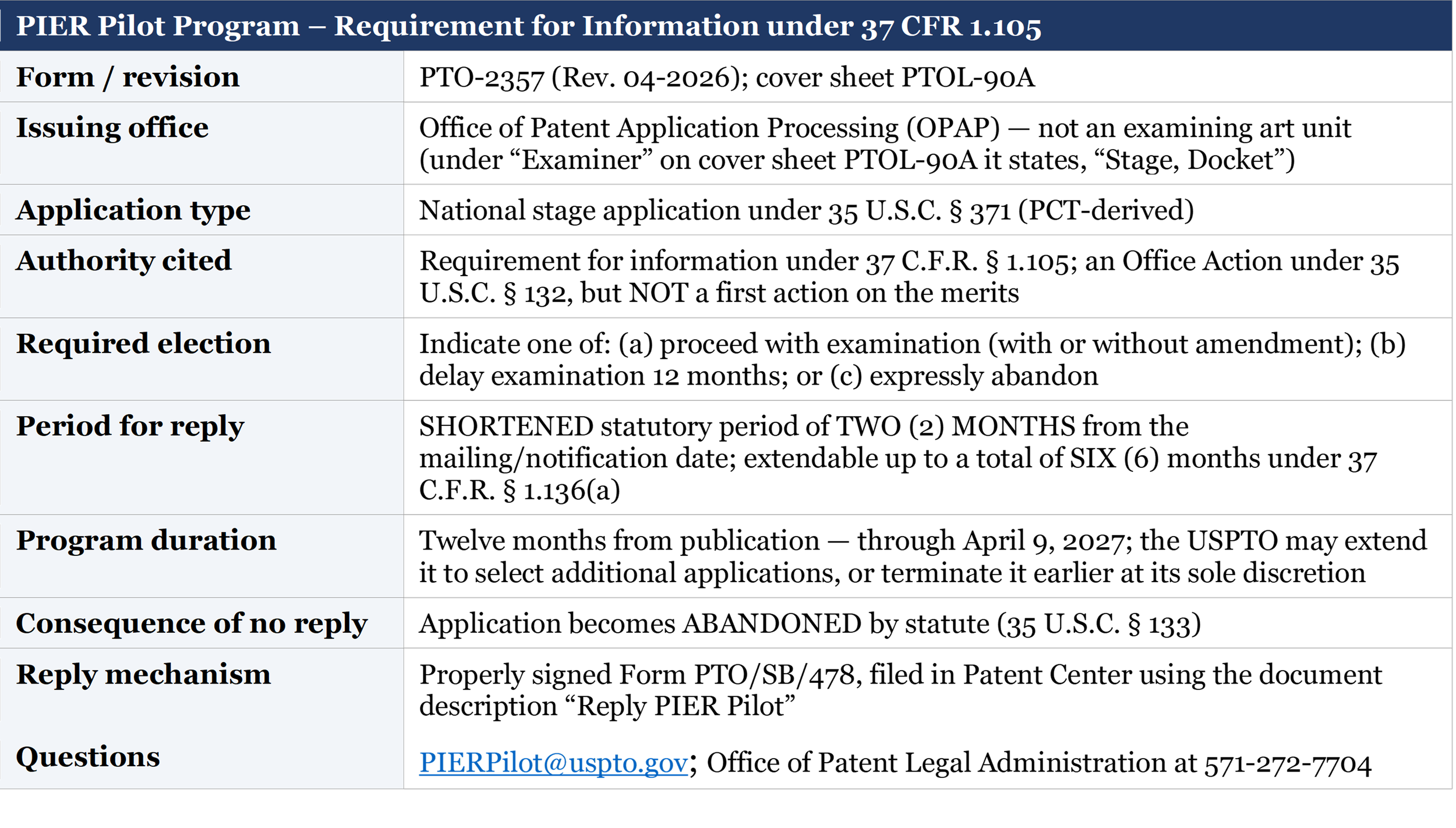
Two features of the requirement deserve emphasis because they are easy to miss and carry real consequences.
The two-month clock is short—and it is a statutory abandonment trap
The requirement sets a shortened statutory period for reply of two months, extendable to a maximum of six months under 37 C.F.R. § 1.136(a) with payment of the corresponding extension fees. As with any shortened statutory period, the six-month statutory ceiling under 35 U.S.C. § 133 cannot be exceeded. Because the requirement is an Office Action under 35 U.S.C. § 132, failure to file a complete, properly signed reply within the period results in abandonment. This is not a courtesy inquiry that can be ignored; it is a deadline that must be docketed like any other Office Action.
The “Duty of Reasonable Inquiry” reminder adds a certification dimension
The requirement we received contained a section titled “Reminder of the Duty of Reasonable Inquiry.” This is a significant and somewhat novel feature. It invokes 37 C.F.R. § 1.4(d)(5)(i), under which the presentation of any paper to the Office constitutes a certification under 37 C.F.R. § 11.18(b), and specifically points to § 11.18(b)(2)’s duty of reasonable inquiry. The notice states that this duty requires review of the PCT international phase work products and “appropriate action when the information submitted to the USPTO is inaccurate, unsupported, or could cause unnecessary delay or needless increase in the cost of the proceeding.”
In plain terms, the USPTO is framing the applicant’s election as a certification subject to Rule 11-type obligations. The Office is signaling that an applicant who elects to proceed should have actually reviewed the searching authority’s prior art and patentability assessment, and should not press forward with an application the applicant knows to be unpatentable merely to preserve a place in the queue. Practitioners should treat the election as a paper carrying certification weight, and should ensure that a genuine review of the ISR and WO/ISA precedes the decision to proceed. We address how to document that review in the best-practices section below.
The Three Options, in Detail
Option (a): Proceed with Examination—With or Without Amendment
Electing to proceed places the application on an examiner’s docket in the ordinary course. The applicant may proceed as-is, or may simultaneously file a preliminary amendment under 37 C.F.R. § 1.115 to place the application in better condition for examination, such as, for example, by amending claims to address the prior art identified in the ISR or the objections raised in the WO/ISA. For most applicants who intend to obtain a patent, this is the default and usually the correct choice. The preliminary-amendment opportunity is genuinely valuable: it allows the applicant to narrow or refine claims before the examiner’s first review, which can shorten prosecution and reduce the number of Office Action rounds.
Option (b): Delay Examination for 12 Months—Free of Fee, But Not Free of Cost
The delay option affords a non-terminable 12-month period, running from the date of receipt of the request, during which the applicant can assess the commercial viability of the invention before the application is docketed for examination. It requires no processing fee, unlike a suspension or deferral under 37 C.F.R. § 1.103. But there are two traps. First, the delay is non-terminable. Once a request to delay examination under the program is approved, applicant is not permitted to terminate the delay period early. Second, and more consequentially, the entire delay period is treated as applicant delay for PTA purposes. We analyze this in depth in the next section.
Option (c): Expressly Abandon the Application
An applicant that no longer wants the application may expressly abandon it under 37 C.F.R. § 1.138(a). This option is permanent and carries several specific consequences:
• No fee refund. Because the requirement is an action under 35 U.S.C. § 132, express abandonment under 37 C.F.R. § 1.138(d), which normally would allow a refund of search and excess claims fees, is unavailable.
• Publication. To avoid publication, a separate petition under 37 C.F.R. § 1.138(c) must be filed (e.g., Form PTO/AIA/24A). The petition generally will not stop publication unless recognized by the appropriate Office personnel more than four weeks before the projected publication date.
• Signature limits. A registered practitioner acting in a representative capacity is NOT authorized to sign an express abandonment, except when filing a continuing application. (See 37 C.F.R. § 1.138(b)). In all other cases, the form must be signed by the practitioner of record or by the applicant (if not a juristic entity).
• No “unintentional” revival. Where an applicant deliberately allows an application to go abandoned, the abandonment is a deliberately chosen course of action and the resulting delay cannot later be characterized as “unintentional” under 37 C.F.R. § 1.137.
The USPTO’s own Federal Register notice cautions that the attorney or agent of record must exercise “every precaution” in confirming that abandonment accords with the applicant’s wishes and best interests before selecting this option.
Patent Term Adjustment: The Trap Hidden in the Delay Option
The PTA mechanics of the PIER program are the single most important thing for practitioners to understand, because it creates a structural asymmetry that quietly disadvantages applicants who elect to delay examination. Two distinct PTA effects operate at once.
Effect 1: The requirement stops the USPTO’s “A Delay” clock
Under 35 U.S.C. § 154(b)(1)(A)(i) and 37 C.F.R. § 1.702(a)(1), the USPTO must act on an application within 14 months or accrue “A Delay” PTA in the applicant’s favor. The PIER notice provides that the mailing of the 37 C.F.R. § 1.105 requirement will be considered the date the Office met the 14-month obligation. The practical effect is striking: the issuance of the requirement, which is expressly not a first action on the merits, nonetheless stops the accrual of USPTO-side “A Delay” PTA. The Office gets credit for having “acted,” even though no substantive examination has occurred.
Effect 2: The 12-month delay is charged to the applicant
If the applicant elects the delay option, the notice provides that the Office will treat the request as a failure to engage in reasonable efforts to conclude prosecution under 35 U.S.C. § 154(b)(2)(C)(i) and (iii) and 37 C.F.R. § 1.704(c). The full 12-month delay period, beginning on the date of receipt of the request and ending on its one-year anniversary. is therefore deducted from any PTA the applicant would otherwise earn. The applicant is, in effect, penalized for choosing an option the program itself offers.
The combined result
Put the two effects together and the asymmetry is clear: issuance of the requirement halts the USPTO’s delay clock, while election of the delay option adds a year of applicant delay. For applicants in the life sciences, where every day of patent term at the back end of the term can translate into substantial revenue during a product’s exclusivity period, this is not a trivial accounting matter. The 12 months of “free” assessment time can carry a very real cost measured in forfeited term. As a rule of thumb, unless the client has a concrete, articulated commercial reason to defer and accept the corresponding term loss, the delay option should be approached with great caution; proceeding (with a preliminary amendment where useful) will usually be the better course for an application the applicant intends to pursue.
The Reply Form: A Walkthrough of PTO/SB/478
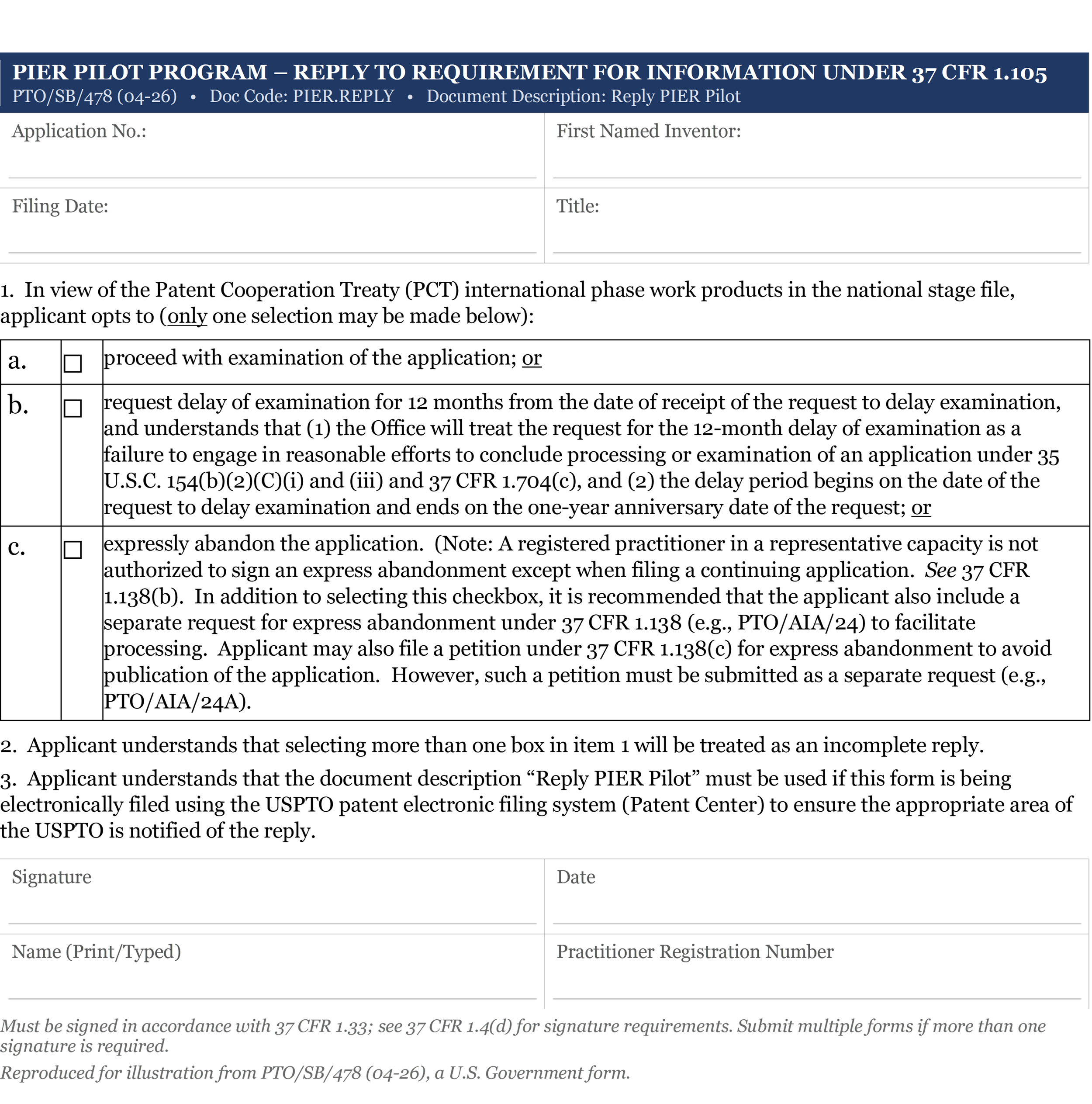
A complete reply to a PIER requirement must be made on Form PTO/SB/478 (Rev. 04-26), “PIER Pilot Program – Reply to Requirement for Information under 37 CFR 1.105.” The form is short, but every field matters, and a defect in completion or signature can render the reply incomplete. The figure below reproduces the operative structure of the form.
Figure 1. Reproduction of Form PTO/SB/478 (operative content)
Completing and Filing the Reply: What Makes a Reply Complete
The USPTO will treat a reply as complete only if the form is properly signed and exactly one of the item-1 checkboxes is selected. The following defects will render a reply incomplete, and an incomplete reply that is not a bona fide attempt to advance prosecution will not stop the abandonment clock:
• Selecting more than one box. Choosing, for example, both “proceed” and “delay” is expressly treated as incomplete.
• Selecting no box. A reply that states the information is “unknown” or “not readily available” under 37 C.F.R. § 1.105(a)(3) is not a proper reply, because the applicant always has the option to elect the 12-month delay if undecided.
• Improper signature. A form signed by someone not authorized under 37 C.F.R. § 1.33(b), or an express-abandonment election signed by a practitioner in a representative capacity outside the continuing-application exception, is defective.
If a reply is an incomplete but bona fide attempt to advance the case, the USPTO will notify the applicant of the deficiency and ordinarily set a new two-month period (itself extendable under 37 C.F.R. § 1.136(a), subject to the six-month statutory maximum) to cure. A further non-responsive reply typically will not be treated as bona fide, and the original clock will continue to run. Do not rely on the cure period as a safety net; treat the first reply as the operative one.
Filing mechanics. File the PTO/SB/478 electronically in Patent Center using the document description “Reply PIER Pilot.” This document description is not a mere formality, it is how the reply is routed to the correct area of the USPTO for timely processing. If electing abandonment, submit the recommended separate request (e.g., PTO/AIA/24), and, if avoiding publication is important, file the separate petition under 37 C.F.R. § 1.138(c) (e.g., PTO/AIA/24A) as early as possible given the four-week-before-publication recognition window.
A Step-by-Step Response Playbook
1. Docket it as an Office Action. Calendar the two-month shortened statutory period and the six-month statutory maximum the moment the requirement is received. Treat it with the same rigor as any § 132 action.
2. Pull and review the international phase work products. Locate the ISR, WO/ISA, and any IPRP in the file. Assess the cited art and the searching authority’s patentability views against the claims as you intend to prosecute them in the United States.
3. Confirm the client’s commercial intent. Determine whether the client still wants the application, wants more time to decide, or no longer needs it. This is a business decision that should be made by the client with your counsel, especially for the abandonment option.
4. Run the PTA math before considering delay. If delay is on the table, quantify the term consequence. In most life-sciences matters, the forfeited term will counsel against delay absent a specific commercial rationale.
5. If proceeding, decide whether to file a preliminary amendment. Where the ISR or WO/ISA flags genuine issues, a preliminary amendment under 37 C.F.R. § 1.115 can improve the application’s posture and reduce prosecution rounds.
6. Select exactly one box and obtain the correct signature. Verify signatory authority under 37 C.F.R. § 1.33(b), and observe the special signature rule for express abandonment under § 1.138(b).
7. File in Patent Center with the correct document description. Use “Reply PIER Pilot.” Submit any companion abandonment request or non-publication petition separately.
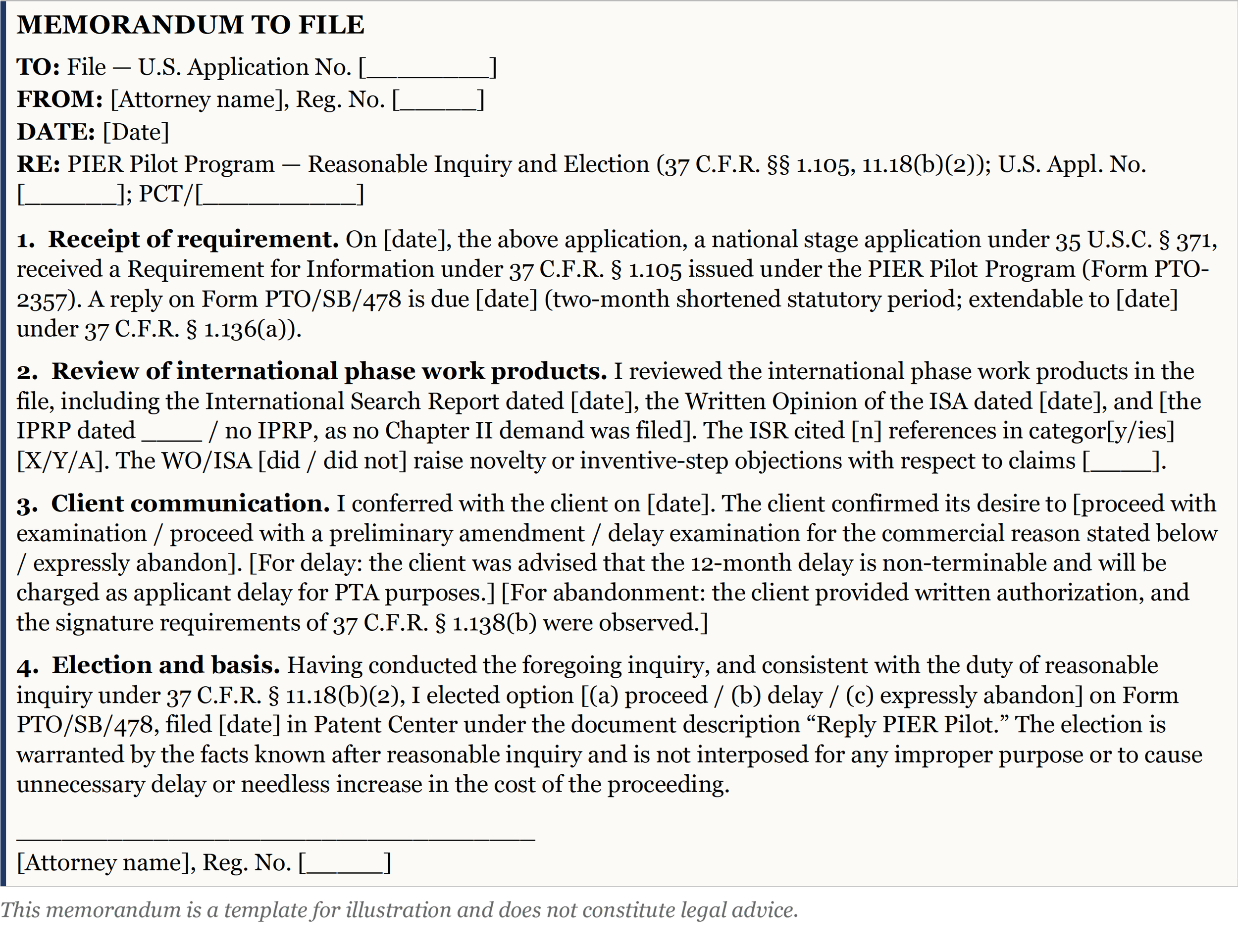
8. Document your reasonable inquiry. Given the 37 C.F.R. § 11.18(b)(2) reminder, keep a short internal record or memorandum reflecting that the work products were reviewed and the election was made on a reasoned basis. A sample file memorandum is provided in Appendix A.
Best Practices and Practical Tips
• Audit your § 371 portfolio now. Identify pending, unexamined national stage applications that could be selected, and pre-assess the ISR/WO/ISA posture of the most valuable ones so you are not starting cold under a two-month clock.
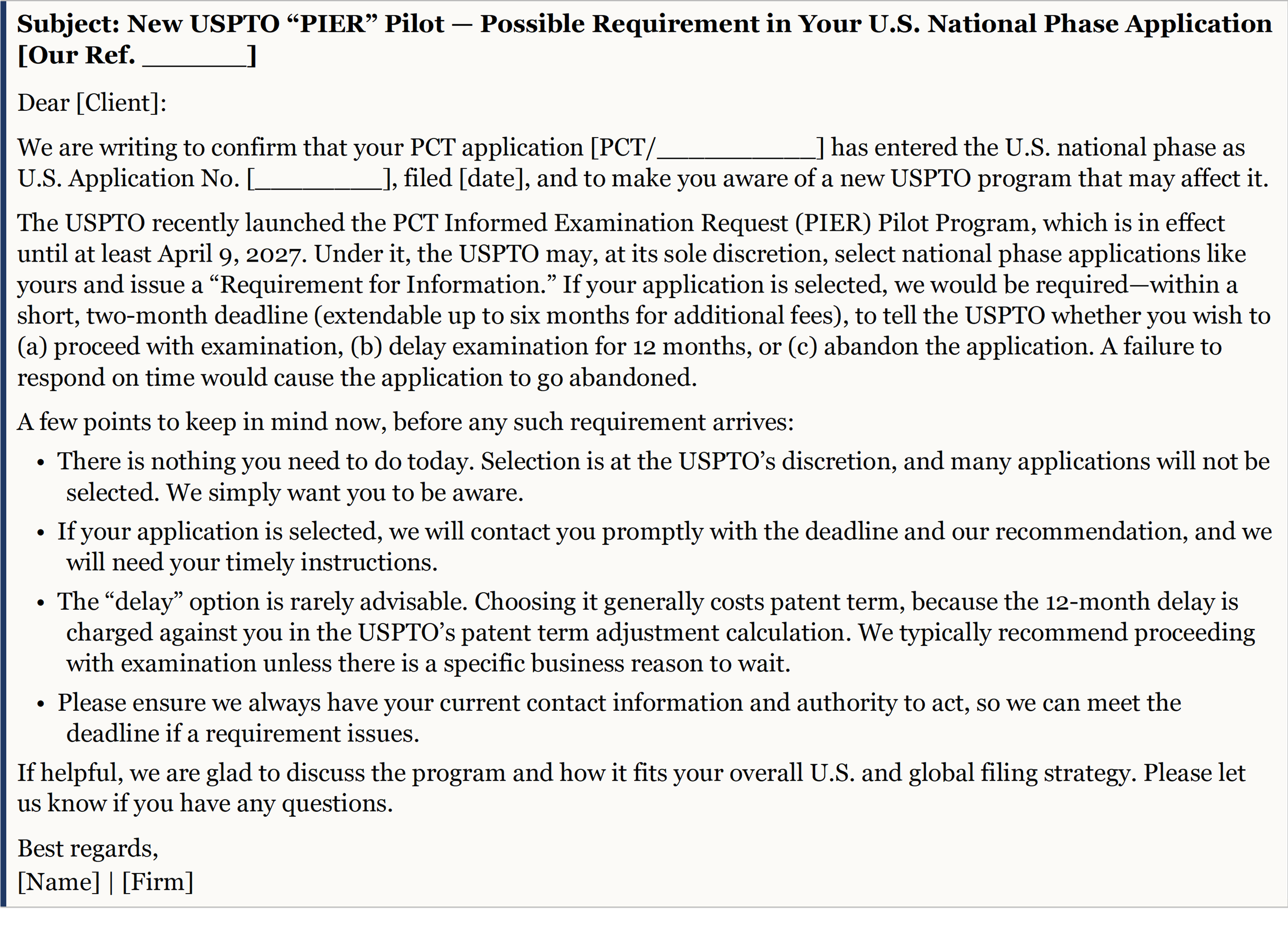
• Put clients on notice at national phase entry. Consider alerting clients to the PIER program as soon as a PCT application enters the U.S. national phase, so they are prepared to act quickly if a requirement issues. A sample client notice email appears in Appendix B.
• Pre-stage preliminary amendments. For high-value applications likely to proceed, consider drafting preliminary amendments in advance to address known prior art.
• Default to “proceed” for applications you intend to pursue. Given the PTA asymmetry, delay should be the exception, reserved for cases with a concrete reason to wait.
• Treat abandonment as a client decision in writing. Obtain documented client authorization before electing abandonment, and confirm the signatory rules. Remember there is no “unintentional” revival for a deliberate abandonment.
• Mind publication timing. If avoiding publication matters, file a § 1.138(c) petition early, as the four-week recognition window is unforgiving.
• Update docketing rules for the new action type. Ensure your system recognizes a § 1.105 PIER requirement as a distinct, abandonment-bearing action with its own deadlines.
• Calendar IDS obligations separately. Remember that references cited in the PCT international phase will be printed on any resulting patent only if the applicant cites them on an IDS in compliance with 37 C.F.R. §§ 1.97 and 1.98; the examiner is not required to list ISR references on a PTO-892. File an initial IDS at least one month before the first Office Action on the merits to avoid an additional applicant delay PTA charge.
• Give the USPTO feedback. This is a pilot, and practitioner feedback (PIERPilot@uspto.gov) will shape whether and how it continues.
A Strategic Alternative: The Bypass Continuation
Because the PIER program reaches only § 371 national stage applications and expressly excludes § 111(a) applications, the route by which a PCT application enters the United States now carries an added strategic dimension. A long-standing alternative to national stage entry is the bypass continuation. Rather than entering the national stage under § 371, the applicant files a U.S. national application under 35 U.S.C. § 111(a) (as a continuation, division, or continuation-in-part of the international application) that claims the benefit of the PCT application’s filing date under 35 U.S.C. § 365(c) and § 120. See MPEP §§ 1895, 1896. The bypass application must be filed before the international application is abandoned as to the United States, generally, on or before the 30-month date.
Why this matters for PIER. Because a bypass continuation is filed under § 111(a) rather than § 371, it is not a national stage application and therefore is not eligible for selection under the PIER program. For applicants who wish to avoid the prospect of an involuntary PIER requirement, and the two-month clock, the certification overlay, and the patent term adjustment considerations that come with it, the bypass route is one way to keep a PCT-derived application outside the program’s scope from the outset.
The tradeoffs. The bypass route is not free of cost or consequence, and it should be evaluated case by case. Among the considerations:
• Filing date and patent term. A § 111(a) bypass application receives its own actual U.S. filing date, whereas a § 371 national stage application takes the international filing date. This difference affects term and the running of the PTA clocks, and it should be modeled for any term-sensitive matter. See MPEP § 1896.
• Additional filings and fees. A bypass application is treated as a new U.S. application. The applicant must (re)file the specification, drawings, and any required English translation, and pay a fresh set of filing, search, and examination fees, generally adding cost relative to national stage entry. Unlike in § 371 national stage filings, Applicants must provide the USPTO a certified copy of any foreign priority application (except for PCT applications).
• New matter and claim flexibility. Because a bypass application is a new § 111(a) filing, an applicant may file a continuation-in-part to add subject matter developed since the PCT filing, something a § 371 national stage application, which cannot receive new matter, does not allow. This flexibility is itself a frequent, PIER-independent reason to choose the bypass route.
• Access to Track One prioritized examination. Track One prioritized examination at the time of filing (37 C.F.R. § 1.102(e)(1)) is not available to § 371 national stage applications; it may be requested only for applications filed under § 111(a). An applicant who wants Track One for PCT-derived subject matter must therefore file a § 111(a) application, either a bypass continuation of the international application or a continuation of an existing national stage application. The bypass route thus opens a door to accelerated examination that a § 371 filing does not.
• IDS obligations still apply. As with national stage applications, art cited during the international phase will not automatically be considered or printed on any resulting patent unless the applicant submits it on an IDS in compliance with 37 C.F.R. §§ 1.97 and 1.98.
• Timing discipline. The bypass application must be on file before the international application terminates as to the United States. Missing that window forecloses the option entirely.
The bypass continuation remains available, and the PIER program gives practitioners a new reason to weigh it at the point of U.S. entry. For a high-value application that the applicant fully intends to prosecute, and where the added cost is justified, the bypass route can keep the matter off the PIER track and preserve the applicant’s control over examination timing. For routine matters, the added cost and the loss of the international filing date will often make ordinary § 371 entry the better choice, with any PIER requirement handled as described above. Note, too, that a bypass continuation can also serve as a response strategy after a § 371 application has already been selected for PIER, but doing so means paying for a new application and, typically, allowing the national stage application to go abandoned, so the economics are less favorable than choosing the bypass route at the outset. As always, the decision should account for term modeling, budget, and the client’s commercial objectives.
Open Questions
Several aspects of the program remain undefined. The USPTO has described its general selection approach, as discussed above, but has not committed to specific relevancy thresholds or an overall volume, so practitioners still cannot reliably predict which individual cases are at risk. The notice does not address how a PIER requirement interacts with other pending matters, a co-pending petition to make special, a PPH request, or a pending IDS. And the practical reach of the § 11.18(b)(2) reminder, whether it is purely hortatory or will have teeth, will not be clear until the Office signals how it intends to treat elections to proceed in applications with unfavorable international work products. We will track each of these as the program matures.
Conclusion
The PIER Pilot Program is an important development for anyone managing PCT-derived U.S. portfolios. Its premise, putting the searching authority’s existing work product to use and clearing dormant applications from the queue, is defensible. But its involuntary selection, its short abandonment-bearing deadline, the certification overlay of the duty of reasonable inquiry, and above all the PTA asymmetry built into the delay option make it a program that rewards preparation and punishes inattention.
For practitioners, the message is straightforward: docket the requirement like any Office Action, review the international work products, run the PTA math before considering delay, choose exactly one option, obtain the correct signature, and file on PTO/SB/478 with the right document description. Handled that way, a PIER requirement is manageable. Handled carelessly, it can cost an applicant patent term, or the application itself.
In nearly all circumstances, Applicants will want to pursue option (a), to proceed with examination, as this preserves all options and does not cost any PTA.
Appendix A: Sample Memorandum Documenting Reasonable Inquiry
The following is a sample internal file memorandum that a practitioner can adapt to document the reasonable inquiry underlying a PIER election under 37 C.F.R. §§ 1.105 and 11.18(b)(2). It is a template only and should be tailored to the specific application and to the review actually performed. Bracketed items are placeholders.
Appendix B: Sample Client Notice Email (Upon U.S. National Phase Entry)
The following is a sample client communication that can be sent when a PCT application enters the U.S. national phase, to put the client on notice of the PIER program. Adapt as appropriate before use; it is not legal advice.
This post was written by Lisa Mueller.